With interest rate differentials of 3.75% and 1.0%, why is a rebound in the yen destined to be difficult?
2026-07-09 18:27:21
On Thursday, July 9th, the USD/JPY pair once again became one of the most sensitive macro trading pairs in the foreign exchange market. Currently, USD/JPY is fluctuating around 162.40, with the high of the past week around 162.70 and the low around 160.50, remaining close to the upper limit of the past year's trading range.

The current contradiction in the USD/JPY exchange rate lies not in a specific round number, but in the market re-integrating energy, inflation, the Fed's policy path, and the yen's role as a funding source into a single pricing framework. Despite escalating risks from the Middle East conflict, Brent crude remained around $78 per barrel on July 9th. While intraday prices fluctuated, this was enough for traders to reassess the secondary transmission of energy prices to inflation expectations.
This is particularly crucial for the USD/JPY exchange rate. The US CPI rose 4.2% year-on-year in May, up from 3.8% in April; the core CPI, excluding food and energy, was 2.9% year-on-year; and the energy component rose 23.5% year-on-year. This data suggests that the reaction of the US dollar interest rate to the impact of oil prices will not be limited to safe-haven demand, but will continue to influence the exchange rate through inflation expectations, real interest rates, and long-term policy paths.
The Federal Reserve maintained its target range for the federal funds rate at 3.50% to 3.75% at its June meeting, which remains significantly higher than the Bank of Japan's short-term policy rate. The Bank of Japan also guided its target for the unsecured overnight call rate to approximately 1.0% and set some deposit facility rates at 1.0% in June, but the statement emphasized that financial conditions remained accommodative after the adjustments.
This is the core reason for the yen's weak rebound. The Bank of Japan has entered a normalization phase, but the pace remains constrained by growth, fiscal policy, energy costs, and real wages. On the daily chart, the USD/JPY pair briefly dipped to 160.478 before quickly recovering above 162, indicating that short covering and carry trades are still supporting the exchange rate. As long as US short-term interest rates remain high, a sustained yen recovery cannot rely solely on verbal warnings or single-day fluctuations; it requires a significant cooling of US inflation or a stronger repricing of expectations for a Bank of Japan rate hike.
From the daily chart, the Bollinger Bands have a middle band at 161.243, an upper band at 163.007, and a lower band at 159.480. The price is above the middle band and close to the upper band, indicating the trend hasn't been broken, but upward momentum is entering a compression phase. A previous high was formed around 162.834, after which the price dipped to around 160.478 but failed to break below the middle band, returning above 162. This movement isn't a simple trend reversal, but rather more like a rapid liquidation and repricing within a high-level range.
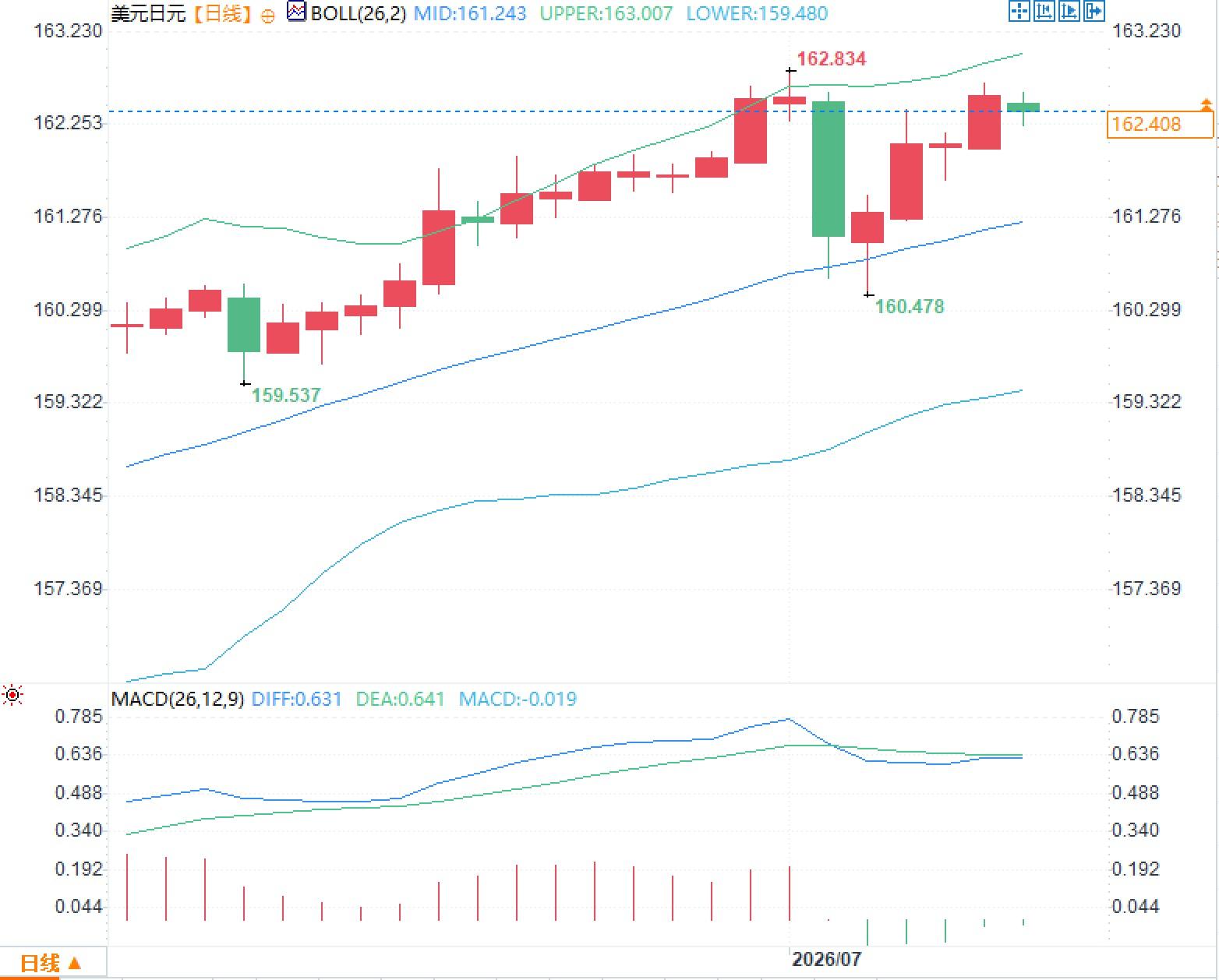
On the MACD level, the DIFF is around 0.631 and the DEA is around 0.641, with the histogram values near the zero line, indicating that momentum is shifting from unilateral expansion to convergence. For traders, this means that the current market is more reliant on event catalysts than on the inertia of moving averages themselves. If the US CPI is higher than expected again, the exchange rate is likely to retest the resistance near the upper Bollinger Band; if the data is lower than expected, a decline in interest rates will amplify short covering in the yen, but as long as there is support near the middle Bollinger Band, it is still difficult to directly determine that the market is dominated by bears.
Japanese authorities' foreign exchange intervention mechanisms typically revolve around addressing "excessive volatility" and "disorderly price movements," rather than simply targeting a static price level. The Bank of Japan's statements also explicitly state that foreign exchange intervention involves buying and selling yen and dollars, with funding arrangements coming from a special foreign exchange account; Japanese authorities also disclose the range of intervention operations monthly.
Therefore, the impact of intervention risk on USD/JPY should be understood as increased volatility rather than an automatic trend reversal. If prices surge rapidly in a short period, the market will increase the premium for the hidden intervention risk, leading to a momentary liquidity contraction and a long upper shadow. However, if the real interest rate differential between USD and Japan, energy prices, and inflation expectations do not reverse synchronously, intervention can only change the path and pace, not the direction alone. Currently, three key factors need to be monitored: whether US inflation continues to be sticky, whether crude oil prices remain high, and whether the Bank of Japan releases a clearer indication of its subsequent interest rate hike pace.
The core issue behind the high-level fluctuations is not the 162 level, but rather the re-entry of inflation into the pricing chain.
The current contradiction in the USD/JPY exchange rate lies not in a specific round number, but in the market re-integrating energy, inflation, the Fed's policy path, and the yen's role as a funding source into a single pricing framework. Despite escalating risks from the Middle East conflict, Brent crude remained around $78 per barrel on July 9th. While intraday prices fluctuated, this was enough for traders to reassess the secondary transmission of energy prices to inflation expectations.
This is particularly crucial for the USD/JPY exchange rate. The US CPI rose 4.2% year-on-year in May, up from 3.8% in April; the core CPI, excluding food and energy, was 2.9% year-on-year; and the energy component rose 23.5% year-on-year. This data suggests that the reaction of the US dollar interest rate to the impact of oil prices will not be limited to safe-haven demand, but will continue to influence the exchange rate through inflation expectations, real interest rates, and long-term policy paths.
Interest rate differentials remain the main driver, and the yen's rebound lacks sustained momentum.
The Federal Reserve maintained its target range for the federal funds rate at 3.50% to 3.75% at its June meeting, which remains significantly higher than the Bank of Japan's short-term policy rate. The Bank of Japan also guided its target for the unsecured overnight call rate to approximately 1.0% and set some deposit facility rates at 1.0% in June, but the statement emphasized that financial conditions remained accommodative after the adjustments.
This is the core reason for the yen's weak rebound. The Bank of Japan has entered a normalization phase, but the pace remains constrained by growth, fiscal policy, energy costs, and real wages. On the daily chart, the USD/JPY pair briefly dipped to 160.478 before quickly recovering above 162, indicating that short covering and carry trades are still supporting the exchange rate. As long as US short-term interest rates remain high, a sustained yen recovery cannot rely solely on verbal warnings or single-day fluctuations; it requires a significant cooling of US inflation or a stronger repricing of expectations for a Bank of Japan rate hike.
The technical structure indicates a period of consolidation following a strong trend.
From the daily chart, the Bollinger Bands have a middle band at 161.243, an upper band at 163.007, and a lower band at 159.480. The price is above the middle band and close to the upper band, indicating the trend hasn't been broken, but upward momentum is entering a compression phase. A previous high was formed around 162.834, after which the price dipped to around 160.478 but failed to break below the middle band, returning above 162. This movement isn't a simple trend reversal, but rather more like a rapid liquidation and repricing within a high-level range.
On the MACD level, the DIFF is around 0.631 and the DEA is around 0.641, with the histogram values near the zero line, indicating that momentum is shifting from unilateral expansion to convergence. For traders, this means that the current market is more reliant on event catalysts than on the inertia of moving averages themselves. If the US CPI is higher than expected again, the exchange rate is likely to retest the resistance near the upper Bollinger Band; if the data is lower than expected, a decline in interest rates will amplify short covering in the yen, but as long as there is support near the middle Bollinger Band, it is still difficult to directly determine that the market is dominated by bears.
Intervention risk is more like a volatility factor than a trend factor.
Japanese authorities' foreign exchange intervention mechanisms typically revolve around addressing "excessive volatility" and "disorderly price movements," rather than simply targeting a static price level. The Bank of Japan's statements also explicitly state that foreign exchange intervention involves buying and selling yen and dollars, with funding arrangements coming from a special foreign exchange account; Japanese authorities also disclose the range of intervention operations monthly.
Therefore, the impact of intervention risk on USD/JPY should be understood as increased volatility rather than an automatic trend reversal. If prices surge rapidly in a short period, the market will increase the premium for the hidden intervention risk, leading to a momentary liquidity contraction and a long upper shadow. However, if the real interest rate differential between USD and Japan, energy prices, and inflation expectations do not reverse synchronously, intervention can only change the path and pace, not the direction alone. Currently, three key factors need to be monitored: whether US inflation continues to be sticky, whether crude oil prices remain high, and whether the Bank of Japan releases a clearer indication of its subsequent interest rate hike pace.
- Risk Warning and Disclaimer
- The market involves risk, and trading may not be suitable for all investors. This article is for reference only and does not constitute personal investment advice, nor does it take into account certain users’ specific investment objectives, financial situation, or other needs. Any investment decisions made based on this information are at your own risk.