"Manchester Doctrine" awaits implementation; Burnham leads the Labour leadership race; pound enters new government pricing window.
2026-07-10 08:22:02
On Friday (July 10) in early Asian trading, the pound continued its upward trend against the dollar, currently trading around 1.3410, breaking through the 200-day exponential moving average since mid-June.
The significance of this trend lies in its context—the US military clashed with Iran for the second consecutive day, oil prices remained at a war premium, and Federal Reserve officials made hawkish comments, but none of these factors provided the dollar with buying support for the pound.
Thursday's U.S. economic data and geopolitical backdrop should have supported the dollar. Initial jobless claims came in at 215,000, better than the expected 218,000 and the previous reading of 217,000.
Geopolitically, the U.S. military has struck about 90 targets in Iran, reimposed oil sanctions, and the interim peace framework signed last month has been effectively suspended.
However, the US dollar reacted very little to these positive factors. The pound sterling not only remained unaffected by the dollar but actually strengthened over several trading days.
The explanation for this phenomenon is that dollar bulls are already highly positioned. The market has priced in a three-quarters probability that the Fed will keep interest rates unchanged in July, meaning that the marginal impact of hawkish comments has been fully priced in, and the dollar lacks further upward momentum.
Positive factors for the pound are continuing to accumulate. The Bank of England's June meeting saw a 7-2 vote to keep interest rates unchanged at 3.75%, with two policymakers pushing for a rate hike to 4.00%, compared to only one member supporting a rate increase at the April meeting. This shift signifies a significant increase in hawkish forces within the Bank of England.
Services inflation remained at 3.7%, and the ceiling on household energy prices rose 13.5% in the third quarter, providing ample ammunition for the hawkish camp. The market currently prices in approximately a 76% probability of a Bank of England rate hike before the end of the year.
The political transition is also proceeding as planned. Nominations for the Labour leader to succeed Starmer opened on Thursday and will continue until July 16. Lead runner Andy Burnham currently has no formal opponent, and the schedule confirms the new party leader will be elected on July 17, with the new prime minister sworn in on July 20.
The market has already priced in the political transition over the past two weeks – what is truly unpriced in is the new government’s fiscal policy direction, as Burnham has not yet appointed a Chancellor of the Exchequer and the details of spending in his “Manchesterian” agenda remain to be confirmed.
Friday (July 10th) features a relatively light schedule of US and UK economic data releases, with exchange rates likely to be primarily driven by news related to the Strait of Hormuz and position adjustments ahead of the CPI release. However, this period of calm will not last long: The British Retail Consortium's same-store sales data will be released next Monday (previous value 3.4%); next Tuesday's US CPI will be the most important data event of the month, with the market expecting an overall CPI month-on-month decrease of 0.1% (previous value 0.5%) and core CPI remaining at 2.9% year-on-year.
Next Wednesday will be followed by the US PPI data and the Federal Reserve Beige Book; next Thursday (July 16) will see a flurry of releases including UK May GDP, industrial production, and manufacturing output data, as well as US retail sales data, with US retail sales expected to cool from 0.9% to 0.3%. Next Friday (July 17), the preliminary reading of the University of Michigan Consumer Sentiment Index will be released, and on the same day, if the Labour Party nomination process proceeds smoothly, the new Labour Party leader will be confirmed at a special meeting—meaning that the pound will be driven by both a new government and a new fiscal narrative within five trading days.
In summary, the pound's breakout above 1.3400 against the dollar is the result of a confluence of positive factors: technical, policy, and fundamental. The strengthening of hawkish sentiment within the Bank of England, the orderly progress of the political transition, and the dollar's "immunity" to hawkish rhetoric after significant positioning have all provided support for the pound. The breakout above the 200-day moving average further reinforces the bullish narrative.
However, the real test is yet to come. Next Tuesday's US CPI data, next Thursday's UK GDP and US retail sales data, and the new government's fiscal policy signals will collectively determine whether this breakout is a trend reversal or a false breakout. Short-term upside targets are 1.3450 and 1.3500, while a break below 1.3350 would confirm a reversal scenario. In the current highly volatile environment, the battle between bulls and bears in GBP/USD has only just entered a crucial phase.
According to the daily chart, the British pound against the US dollar rose to 1.3657 before falling back down to a low of 1.3139, triggering an oversold rebound. The price rose above the MA20 (1.3299), MA50, MA100, and M200, with the long and short-term moving averages forming a bullish support pattern, and the market's position structure improving.
In terms of indicators, the MACD is near the zero line, the DIFF crosses above the DEA to form a golden cross, and the red bars are increasing slightly, indicating a significant weakening of bearish momentum; the RSI1 value is 74.88, which has entered the overbought zone, indicating that the short-term bullish power is overdrawn and the risk of a market correction is increasing.
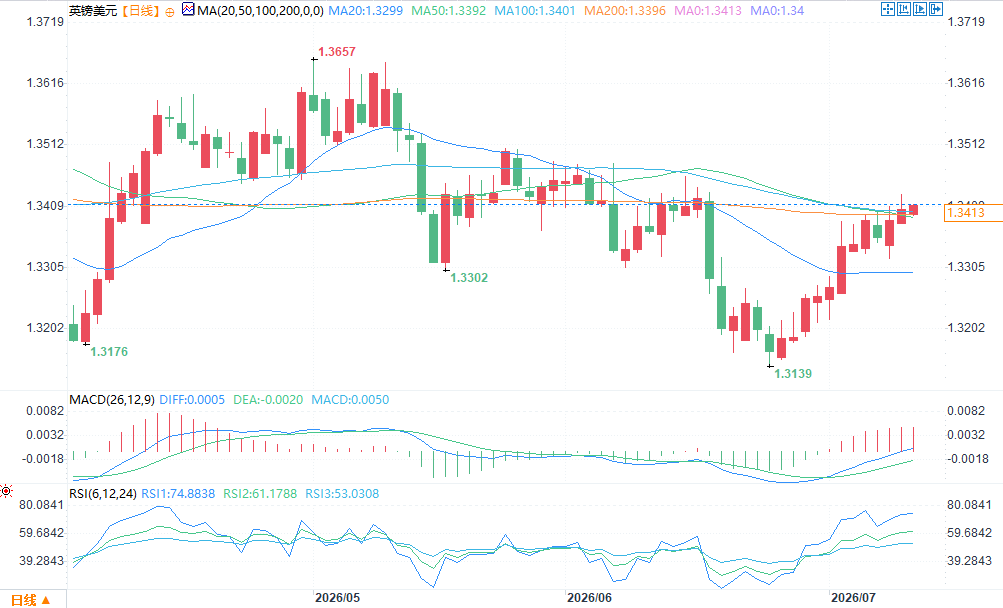
(GBP/USD daily chart, source: FX678)
At 8:15 a.m. Beijing time on July 10, the British pound was trading at 1.3409/10 against the US dollar.
The significance of this trend lies in its context—the US military clashed with Iran for the second consecutive day, oil prices remained at a war premium, and Federal Reserve officials made hawkish comments, but none of these factors provided the dollar with buying support for the pound.
US Dollar: Despite numerous positive factors, it failed to provide a boost; the market has already fully priced it in.
Thursday's U.S. economic data and geopolitical backdrop should have supported the dollar. Initial jobless claims came in at 215,000, better than the expected 218,000 and the previous reading of 217,000.
Geopolitically, the U.S. military has struck about 90 targets in Iran, reimposed oil sanctions, and the interim peace framework signed last month has been effectively suspended.
However, the US dollar reacted very little to these positive factors. The pound sterling not only remained unaffected by the dollar but actually strengthened over several trading days.
The explanation for this phenomenon is that dollar bulls are already highly positioned. The market has priced in a three-quarters probability that the Fed will keep interest rates unchanged in July, meaning that the marginal impact of hawkish comments has been fully priced in, and the dollar lacks further upward momentum.
British Pound: Driven by both central bank hawks and a smooth political transition
Positive factors for the pound are continuing to accumulate. The Bank of England's June meeting saw a 7-2 vote to keep interest rates unchanged at 3.75%, with two policymakers pushing for a rate hike to 4.00%, compared to only one member supporting a rate increase at the April meeting. This shift signifies a significant increase in hawkish forces within the Bank of England.
Services inflation remained at 3.7%, and the ceiling on household energy prices rose 13.5% in the third quarter, providing ample ammunition for the hawkish camp. The market currently prices in approximately a 76% probability of a Bank of England rate hike before the end of the year.
The political transition is also proceeding as planned. Nominations for the Labour leader to succeed Starmer opened on Thursday and will continue until July 16. Lead runner Andy Burnham currently has no formal opponent, and the schedule confirms the new party leader will be elected on July 17, with the new prime minister sworn in on July 20.
The market has already priced in the political transition over the past two weeks – what is truly unpriced in is the new government’s fiscal policy direction, as Burnham has not yet appointed a Chancellor of the Exchequer and the details of spending in his “Manchesterian” agenda remain to be confirmed.
Outlook: After a calm Friday, a data-packed week is on its way.
Friday (July 10th) features a relatively light schedule of US and UK economic data releases, with exchange rates likely to be primarily driven by news related to the Strait of Hormuz and position adjustments ahead of the CPI release. However, this period of calm will not last long: The British Retail Consortium's same-store sales data will be released next Monday (previous value 3.4%); next Tuesday's US CPI will be the most important data event of the month, with the market expecting an overall CPI month-on-month decrease of 0.1% (previous value 0.5%) and core CPI remaining at 2.9% year-on-year.
Next Wednesday will be followed by the US PPI data and the Federal Reserve Beige Book; next Thursday (July 16) will see a flurry of releases including UK May GDP, industrial production, and manufacturing output data, as well as US retail sales data, with US retail sales expected to cool from 0.9% to 0.3%. Next Friday (July 17), the preliminary reading of the University of Michigan Consumer Sentiment Index will be released, and on the same day, if the Labour Party nomination process proceeds smoothly, the new Labour Party leader will be confirmed at a special meeting—meaning that the pound will be driven by both a new government and a new fiscal narrative within five trading days.
Outlook: The post-breakout verification period, with 1.3450-1.3500 serving as a litmus test for the bulls.
In summary, the pound's breakout above 1.3400 against the dollar is the result of a confluence of positive factors: technical, policy, and fundamental. The strengthening of hawkish sentiment within the Bank of England, the orderly progress of the political transition, and the dollar's "immunity" to hawkish rhetoric after significant positioning have all provided support for the pound. The breakout above the 200-day moving average further reinforces the bullish narrative.
However, the real test is yet to come. Next Tuesday's US CPI data, next Thursday's UK GDP and US retail sales data, and the new government's fiscal policy signals will collectively determine whether this breakout is a trend reversal or a false breakout. Short-term upside targets are 1.3450 and 1.3500, while a break below 1.3350 would confirm a reversal scenario. In the current highly volatile environment, the battle between bulls and bears in GBP/USD has only just entered a crucial phase.
Technical Analysis
According to the daily chart, the British pound against the US dollar rose to 1.3657 before falling back down to a low of 1.3139, triggering an oversold rebound. The price rose above the MA20 (1.3299), MA50, MA100, and M200, with the long and short-term moving averages forming a bullish support pattern, and the market's position structure improving.
In terms of indicators, the MACD is near the zero line, the DIFF crosses above the DEA to form a golden cross, and the red bars are increasing slightly, indicating a significant weakening of bearish momentum; the RSI1 value is 74.88, which has entered the overbought zone, indicating that the short-term bullish power is overdrawn and the risk of a market correction is increasing.
(GBP/USD daily chart, source: FX678)
At 8:15 a.m. Beijing time on July 10, the British pound was trading at 1.3409/10 against the US dollar.
- Risk Warning and Disclaimer
- The market involves risk, and trading may not be suitable for all investors. This article is for reference only and does not constitute personal investment advice, nor does it take into account certain users’ specific investment objectives, financial situation, or other needs. Any investment decisions made based on this information are at your own risk.