With geopolitical tensions fluctuating, gold prices are consolidating and awaiting a rebound.
2026-07-10 09:51:36
International gold prices rose slightly in early Asian trading on Friday, with spot gold (XAU/USD) climbing to around $4,120, as the market reassessed the impact of developments in the Middle East, energy price risks, and the future direction of the Federal Reserve's monetary policy on the precious metals market.

The main driver of the gold market recently has shifted back to geopolitical risks. Tensions between the US and Iran have shown signs of recurring tensions. While the market had previously anticipated a possible diplomatic resolution to reduce the risk of conflict, the latest news indicates that the situation remains highly uncertain. The White House has stated that the US remains committed to the previously reached understanding with Iran; however, President Trump's earlier statement that the agreement to end the conflict was "over" has created market uncertainty regarding future developments.
Market anxieties intensified following Iran's recent actions against vessels near the Strait of Hormuz and targets in the surrounding region, prompting investors to reassess energy supply risks. Trump stated that further escalation could occur if Iran attacks ships in the strait again. Furthermore, market research indicates that recent Iranian actions against U.S. military facilities, coupled with Jordan's interception of several missiles, have brought regional risk premiums back into the market's focus.
The situation in the Middle East could impact energy supplies, posing a risk of rising crude oil prices. Rising energy prices could further fuel global inflation expectations. This inflationary pressure from rising oil prices may prompt the Federal Reserve to maintain a relatively restrictive interest rate policy for an extended period , becoming a significant factor influencing gold price movements.
Meanwhile, the minutes of the Federal Reserve's June meeting revealed a significant divergence of opinion within the policymaking body regarding the future path of interest rates. This meeting also marked the first time Fed Chairman Kevin Warsh chaired a discussion on this policy. The minutes showed that some officials believed the federal funds rate should be near or slightly below its current target range by the end of the year; however, others believed that the rate might still need to be higher than the current target range by the end of the year.
This policy divergence has increased market uncertainty regarding the Federal Reserve's future actions. Previously, the market anticipated the start of a rate-cutting cycle, which would lower the opportunity cost of holding gold and support the precious metal's rise. However, if inflationary pressures resurface due to rising energy prices, the Fed may remain cautious, and the high-interest-rate environment will limit the potential for further gold price increases.
From a capital flow perspective, gold is currently still supported by safe-haven demand. When geopolitical risks escalate, gold, as a traditional safe-haven asset, typically attracts inflows. However, at the same time, US Treasury yields and the dollar's performance remain crucial factors determining gold's medium-term direction. If the dollar strengthens again, it could weaken demand for gold from non-dollar investors.
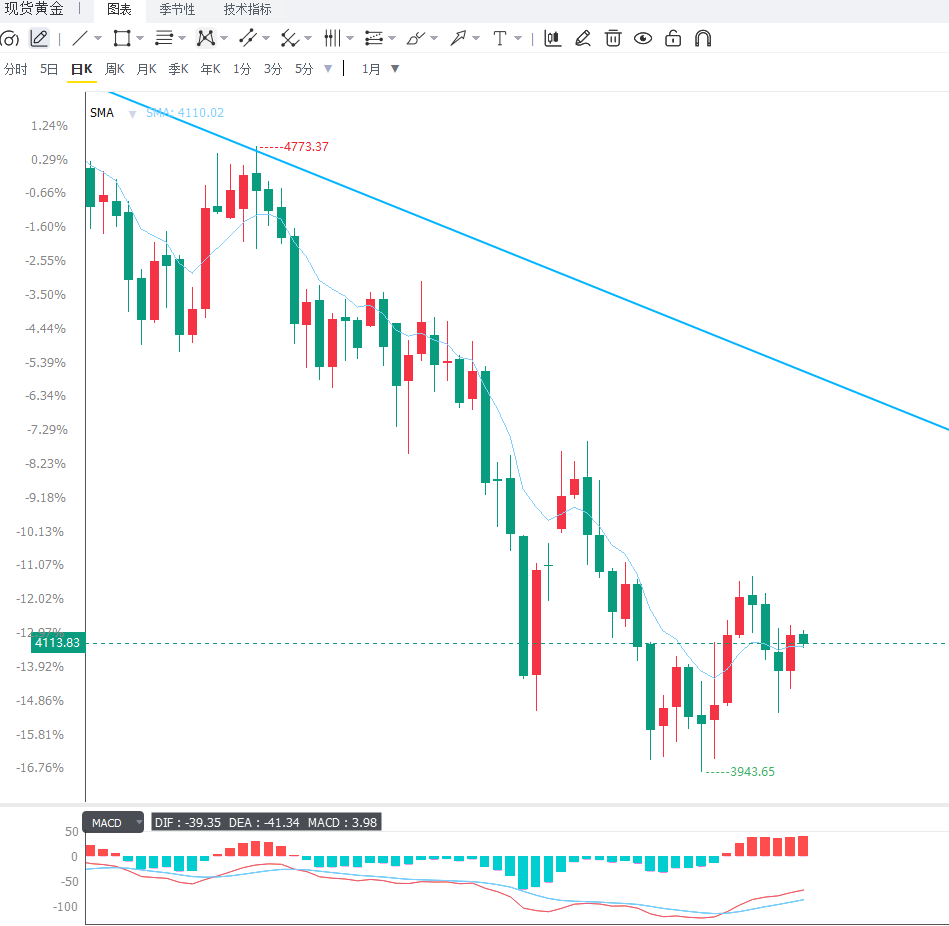
From a daily chart perspective, spot gold has rebounded after a recent correction, currently trading above the $4100 level, indicating a recovery in short-term bullish momentum. The daily moving average structure suggests that gold is attempting to recover from previous downward pressure, but a break above key resistance is needed to confirm a trend reversal. Resistance is seen in the $4150-$4180 area; a break above this area could lead to a further test of the $4200 psychological level. Support is seen in the $4080-$4050 area; a break below this level could lead to a retest of the $4000 level. The MACD indicator shows that bearish momentum is gradually weakening, and the market is entering a consolidation phase.
From a 4-hour chart perspective, gold prices are maintaining a rebound followed by an upward trend, with short-term moving averages gradually turning upwards, indicating strengthening short-term buying pressure. However, the current price is approaching the previous resistance zone, and a technical pullback may occur if it fails to break through the resistance near $4150. The RSI indicator is in the neutral-to-strong zone, indicating improved market sentiment, but no clear overbought signal has yet formed. Short-term price movements will still depend on changes in geopolitical risks, speeches by Federal Reserve officials, and the direction of the US dollar.
Editor's Summary : Gold's current rise is primarily driven by uncertainty in the Middle East and safe-haven inflows, but internal disagreements within the Federal Reserve regarding interest rate paths keep the market cautious. Future gold price movements will depend on two core factors: whether geopolitical risks escalate further and whether inflationary pressures alter the Fed's policy expectations. If the energy market comes under renewed pressure due to escalating tensions, gold may gain further upward momentum; however, if the situation eases while the dollar and interest rates remain high, the upside potential for gold prices may be limited. In the short term, gold remains in a phase of balancing risk premiums and interest rate pressures, and investors need to pay close attention to key technical levels and changes in global macroeconomic policies.
The main driver of the gold market recently has shifted back to geopolitical risks. Tensions between the US and Iran have shown signs of recurring tensions. While the market had previously anticipated a possible diplomatic resolution to reduce the risk of conflict, the latest news indicates that the situation remains highly uncertain. The White House has stated that the US remains committed to the previously reached understanding with Iran; however, President Trump's earlier statement that the agreement to end the conflict was "over" has created market uncertainty regarding future developments.
Market anxieties intensified following Iran's recent actions against vessels near the Strait of Hormuz and targets in the surrounding region, prompting investors to reassess energy supply risks. Trump stated that further escalation could occur if Iran attacks ships in the strait again. Furthermore, market research indicates that recent Iranian actions against U.S. military facilities, coupled with Jordan's interception of several missiles, have brought regional risk premiums back into the market's focus.
The situation in the Middle East could impact energy supplies, posing a risk of rising crude oil prices. Rising energy prices could further fuel global inflation expectations. This inflationary pressure from rising oil prices may prompt the Federal Reserve to maintain a relatively restrictive interest rate policy for an extended period , becoming a significant factor influencing gold price movements.
Meanwhile, the minutes of the Federal Reserve's June meeting revealed a significant divergence of opinion within the policymaking body regarding the future path of interest rates. This meeting also marked the first time Fed Chairman Kevin Warsh chaired a discussion on this policy. The minutes showed that some officials believed the federal funds rate should be near or slightly below its current target range by the end of the year; however, others believed that the rate might still need to be higher than the current target range by the end of the year.
This policy divergence has increased market uncertainty regarding the Federal Reserve's future actions. Previously, the market anticipated the start of a rate-cutting cycle, which would lower the opportunity cost of holding gold and support the precious metal's rise. However, if inflationary pressures resurface due to rising energy prices, the Fed may remain cautious, and the high-interest-rate environment will limit the potential for further gold price increases.
From a capital flow perspective, gold is currently still supported by safe-haven demand. When geopolitical risks escalate, gold, as a traditional safe-haven asset, typically attracts inflows. However, at the same time, US Treasury yields and the dollar's performance remain crucial factors determining gold's medium-term direction. If the dollar strengthens again, it could weaken demand for gold from non-dollar investors.
From a daily chart perspective, spot gold has rebounded after a recent correction, currently trading above the $4100 level, indicating a recovery in short-term bullish momentum. The daily moving average structure suggests that gold is attempting to recover from previous downward pressure, but a break above key resistance is needed to confirm a trend reversal. Resistance is seen in the $4150-$4180 area; a break above this area could lead to a further test of the $4200 psychological level. Support is seen in the $4080-$4050 area; a break below this level could lead to a retest of the $4000 level. The MACD indicator shows that bearish momentum is gradually weakening, and the market is entering a consolidation phase.
From a 4-hour chart perspective, gold prices are maintaining a rebound followed by an upward trend, with short-term moving averages gradually turning upwards, indicating strengthening short-term buying pressure. However, the current price is approaching the previous resistance zone, and a technical pullback may occur if it fails to break through the resistance near $4150. The RSI indicator is in the neutral-to-strong zone, indicating improved market sentiment, but no clear overbought signal has yet formed. Short-term price movements will still depend on changes in geopolitical risks, speeches by Federal Reserve officials, and the direction of the US dollar.
Editor's Summary : Gold's current rise is primarily driven by uncertainty in the Middle East and safe-haven inflows, but internal disagreements within the Federal Reserve regarding interest rate paths keep the market cautious. Future gold price movements will depend on two core factors: whether geopolitical risks escalate further and whether inflationary pressures alter the Fed's policy expectations. If the energy market comes under renewed pressure due to escalating tensions, gold may gain further upward momentum; however, if the situation eases while the dollar and interest rates remain high, the upside potential for gold prices may be limited. In the short term, gold remains in a phase of balancing risk premiums and interest rate pressures, and investors need to pay close attention to key technical levels and changes in global macroeconomic policies.
- Risk Warning and Disclaimer
- The market involves risk, and trading may not be suitable for all investors. This article is for reference only and does not constitute personal investment advice, nor does it take into account certain users’ specific investment objectives, financial situation, or other needs. Any investment decisions made based on this information are at your own risk.