Ignoring the Middle East conflict? The Fed's third-in-command makes a significant statement: Oil prices are near their peak, and the market expects them to fall over the next six months!
2026-07-10 10:25:38
On Friday (July 10) in early Asian trading, US crude oil futures opened lower but then rose, currently trading around $72 per barrel.
New York Federal Reserve President Williams said on Thursday (July 9) that despite the renewed fighting in the Middle East, he does not expect energy prices to continue rising for the remainder of the year.
He pointed out that the market expects oil prices to fall within the next 6 to 12 months, and believes that "this is a fairly reasonable baseline scenario," and that energy prices are likely near their peak and will gradually decline thereafter.
Williams' assessment of energy prices is based on two lines of reasoning. First, market pricing already implies an expectation of a future decline in oil prices—"the market still expects oil prices to fall within the next six to twelve months," a baseline scenario he considers reasonable. Second, from a fundamental perspective, energy prices "are likely nearing their peak" and will subsequently decline gradually.
The context of this assessment is noteworthy. Just days before Williams' speech, Trump announced that the interim agreement aimed at ending the conflict with Iran "had ended," and the US military launched a series of airstrikes against Iran, causing tensions in the Strait of Hormuz to escalate sharply. The war premium on energy prices subsequently soared.
However, Williams chose to downplay the persistence of this geopolitical shock, suggesting he tends to view it as a temporary disturbance rather than a persistent driver of inflation.
On a broader inflation front, Williams also specifically addressed the impact of AI investment. He noted that investments related to building the nation's AI infrastructure "may ease price pressures in the future," but "are clearly fueling inflation at present," and that current inflation levels remain too high. He further stated, "If this continues to drive demand relative to supply, and consequently affects inflation... you need to position monetary policy somewhere to offset that inflationary pressure." This statement suggests that the Federal Reserve has incorporated the AI investment boom into its inflation monitoring framework and is prepared to hedge against it through monetary policy if necessary.
Williams maintained a high degree of flexibility in policy guidance. When asked if a rate hike was possible at the July meeting, he stated unequivocally, "We haven't even started the analysis process yet," emphasizing that decisions are not permanent. This stance is highly consistent with Fed Chairman Warsh's overall style of "avoiding commitments to future interest rate decisions"—policymakers are consciously reducing the weight of forward guidance and returning to a "meeting-by-meeting assessment" model.
Williams also offered important insights into the Fed's "reaction function." He stated that the June meeting minutes revealed a "richness" of possible future scenarios—in some parts of the inflation outlook, the situation could be slightly more moderate (such as tariffs and energy price trends); however, there are also other scenarios where inflation becomes more sticky and remains at a high level, which would require tighter monetary policy. He commented that "the minutes actually reflect a collective reaction function to some extent," and reiterated that "as a policymaker, I have emphasized 'data-driven' for most of my career. My view has not changed."
This statement sends two signals: first, the Federal Reserve has formed a relatively comprehensive discussion framework on the policy path under different inflation scenarios; second, decision-making will be data-driven, and the market should not expect policymakers to provide clear guidance in advance.
Williams also commented on adjustments to the Federal Reserve's balance sheet. With Fed Chairman Warsh considering adjustments to the way the Fed manages interest rate tools and aiming to further reduce the size of its balance sheet, Williams emphasized that any adjustments should prioritize maintaining the safety and stability of the banking system.
He stated, "I believe the driving force behind this adjustment should not be focused on how much the Federal Reserve's balance sheet can be reduced, but rather on how to improve, refine, and strengthen our financial system." This statement is noteworthy because it reflects the Federal Reserve's internal considerations regarding the balance sheet reduction pace and financial stability—the resilience of the banking system is the priority of reform over a simple reduction in size.
In summary, Williams' speech on Thursday conveyed several key messages: First, he downplayed the ongoing impact of the Middle East conflict on energy prices, suggesting that oil prices may have peaked and would gradually decline, which provided some reassurance to the market. Second, he declined to provide clear guidance on whether to raise interest rates at the July meeting, emphasizing that decisions would rely on data, which is highly consistent with the "de-forward guidance" policy framework led by Warsh. Third, he explicitly stated that AI investment is currently driving up inflation, and the Fed will closely monitor its impact. Fourth, regarding balance sheet reform, he stressed that bank safety should take precedence over the goal of reducing the size of the balance sheet.
For the market, Williams' remarks did not change the current policy pricing framework. Holding rates steady at the July meeting remains the baseline scenario, while the policy path in September and beyond will depend on economic data in the coming weeks—particularly the trajectory of energy prices, the actual inflation-boosting effect of AI investment, and the evolution of the labor market. With the Fed entering a "data-dependent" mode, every key data point could trigger a repricing of the policy path by the market.
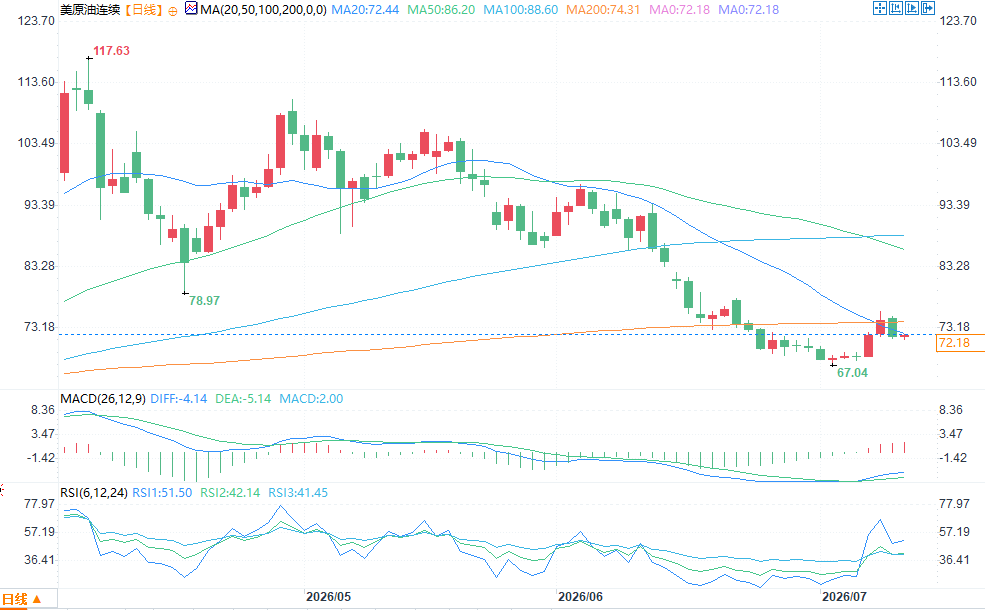
(US crude oil futures daily chart, source: FX678)
At 10:25 AM Beijing time on July 10, US crude oil futures were trading around $72.27 per barrel.
New York Federal Reserve President Williams said on Thursday (July 9) that despite the renewed fighting in the Middle East, he does not expect energy prices to continue rising for the remainder of the year.
He pointed out that the market expects oil prices to fall within the next 6 to 12 months, and believes that "this is a fairly reasonable baseline scenario," and that energy prices are likely near their peak and will gradually decline thereafter.
Energy Price Outlook: We do not believe prices will continue to rise; AI investment will drive inflation in the short term but suppress prices in the long term.
Williams' assessment of energy prices is based on two lines of reasoning. First, market pricing already implies an expectation of a future decline in oil prices—"the market still expects oil prices to fall within the next six to twelve months," a baseline scenario he considers reasonable. Second, from a fundamental perspective, energy prices "are likely nearing their peak" and will subsequently decline gradually.
The context of this assessment is noteworthy. Just days before Williams' speech, Trump announced that the interim agreement aimed at ending the conflict with Iran "had ended," and the US military launched a series of airstrikes against Iran, causing tensions in the Strait of Hormuz to escalate sharply. The war premium on energy prices subsequently soared.
However, Williams chose to downplay the persistence of this geopolitical shock, suggesting he tends to view it as a temporary disturbance rather than a persistent driver of inflation.
On a broader inflation front, Williams also specifically addressed the impact of AI investment. He noted that investments related to building the nation's AI infrastructure "may ease price pressures in the future," but "are clearly fueling inflation at present," and that current inflation levels remain too high. He further stated, "If this continues to drive demand relative to supply, and consequently affects inflation... you need to position monetary policy somewhere to offset that inflationary pressure." This statement suggests that the Federal Reserve has incorporated the AI investment boom into its inflation monitoring framework and is prepared to hedge against it through monetary policy if necessary.
Policy stance: Relying on data, rejecting premature commitments, and emphasizing the collective nature of the response function.
Williams maintained a high degree of flexibility in policy guidance. When asked if a rate hike was possible at the July meeting, he stated unequivocally, "We haven't even started the analysis process yet," emphasizing that decisions are not permanent. This stance is highly consistent with Fed Chairman Warsh's overall style of "avoiding commitments to future interest rate decisions"—policymakers are consciously reducing the weight of forward guidance and returning to a "meeting-by-meeting assessment" model.
Williams also offered important insights into the Fed's "reaction function." He stated that the June meeting minutes revealed a "richness" of possible future scenarios—in some parts of the inflation outlook, the situation could be slightly more moderate (such as tariffs and energy price trends); however, there are also other scenarios where inflation becomes more sticky and remains at a high level, which would require tighter monetary policy. He commented that "the minutes actually reflect a collective reaction function to some extent," and reiterated that "as a policymaker, I have emphasized 'data-driven' for most of my career. My view has not changed."
This statement sends two signals: first, the Federal Reserve has formed a relatively comprehensive discussion framework on the policy path under different inflation scenarios; second, decision-making will be data-driven, and the market should not expect policymakers to provide clear guidance in advance.
Balance sheet reform: Adjustments should prioritize bank safety.
Williams also commented on adjustments to the Federal Reserve's balance sheet. With Fed Chairman Warsh considering adjustments to the way the Fed manages interest rate tools and aiming to further reduce the size of its balance sheet, Williams emphasized that any adjustments should prioritize maintaining the safety and stability of the banking system.
He stated, "I believe the driving force behind this adjustment should not be focused on how much the Federal Reserve's balance sheet can be reduced, but rather on how to improve, refine, and strengthen our financial system." This statement is noteworthy because it reflects the Federal Reserve's internal considerations regarding the balance sheet reduction pace and financial stability—the resilience of the banking system is the priority of reform over a simple reduction in size.
Outlook: Williams' speech offered reassuring signals, but the data remains the final arbiter.
In summary, Williams' speech on Thursday conveyed several key messages: First, he downplayed the ongoing impact of the Middle East conflict on energy prices, suggesting that oil prices may have peaked and would gradually decline, which provided some reassurance to the market. Second, he declined to provide clear guidance on whether to raise interest rates at the July meeting, emphasizing that decisions would rely on data, which is highly consistent with the "de-forward guidance" policy framework led by Warsh. Third, he explicitly stated that AI investment is currently driving up inflation, and the Fed will closely monitor its impact. Fourth, regarding balance sheet reform, he stressed that bank safety should take precedence over the goal of reducing the size of the balance sheet.
For the market, Williams' remarks did not change the current policy pricing framework. Holding rates steady at the July meeting remains the baseline scenario, while the policy path in September and beyond will depend on economic data in the coming weeks—particularly the trajectory of energy prices, the actual inflation-boosting effect of AI investment, and the evolution of the labor market. With the Fed entering a "data-dependent" mode, every key data point could trigger a repricing of the policy path by the market.
(US crude oil futures daily chart, source: FX678)
At 10:25 AM Beijing time on July 10, US crude oil futures were trading around $72.27 per barrel.
- Risk Warning and Disclaimer
- The market involves risk, and trading may not be suitable for all investors. This article is for reference only and does not constitute personal investment advice, nor does it take into account certain users’ specific investment objectives, financial situation, or other needs. Any investment decisions made based on this information are at your own risk.