The Japanese Finance Minister's remarks signaled a potential interest rate hike, causing the dollar to briefly fall below the 162 yen level against the yen.
2026-07-10 09:08:09
On Friday (July 10) in early Asian trading, the US dollar fell from its highs against the Japanese yen. As of 09:06, it had briefly fallen below the 162 level to around 161.86, a new low in the past three trading days, with a drop of about 0.28%.
Better-than-expected US initial jobless claims data, hawkish comments from Federal Reserve officials, and the second consecutive night of US airstrikes on Iran boosting the war premium on oil prices all provided some support for the US dollar. However, comments from Japanese Finance Minister Satsuki Katayama on Thursday, which signaled expectations of rising interest rates, led to a stronger yen.

Japanese Finance Minister Satsuki Katayama delivered a speech on Thursday, sending multiple policy signals.
She stated that interest rates are expected to rise gradually as the government actively implements fiscal policy and hopes to accelerate discussions on expanding Japanese government bond products for households. Regarding monetary policy, Katayama emphasized that the Bank of Japan can adjust its policy independently, unaffected by government statements, and that specific monetary tools are determined by the central bank. She added that the ruling party is adjusting the wording in its economic blueprint.
She stated that she would closely monitor economic indicators and market conditions to ensure fiscal sustainability in order to win market trust.
Thursday provided ample ammunition for dollar bulls. Initial jobless claims came in at 215,000, better than the expected 218,000. A voting FOMC member delivered clearly hawkish comments at 13:00 GMT.
Geopolitically, the U.S. military has struck about 90 targets in Iran, reimposed oil sanctions, and the interim peace framework signed last month has been effectively suspended.
For Japan, tensions in the Strait of Hormuz hold particular significance. Japan is almost entirely reliant on energy imports, meaning any negative news regarding the Strait of Hormuz constitutes a trade condition tax on the yen—one of the fundamental reasons why the dollar initially rose to its highest level against the yen since 1986.
However, the fact that the exchange rate has stalled in such a favorable environment is itself a signal: marginal buyers have entered the market when the upward trend stops advancing amidst its most favorable news flow. The Stochastic Relative Strength Index (SRSI) has fallen from overbought territory to around 60 after prices were capped below 163.00, further confirming the weakening momentum.
The very notion that the market will return to intervention-dangerous territory is a geographical miscalculation, as the market has never truly left. The April intervention was initiated after the exchange rate broke through 160.00; the combined interventions in April and May cost a record 11.73 trillion yen—roughly twice the size of the previous largest intervention—yet the exchange rate recovered to intervention levels within six weeks. At current price levels, every new long dollar position is being established above the Ministry of Finance's known "pain threshold."
Tokyo's current strategy has shifted from public warnings to tactical ambushes: no public red lines are set, with Finance Minister Katsuki Kato issuing only the standard "ready to respond at any time" statement, and the timing of the action chosen to maximize damage to short yen positions. The brief but sharp surge in the yen on July 2nd could not be attributed to anything before the monthly intervention data was released at the end of July—this is precisely what "secret probing" should look like.
Of course, constraints remain—from the IMF’s free-floating accounting rules to Prime Minister Sanae Takaichi’s reflation policy inclinations—but these constraints make the Ministry of Finance’s options more selective, rather than completely absent.
Policy divergences are narrowing at both ends. The Bank of Japan raised its policy rate to 1.00% in June, and the government's revised policy agenda now calls for monetary policy to "support stable price growth"—a phrase interpreted by the market as providing political cover for further tightening rather than a constraint.
In the US, the market is pricing in about a three-quarters probability that the Federal Reserve will keep interest rates unchanged in July. The fact that non-farm payrolls increased by only 57,000 in June weakened the case for a rate hike, and the Fed's hawkish dot plot is no longer news to those who already hold dollars.
Next week's US CPI report will be a key audit point for testing the logic of carry trades. Market consensus expects overall CPI to decline by 0.1% month-on-month (previous value: +0.5%), with the previous annual rate at 4.2%. If the CPI data reaches or falls below the consensus level, it will compress US front-end yields, while the Bank of Japan remains on a tightening track—crowded positions will do the rest.
In addition, geopolitical factors are also worth noting: Trump announced the end of the ceasefire agreement but insisted that Tehran wanted to reach an agreement, and any shift back to negotiations would remove the oil war premium—which has been the heaviest drag on the yen.
Resistance: The current resistance is the weekly high slightly below 163.00. If the daily close is above 163.00, it will reopen the upside potential to 163.50 – at which point the Ministry of Finance will be on high alert.
Support: 161.00 is holding the recent bottom. The 50-day exponential moving average at around 160.00 is a level that will be tested within hours after any real intervention news emerges.
Bias: Remain bearish below 163.00; shorting on rallies targets 161.00, and 160.00 if intervention-related news emerges; only a daily close above 163.00 can negate this assessment.
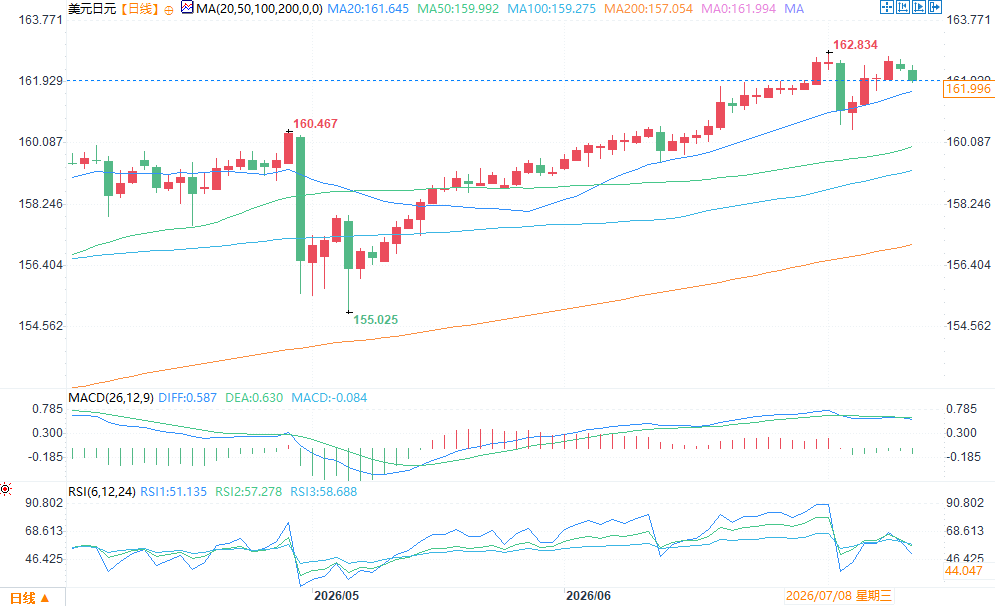
(USD/JPY daily chart, source: FX678)
Friday's economic data schedule in Tokyo and Washington is relatively light, and exchange rates are likely to be driven primarily by news related to the Gulf situation and positioning adjustments ahead of the CPI release. This illiquid environment has historically been a window for the Ministry of Finance to intervene to maximize its effectiveness—the record intervention in April was implemented during Japan's Golden Week holiday window, and the thin liquidity is a characteristic of this strategy manual, not a coincidence.
Next week's economic data schedule is dominated by the United States. US CPI data will be released next Tuesday, followed by PPI and the Federal Reserve Beige Book on Wednesday (core PPI annual rate previously 4.9%), US retail sales on Thursday (expected to cool from 0.9% to 0.3%), and the preliminary reading of the University of Michigan Consumer Sentiment Index on Friday (one-year inflation expectations previously 4.6%).
From a broader perspective, the Japanese yen is currently at a critical juncture where multiple forces converge: the marginal cooling of expectations for a Fed rate hike, the Bank of Japan's continued tightening, the lingering shadow of intervention, and crowded short positions in the yen. Any marginal change in these variables—whether it's lower-than-expected US CPI, new intervention actions, or unexpected developments in the Middle East—could trigger a sharp rebound in the yen. The battle for the 163.00 level is only just beginning to intensify.
At 0:07 Beijing time on July 10, the USD/JPY exchange rate was 161.86/87.
Better-than-expected US initial jobless claims data, hawkish comments from Federal Reserve officials, and the second consecutive night of US airstrikes on Iran boosting the war premium on oil prices all provided some support for the US dollar. However, comments from Japanese Finance Minister Satsuki Katayama on Thursday, which signaled expectations of rising interest rates, led to a stronger yen.
Katayama Satsuki: Interest rates will gradually rise; the Bank of Japan will independently determine its monetary policy.
Japanese Finance Minister Satsuki Katayama delivered a speech on Thursday, sending multiple policy signals.
She stated that interest rates are expected to rise gradually as the government actively implements fiscal policy and hopes to accelerate discussions on expanding Japanese government bond products for households. Regarding monetary policy, Katayama emphasized that the Bank of Japan can adjust its policy independently, unaffected by government statements, and that specific monetary tools are determined by the central bank. She added that the ruling party is adjusting the wording in its economic blueprint.
She stated that she would closely monitor economic indicators and market conditions to ensure fiscal sustainability in order to win market trust.
With all the positive factors for the US dollar priced in, the Japanese yen showed resilience before reaching the 163 level.
Thursday provided ample ammunition for dollar bulls. Initial jobless claims came in at 215,000, better than the expected 218,000. A voting FOMC member delivered clearly hawkish comments at 13:00 GMT.
Geopolitically, the U.S. military has struck about 90 targets in Iran, reimposed oil sanctions, and the interim peace framework signed last month has been effectively suspended.
For Japan, tensions in the Strait of Hormuz hold particular significance. Japan is almost entirely reliant on energy imports, meaning any negative news regarding the Strait of Hormuz constitutes a trade condition tax on the yen—one of the fundamental reasons why the dollar initially rose to its highest level against the yen since 1986.
However, the fact that the exchange rate has stalled in such a favorable environment is itself a signal: marginal buyers have entered the market when the upward trend stops advancing amidst its most favorable news flow. The Stochastic Relative Strength Index (SRSI) has fallen from overbought territory to around 60 after prices were capped below 163.00, further confirming the weakening momentum.
The shadow of intervention looms large – the Ministry of Finance's "silent tactics"
The very notion that the market will return to intervention-dangerous territory is a geographical miscalculation, as the market has never truly left. The April intervention was initiated after the exchange rate broke through 160.00; the combined interventions in April and May cost a record 11.73 trillion yen—roughly twice the size of the previous largest intervention—yet the exchange rate recovered to intervention levels within six weeks. At current price levels, every new long dollar position is being established above the Ministry of Finance's known "pain threshold."
Tokyo's current strategy has shifted from public warnings to tactical ambushes: no public red lines are set, with Finance Minister Katsuki Kato issuing only the standard "ready to respond at any time" statement, and the timing of the action chosen to maximize damage to short yen positions. The brief but sharp surge in the yen on July 2nd could not be attributed to anything before the monthly intervention data was released at the end of July—this is precisely what "secret probing" should look like.
Of course, constraints remain—from the IMF’s free-floating accounting rules to Prime Minister Sanae Takaichi’s reflation policy inclinations—but these constraints make the Ministry of Finance’s options more selective, rather than completely absent.
Yield spreads are narrowing: Macroeconomic backdrop shifts favorably for the yen.
Policy divergences are narrowing at both ends. The Bank of Japan raised its policy rate to 1.00% in June, and the government's revised policy agenda now calls for monetary policy to "support stable price growth"—a phrase interpreted by the market as providing political cover for further tightening rather than a constraint.
In the US, the market is pricing in about a three-quarters probability that the Federal Reserve will keep interest rates unchanged in July. The fact that non-farm payrolls increased by only 57,000 in June weakened the case for a rate hike, and the Fed's hawkish dot plot is no longer news to those who already hold dollars.
Next week's US CPI report will be a key audit point for testing the logic of carry trades. Market consensus expects overall CPI to decline by 0.1% month-on-month (previous value: +0.5%), with the previous annual rate at 4.2%. If the CPI data reaches or falls below the consensus level, it will compress US front-end yields, while the Bank of Japan remains on a tightening track—crowded positions will do the rest.
In addition, geopolitical factors are also worth noting: Trump announced the end of the ceasefire agreement but insisted that Tehran wanted to reach an agreement, and any shift back to negotiations would remove the oil war premium—which has been the heaviest drag on the yen.
Technical Analysis
Resistance: The current resistance is the weekly high slightly below 163.00. If the daily close is above 163.00, it will reopen the upside potential to 163.50 – at which point the Ministry of Finance will be on high alert.
Support: 161.00 is holding the recent bottom. The 50-day exponential moving average at around 160.00 is a level that will be tested within hours after any real intervention news emerges.
Bias: Remain bearish below 163.00; shorting on rallies targets 161.00, and 160.00 if intervention-related news emerges; only a daily close above 163.00 can negate this assessment.
(USD/JPY daily chart, source: FX678)
Outlook: A quiet Friday and a busy data week – the yen faces a crucial test.
Friday's economic data schedule in Tokyo and Washington is relatively light, and exchange rates are likely to be driven primarily by news related to the Gulf situation and positioning adjustments ahead of the CPI release. This illiquid environment has historically been a window for the Ministry of Finance to intervene to maximize its effectiveness—the record intervention in April was implemented during Japan's Golden Week holiday window, and the thin liquidity is a characteristic of this strategy manual, not a coincidence.
Next week's economic data schedule is dominated by the United States. US CPI data will be released next Tuesday, followed by PPI and the Federal Reserve Beige Book on Wednesday (core PPI annual rate previously 4.9%), US retail sales on Thursday (expected to cool from 0.9% to 0.3%), and the preliminary reading of the University of Michigan Consumer Sentiment Index on Friday (one-year inflation expectations previously 4.6%).
From a broader perspective, the Japanese yen is currently at a critical juncture where multiple forces converge: the marginal cooling of expectations for a Fed rate hike, the Bank of Japan's continued tightening, the lingering shadow of intervention, and crowded short positions in the yen. Any marginal change in these variables—whether it's lower-than-expected US CPI, new intervention actions, or unexpected developments in the Middle East—could trigger a sharp rebound in the yen. The battle for the 163.00 level is only just beginning to intensify.
At 0:07 Beijing time on July 10, the USD/JPY exchange rate was 161.86/87.
- Risk Warning and Disclaimer
- The market involves risk, and trading may not be suitable for all investors. This article is for reference only and does not constitute personal investment advice, nor does it take into account certain users’ specific investment objectives, financial situation, or other needs. Any investment decisions made based on this information are at your own risk.