The Reserve Bank of Australia's hawkish stance provides support, but the 0.7000 level is within reach—can the Australian dollar bulls maintain their momentum?
2026-07-10 11:16:13
On Friday (July 10) during Asian trading hours, the Australian dollar attracted buying interest against the US dollar, reaching a two-and-a-half-week high of 0.6969, a gain of about 0.42%.
The Australian dollar's strength is mainly attributed to hawkish signals recently released by Reserve Bank of Australia officials. Assistant Governor Sarah Hunt stated on Wednesday that the committee will take necessary actions to bring inflation back to the target level and warned that further tightening may be necessary if oil price shocks push up inflation expectations.
Reserve Bank of Australia Assistant Governor Hunt's remarks on Wednesday were a key driver of the Australian dollar's strength. She explicitly stated that the committee would "take necessary action" to bring inflation back to target – a more hawkish tone than the market had previously expected. Crucially, she warned that if oil price shocks push inflation expectations up, "some tightening may be necessary."
This warning comes against the backdrop of ongoing geopolitical tensions in the Middle East. Escalating conflict in the Strait of Hormuz has driven up global energy prices, and while Australia, as a net energy exporter, has benefited from improved terms of trade due to rising energy prices, increasing inflationary pressures are forcing the Reserve Bank of Australia to remain vigilant.
To date, the Reserve Bank of Australia (RBA) has implemented three interest rate hikes this year, each by 25 basis points, raising the official cash rate to 4.35%. Based on ASX 30-day interbank cash rate futures pricing, the market currently expects a 19% probability of a rate hike to 4.60% at the August meeting. While this probability is not high, if subsequent inflation data or geopolitical tensions deteriorate further, the rising expectation of a rate hike will directly drive the Australian dollar higher.
In contrast to the Reserve Bank of Australia's hawkish tone, Federal Reserve officials made relatively dovish statements. Williams said on Thursday that despite the renewed conflict in the Middle East, he does not expect energy prices to continue rising for the remainder of the year.
He pointed out, "The market still expects oil prices to fall over the next six to twelve months. I think this is a fairly reasonable baseline scenario."
This statement downplayed the continued impact of geopolitical risks on energy prices, suggesting that the Federal Reserve does not believe the current situation in the Middle East will evolve into a persistent driver of inflation. Combined with the previously released minutes of the June FOMC meeting—which showed that many participants believed interest rates would remain unchanged or slightly lower by the end of the year—the Fed's policy stance leans more towards a wait-and-see approach than proactive tightening.
This policy divergence between the Reserve Bank of Australia (RBA) and the Federal Reserve (Fed) is the core macroeconomic driver behind the recent strengthening of the Australian dollar against the US dollar.
From a technical perspective, the Australian dollar found buying support around 0.6950 against the US dollar, and its recent upward trend remains intact. If the Reserve Bank of Australia's hawkish tone is validated by subsequent data (such as better-than-expected Australian inflation or employment data next week), the exchange rate is expected to further test the psychological level of 0.7000.
On the downside, the 0.6900 level has become a recent support level; if it is breached, it may retest the 0.6850 area.
Risk factors to watch include: an unexpected easing of tensions in the Middle East could lead to a decline in energy prices, reducing the urgency for the Reserve Bank of Australia to raise interest rates; and if next week's US CPI data is stronger than expected, it could reignite expectations of a Fed rate hike, thereby reversing the trend of a weakening dollar.
In the current environment, the Australian dollar's trajectory will be highly dependent on the relative shifts in policy expectations between the Reserve Bank of Australia and the Federal Reserve, as well as the different impacts of global energy prices on the inflation outlook of the two countries.
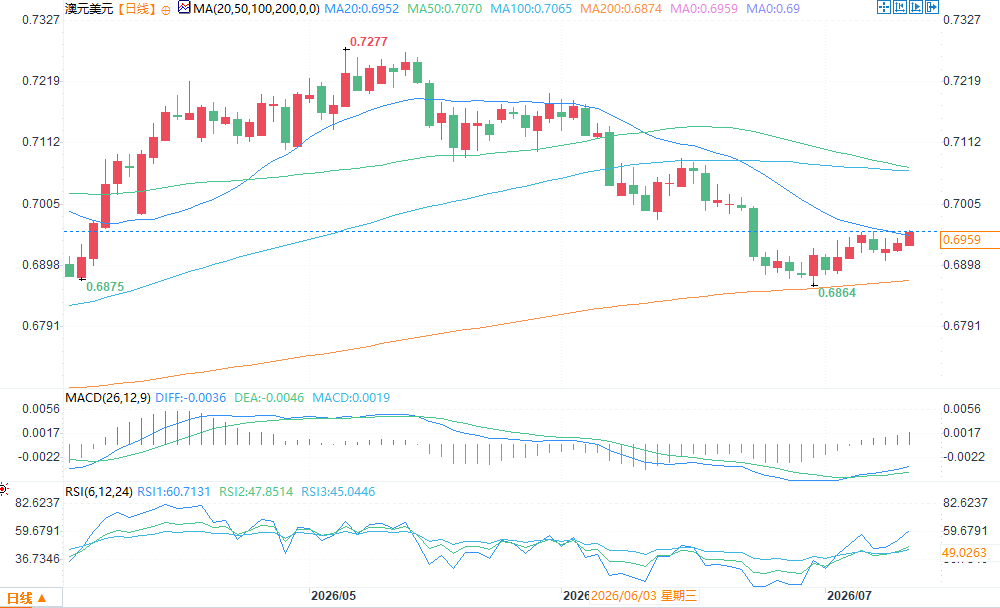
(AUD/USD daily chart, source: FX678)
At 11:15 Beijing time on July 10, the Australian dollar was trading at 0.6964/65 against the US dollar.
The Australian dollar's strength is mainly attributed to hawkish signals recently released by Reserve Bank of Australia officials. Assistant Governor Sarah Hunt stated on Wednesday that the committee will take necessary actions to bring inflation back to the target level and warned that further tightening may be necessary if oil price shocks push up inflation expectations.
Reserve Bank of Australia: Hawkish stance clear, door open for further tightening
Reserve Bank of Australia Assistant Governor Hunt's remarks on Wednesday were a key driver of the Australian dollar's strength. She explicitly stated that the committee would "take necessary action" to bring inflation back to target – a more hawkish tone than the market had previously expected. Crucially, she warned that if oil price shocks push inflation expectations up, "some tightening may be necessary."
This warning comes against the backdrop of ongoing geopolitical tensions in the Middle East. Escalating conflict in the Strait of Hormuz has driven up global energy prices, and while Australia, as a net energy exporter, has benefited from improved terms of trade due to rising energy prices, increasing inflationary pressures are forcing the Reserve Bank of Australia to remain vigilant.
To date, the Reserve Bank of Australia (RBA) has implemented three interest rate hikes this year, each by 25 basis points, raising the official cash rate to 4.35%. Based on ASX 30-day interbank cash rate futures pricing, the market currently expects a 19% probability of a rate hike to 4.60% at the August meeting. While this probability is not high, if subsequent inflation data or geopolitical tensions deteriorate further, the rising expectation of a rate hike will directly drive the Australian dollar higher.
Federal Reserve: Williams downplays energy inflation risks, policy stance leans towards wait-and-see.
In contrast to the Reserve Bank of Australia's hawkish tone, Federal Reserve officials made relatively dovish statements. Williams said on Thursday that despite the renewed conflict in the Middle East, he does not expect energy prices to continue rising for the remainder of the year.
He pointed out, "The market still expects oil prices to fall over the next six to twelve months. I think this is a fairly reasonable baseline scenario."
This statement downplayed the continued impact of geopolitical risks on energy prices, suggesting that the Federal Reserve does not believe the current situation in the Middle East will evolve into a persistent driver of inflation. Combined with the previously released minutes of the June FOMC meeting—which showed that many participants believed interest rates would remain unchanged or slightly lower by the end of the year—the Fed's policy stance leans more towards a wait-and-see approach than proactive tightening.
This policy divergence between the Reserve Bank of Australia (RBA) and the Federal Reserve (Fed) is the core macroeconomic driver behind the recent strengthening of the Australian dollar against the US dollar.
Technical Analysis and Outlook: 0.7000 Level Becomes Near-Term Target
From a technical perspective, the Australian dollar found buying support around 0.6950 against the US dollar, and its recent upward trend remains intact. If the Reserve Bank of Australia's hawkish tone is validated by subsequent data (such as better-than-expected Australian inflation or employment data next week), the exchange rate is expected to further test the psychological level of 0.7000.
On the downside, the 0.6900 level has become a recent support level; if it is breached, it may retest the 0.6850 area.
Risk factors to watch include: an unexpected easing of tensions in the Middle East could lead to a decline in energy prices, reducing the urgency for the Reserve Bank of Australia to raise interest rates; and if next week's US CPI data is stronger than expected, it could reignite expectations of a Fed rate hike, thereby reversing the trend of a weakening dollar.
In the current environment, the Australian dollar's trajectory will be highly dependent on the relative shifts in policy expectations between the Reserve Bank of Australia and the Federal Reserve, as well as the different impacts of global energy prices on the inflation outlook of the two countries.
(AUD/USD daily chart, source: FX678)
At 11:15 Beijing time on July 10, the Australian dollar was trading at 0.6964/65 against the US dollar.
- Risk Warning and Disclaimer
- The market involves risk, and trading may not be suitable for all investors. This article is for reference only and does not constitute personal investment advice, nor does it take into account certain users’ specific investment objectives, financial situation, or other needs. Any investment decisions made based on this information are at your own risk.