The euro is on the verge of breaking through 1.15, with expectations of an ECB rate hike rising, versus the uncertainty surrounding next week's CPI – will it break through or pull back?
2026-07-10 10:49:18
On Friday (July 10) in early Asian trading, the euro continued its upward trend against the US dollar, currently trading around 1.1455, up about 0.25%, after touching 1.1472 overnight.
The exchange rate's strength was mainly due to the weakness of the US dollar and renewed market expectations for further interest rate hikes by the European Central Bank.
The ECB’s June policy meeting minutes, released Thursday, showed that the forecasts received by policymakers at the time indicated that inflation would continue to rise above the target level next year, even though the market had already priced in nearly three rate hikes.
The hawkish implication of this signal is clear: the ECB is facing a more stubborn core inflation problem than previously expected, and may need more tightening measures to bring inflation back to the target range.
The market reacted swiftly. Traders have increased their bets on further interest rate hikes by the ECB in recent days, based on the logic that the prospects for a US-Iran agreement are bleak, and the war premium on energy prices may persist, further increasing inflationary pressures in the Eurozone. Despite differing public guidance from ECB officials, market pricing has shifted towards a more hawkish direction.
This backdrop has provided sustained buying support for the euro. With expectations of a Fed rate hike easing marginally, rising expectations of an ECB rate hike are narrowing the interest rate differential between the US and Europe, thus benefiting the euro against the dollar.
The evolution of the US-Iran conflict remains a key variable for the euro's short-term trajectory. Earlier this week, Trump announced that the framework agreement aimed at ending the conflict with Iran was "over," but on Thursday, a US official stated that Washington remains committed to the memorandum of understanding with Iran. This contradictory signal suggests that diplomatic channels between the US and Iran are not entirely closed, but the prospects for an agreement remain highly uncertain.
For the euro, the situation between the US and Iran has a two-sided impact. On the one hand, if the conflict continues to escalate, risk aversion could push up the dollar, thus putting pressure on the euro; on the other hand, rising energy prices will exacerbate inflationary pressures in the eurozone, thereby reinforcing the necessity for the ECB to raise interest rates—which in turn benefits the euro.
The market currently seems to favor trading the latter, namely, that geopolitical risks support the euro through the transmission path of energy inflation → ECB interest rate hikes.
In summary, the euro is supported by multiple factors at current levels against the dollar: the dollar remains defensive in the absence of new hawkish catalysts in the Fed minutes; hawkish signals from the ECB's account record have prompted the market to repric the path of interest rate hikes; and geopolitical uncertainty is indirectly beneficial to the euro through energy inflation.
The short-term upside target is the resistance near the overnight high of 1.1472; a decisive break above this level could lead to a test of the 1.1500 level. On the downside, 1.1400 has now become a recent support level; a breach of this level could result in a retest of 1.1350.
However, risk factors also need to be considered. If the US-Iran conflict unexpectedly eases, leading to a decline in energy prices, the ECB's interest rate hike expectations may need to be revised, putting pressure on the euro.
Furthermore, if the US CPI data next week is stronger than expected, it could reignite expectations of a Fed rate hike, thereby reversing the trend of a weakening dollar.
In the current environment, the euro's trajectory will be highly dependent on the relative changes in the policy expectations of the ECB and the Federal Reserve, as well as the evolution of the geopolitical situation in the Middle East.
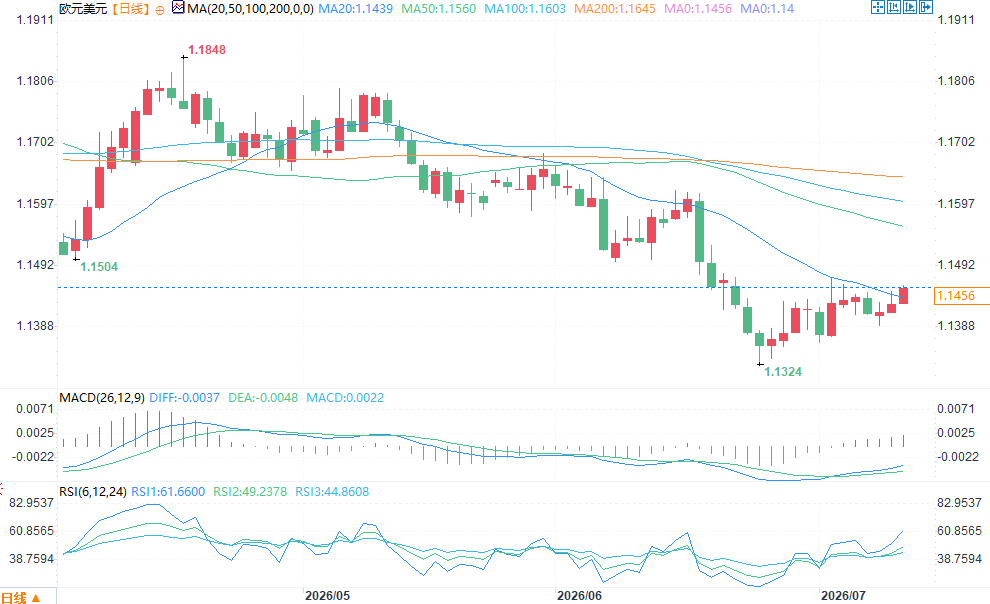
(Euro/USD daily chart, source: FX678)
At 10:49 Beijing time on July 10, the euro was trading at 1.1458/59 against the US dollar.
The exchange rate's strength was mainly due to the weakness of the US dollar and renewed market expectations for further interest rate hikes by the European Central Bank.
ECB account records reveal sticky inflation, reigniting expectations of interest rate hikes.
The ECB’s June policy meeting minutes, released Thursday, showed that the forecasts received by policymakers at the time indicated that inflation would continue to rise above the target level next year, even though the market had already priced in nearly three rate hikes.
The hawkish implication of this signal is clear: the ECB is facing a more stubborn core inflation problem than previously expected, and may need more tightening measures to bring inflation back to the target range.
The market reacted swiftly. Traders have increased their bets on further interest rate hikes by the ECB in recent days, based on the logic that the prospects for a US-Iran agreement are bleak, and the war premium on energy prices may persist, further increasing inflationary pressures in the Eurozone. Despite differing public guidance from ECB officials, market pricing has shifted towards a more hawkish direction.
This backdrop has provided sustained buying support for the euro. With expectations of a Fed rate hike easing marginally, rising expectations of an ECB rate hike are narrowing the interest rate differential between the US and Europe, thus benefiting the euro against the dollar.
Geopolitics: Uncertainty surrounding the US-Iran deal has a dual impact on the euro.
The evolution of the US-Iran conflict remains a key variable for the euro's short-term trajectory. Earlier this week, Trump announced that the framework agreement aimed at ending the conflict with Iran was "over," but on Thursday, a US official stated that Washington remains committed to the memorandum of understanding with Iran. This contradictory signal suggests that diplomatic channels between the US and Iran are not entirely closed, but the prospects for an agreement remain highly uncertain.
For the euro, the situation between the US and Iran has a two-sided impact. On the one hand, if the conflict continues to escalate, risk aversion could push up the dollar, thus putting pressure on the euro; on the other hand, rising energy prices will exacerbate inflationary pressures in the eurozone, thereby reinforcing the necessity for the ECB to raise interest rates—which in turn benefits the euro.
The market currently seems to favor trading the latter, namely, that geopolitical risks support the euro through the transmission path of energy inflation → ECB interest rate hikes.
Outlook: Short-term bias is towards further upside, but risks remain.
In summary, the euro is supported by multiple factors at current levels against the dollar: the dollar remains defensive in the absence of new hawkish catalysts in the Fed minutes; hawkish signals from the ECB's account record have prompted the market to repric the path of interest rate hikes; and geopolitical uncertainty is indirectly beneficial to the euro through energy inflation.
The short-term upside target is the resistance near the overnight high of 1.1472; a decisive break above this level could lead to a test of the 1.1500 level. On the downside, 1.1400 has now become a recent support level; a breach of this level could result in a retest of 1.1350.
However, risk factors also need to be considered. If the US-Iran conflict unexpectedly eases, leading to a decline in energy prices, the ECB's interest rate hike expectations may need to be revised, putting pressure on the euro.
Furthermore, if the US CPI data next week is stronger than expected, it could reignite expectations of a Fed rate hike, thereby reversing the trend of a weakening dollar.
In the current environment, the euro's trajectory will be highly dependent on the relative changes in the policy expectations of the ECB and the Federal Reserve, as well as the evolution of the geopolitical situation in the Middle East.
(Euro/USD daily chart, source: FX678)
At 10:49 Beijing time on July 10, the euro was trading at 1.1458/59 against the US dollar.
- Risk Warning and Disclaimer
- The market involves risk, and trading may not be suitable for all investors. This article is for reference only and does not constitute personal investment advice, nor does it take into account certain users’ specific investment objectives, financial situation, or other needs. Any investment decisions made based on this information are at your own risk.