High oil prices supported the Canadian dollar, and the USD/CAD pair continued to fluctuate at high levels.
2026-07-10 13:31:59
The US dollar continued its weakness against the Canadian dollar in European trading on Friday, falling back to around 1.4160. The market is reassessing the impact of the Federal Reserve's interest rate path, changes in the oil market, and the fundamentals of the Canadian economy on the Canadian dollar. The recent pressure on the dollar is mainly due to the market lowering its expectations for further Fed rate hikes. The minutes of the Fed's June meeting showed that policymakers remain concerned about inflationary pressures, with some officials believing that further rate hikes are still possible if price pressures persist.

However, market bets on short-term policy adjustments by the Federal Reserve have decreased. According to market pricing tools, investors' expectations for a 25 basis point rate hike by the Fed in July have fallen from approximately 31% to 24.6%; expectations for a rate hike at the September meeting have also dropped from 66.6% to 62.3%. This reduced market expectations for Fed rate hikes has become a significant factor in the recent weakening of the US dollar.
New York Federal Reserve President John Williams stated that despite the ongoing tensions in the Middle East, he does not believe energy prices will continue to rise significantly for the remainder of the year. This view alleviated some investors' concerns about long-term inflationary pressures and also influenced expectations for US dollar interest rates. Meanwhile, the Canadian dollar was supported by oil prices. Due to disruptions in shipping activity across the Strait of Hormuz, the market remains focused on global energy supply risks, and international oil prices remain relatively high. Recent developments in the Middle East have increased volatility in the energy market, and rising oil prices have boosted expectations for Canadian export revenue.
Canada is one of the world's major crude oil exporters, so rising oil prices typically benefit the Canadian dollar. High energy prices have boosted expectations of Canadian trade revenue, providing additional support for the Canadian dollar and pushing USD/CAD down in the short term. However, the impact of rising oil prices on global inflation remains a key market focus. If energy prices continue to rise, it could force major central banks to maintain higher interest rates, thereby re-influencing the US dollar's trajectory. Furthermore, uncertainty remains regarding the Middle East situation, and any escalation of risks could alter market fund flows.
The current USD/CAD exchange rate is influenced by both a weaker US dollar and support from oil prices. On the one hand, declining expectations of a Fed rate hike have diminished the dollar's appeal; on the other hand, Canada's energy advantages have strengthened the Canadian dollar. However, if the market re-emphasizes expectations of Fed tightening in the future, the US dollar may still have a chance to rebound.
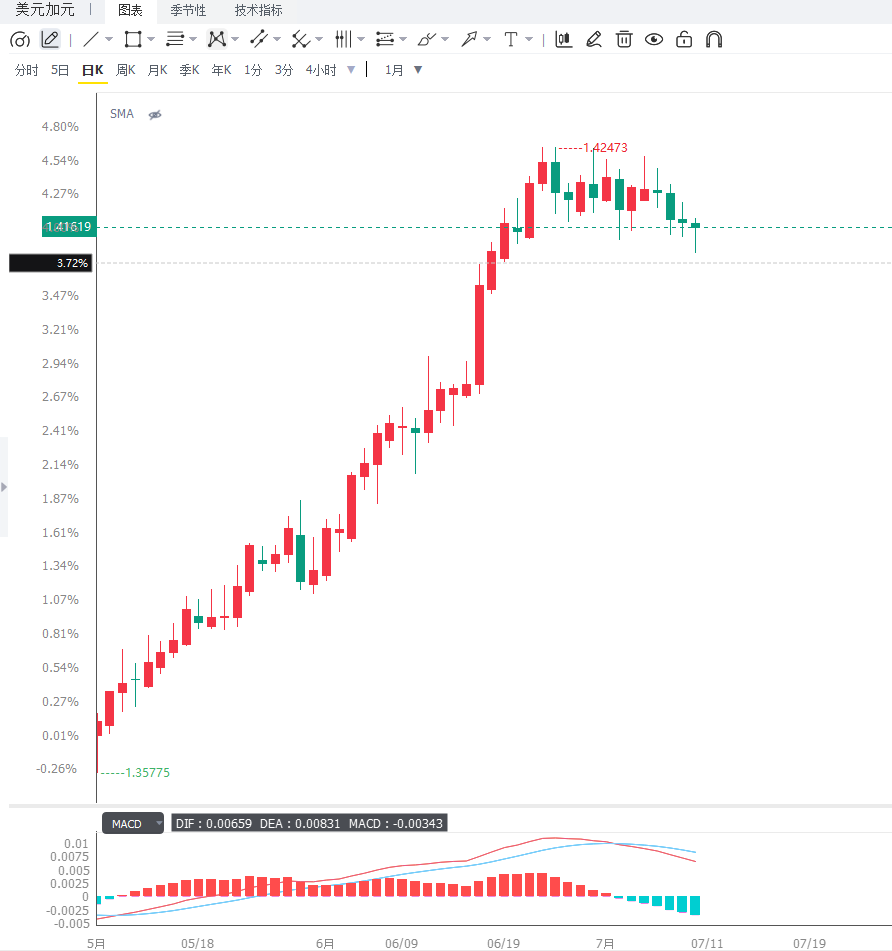
From a daily chart perspective, USD/CAD has maintained a downward trend recently, currently trading around 1.4160, with short-term bears in control. The moving average system shows the price gradually breaking below short-term moving averages, indicating weak market momentum. Support levels to watch are around 1.4120, with further support at 1.4080 and 1.4050. Resistance is seen in the 1.4180-1.4200 area; a break above this level could lead to a test of the 1.4250 area. The MACD indicator suggests increasing bearish momentum, but a rebound should be anticipated near key support levels.
From a 4-hour chart perspective, USD/CAD is showing a short-term downward trend, with the price trading below the moving average, indicating continued selling pressure. The RSI indicator is in weak territory, suggesting bearish market sentiment, but it is also approaching oversold levels, suggesting a potential short-term technical correction. If the exchange rate breaks below 1.4120, it could open up further downside potential; if it rebounds above 1.4180, the short-term pullback pressure may ease.
Editor's Summary
The recent weakness in USD/CAD is mainly due to declining expectations of US interest rates and support for the Canadian dollar from rising oil prices. Canada's energy export advantage makes oil prices a significant factor influencing exchange rates, while the future policy path of the Federal Reserve will still determine the medium-term direction of the US dollar. In the short term, if oil prices continue to be supported by supply risks, and expectations of a Fed rate hike further cool, USD/CAD may continue to test lower support levels. However, if easing Middle East risks lead to a decline in oil prices, or if US inflation data strengthens again, the USD/CAD exchange rate may regain upward momentum. Investors should pay close attention to changes in the energy market, Fed policy signals, and global risk sentiment.
However, market bets on short-term policy adjustments by the Federal Reserve have decreased. According to market pricing tools, investors' expectations for a 25 basis point rate hike by the Fed in July have fallen from approximately 31% to 24.6%; expectations for a rate hike at the September meeting have also dropped from 66.6% to 62.3%. This reduced market expectations for Fed rate hikes has become a significant factor in the recent weakening of the US dollar.
New York Federal Reserve President John Williams stated that despite the ongoing tensions in the Middle East, he does not believe energy prices will continue to rise significantly for the remainder of the year. This view alleviated some investors' concerns about long-term inflationary pressures and also influenced expectations for US dollar interest rates. Meanwhile, the Canadian dollar was supported by oil prices. Due to disruptions in shipping activity across the Strait of Hormuz, the market remains focused on global energy supply risks, and international oil prices remain relatively high. Recent developments in the Middle East have increased volatility in the energy market, and rising oil prices have boosted expectations for Canadian export revenue.
Canada is one of the world's major crude oil exporters, so rising oil prices typically benefit the Canadian dollar. High energy prices have boosted expectations of Canadian trade revenue, providing additional support for the Canadian dollar and pushing USD/CAD down in the short term. However, the impact of rising oil prices on global inflation remains a key market focus. If energy prices continue to rise, it could force major central banks to maintain higher interest rates, thereby re-influencing the US dollar's trajectory. Furthermore, uncertainty remains regarding the Middle East situation, and any escalation of risks could alter market fund flows.
The current USD/CAD exchange rate is influenced by both a weaker US dollar and support from oil prices. On the one hand, declining expectations of a Fed rate hike have diminished the dollar's appeal; on the other hand, Canada's energy advantages have strengthened the Canadian dollar. However, if the market re-emphasizes expectations of Fed tightening in the future, the US dollar may still have a chance to rebound.
From a daily chart perspective, USD/CAD has maintained a downward trend recently, currently trading around 1.4160, with short-term bears in control. The moving average system shows the price gradually breaking below short-term moving averages, indicating weak market momentum. Support levels to watch are around 1.4120, with further support at 1.4080 and 1.4050. Resistance is seen in the 1.4180-1.4200 area; a break above this level could lead to a test of the 1.4250 area. The MACD indicator suggests increasing bearish momentum, but a rebound should be anticipated near key support levels.
From a 4-hour chart perspective, USD/CAD is showing a short-term downward trend, with the price trading below the moving average, indicating continued selling pressure. The RSI indicator is in weak territory, suggesting bearish market sentiment, but it is also approaching oversold levels, suggesting a potential short-term technical correction. If the exchange rate breaks below 1.4120, it could open up further downside potential; if it rebounds above 1.4180, the short-term pullback pressure may ease.
Editor's Summary
The recent weakness in USD/CAD is mainly due to declining expectations of US interest rates and support for the Canadian dollar from rising oil prices. Canada's energy export advantage makes oil prices a significant factor influencing exchange rates, while the future policy path of the Federal Reserve will still determine the medium-term direction of the US dollar. In the short term, if oil prices continue to be supported by supply risks, and expectations of a Fed rate hike further cool, USD/CAD may continue to test lower support levels. However, if easing Middle East risks lead to a decline in oil prices, or if US inflation data strengthens again, the USD/CAD exchange rate may regain upward momentum. Investors should pay close attention to changes in the energy market, Fed policy signals, and global risk sentiment.
- Risk Warning and Disclaimer
- The market involves risk, and trading may not be suitable for all investors. This article is for reference only and does not constitute personal investment advice, nor does it take into account certain users’ specific investment objectives, financial situation, or other needs. Any investment decisions made based on this information are at your own risk.