Geopolitical risks and high interest rates are creating dual pressures, hindering the gold price rebound, but the medium-term outlook remains supportive.
2026-07-10 15:42:58
The gold market has recently faced a confluence of factors, weakening its short-term rebound momentum. Pepperstone research strategist Ahmed Asiri stated that gold is currently under pressure from both geopolitical tensions and a high-interest-rate environment, with declining market risk appetite diminishing the recent recovery in precious metals.

Recent tensions between the US and Iran have reignited risk aversion in global markets, but gold has not seen sustained upward momentum. This is primarily because investors are also focused on changes in the interest rate environment. The market believes that while geopolitical risks enhance gold's safe-haven appeal, if these events drive up energy prices and further impact inflation expectations, it could prompt major central banks to maintain restrictive monetary policies for an extended period.
High US Treasury yields and uncertainty surrounding the Federal Reserve's policy path are significant factors limiting gold's rise . Since gold itself does not generate interest, the opportunity cost of holding gold increases when real yields remain high, suppressing investors' willingness to establish large long positions. Asiri points out that renewed tensions between the US and Iran have already impacted overall market confidence and weakened gold's recent rebound. Furthermore, rising energy prices may delay the global anti-inflation process, causing the market to reassess the future direction of monetary policy.
If oil prices continue to rise and drive up inflationary pressures, the Federal Reserve may need to maintain a more cautious pace of interest rate cuts, which will continue to put pressure on gold. However, from a medium-term perspective, gold still has some supporting factors, including global economic uncertainty, central bank asset allocation needs, and market expectations for a future shift in monetary policy.
Compared to the sharp sell-off gold faced in previous weeks, market sentiment has improved. Investors are awaiting more economic data to confirm the Federal Reserve's policy direction, paying particular attention to US inflation data, the performance of the labor market, and changes in US Treasury yields.
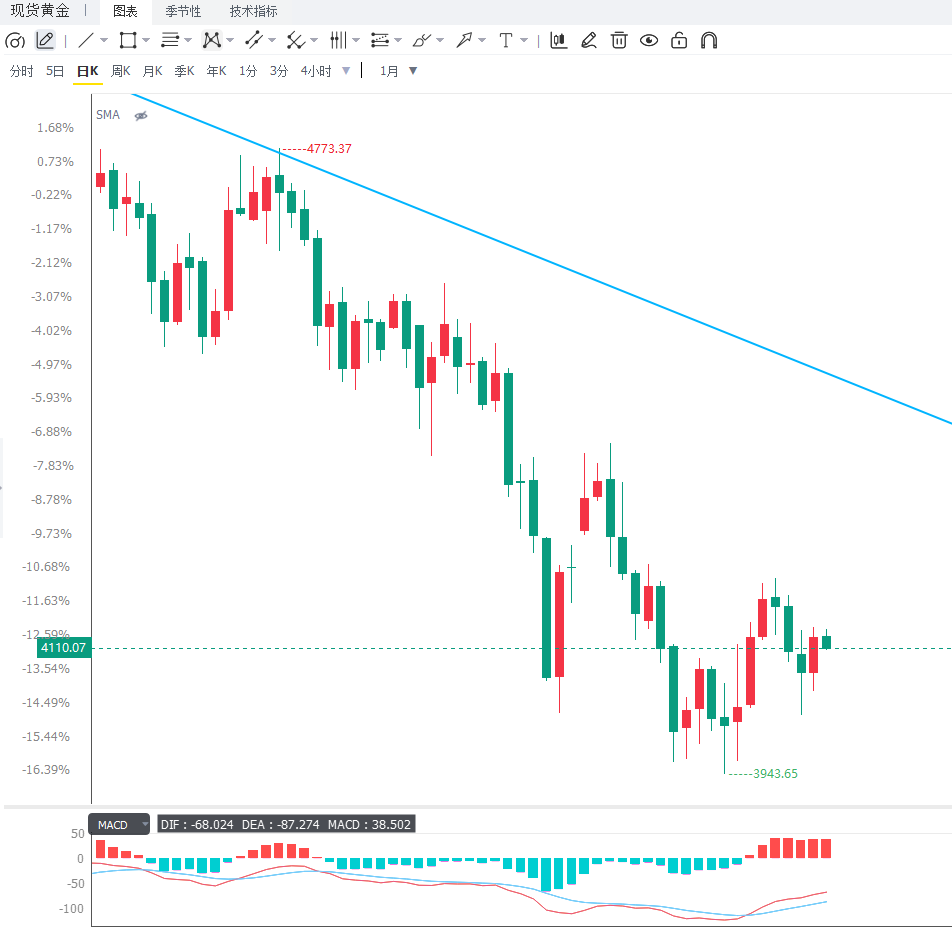
From a technical perspective, gold is still in a short-term corrective phase. On the daily chart, although gold prices are under pressure, they are generally maintaining a high-level consolidation pattern. Resistance is seen in the $4150-$4180 area; a break above this area could lead to a retest of the $4200 level. Support is seen at $4080, $4050, and the $4000 area. A break below $4000 could further confirm the short-term correction trend.
From a 4-hour chart perspective, gold prices have recently been fluctuating around $4100, with short-term bullish and bearish forces relatively balanced. The moving average system is converging, indicating the market is awaiting a new directional signal. The MACD indicator shows that rebound momentum has recovered somewhat, but a strong upward structure has not yet formed. If the price breaks through the resistance around $4150, it may open up upward potential in the short term; if it falls below $4050, it may retest the lower support level.
Editor's Summary : Gold is currently in a phase of balancing safe-haven demand and high interest rate pressures. While geopolitical risks provide support for gold, inflationary pressures from rising energy prices and uncertainty surrounding Federal Reserve policy are keeping short-term investors cautious. In the medium to long term, gold still possesses certain investment value, especially against the backdrop of increasing global economic uncertainty and the potential for gradual adjustments to monetary policy. However, short-term trends still depend on changes in the US dollar, US Treasury yields, and inflation data. The market will need to focus on signals from the Federal Reserve's policy and whether geopolitical risks escalate further, as these will determine the next direction for gold.
Recent tensions between the US and Iran have reignited risk aversion in global markets, but gold has not seen sustained upward momentum. This is primarily because investors are also focused on changes in the interest rate environment. The market believes that while geopolitical risks enhance gold's safe-haven appeal, if these events drive up energy prices and further impact inflation expectations, it could prompt major central banks to maintain restrictive monetary policies for an extended period.
High US Treasury yields and uncertainty surrounding the Federal Reserve's policy path are significant factors limiting gold's rise . Since gold itself does not generate interest, the opportunity cost of holding gold increases when real yields remain high, suppressing investors' willingness to establish large long positions. Asiri points out that renewed tensions between the US and Iran have already impacted overall market confidence and weakened gold's recent rebound. Furthermore, rising energy prices may delay the global anti-inflation process, causing the market to reassess the future direction of monetary policy.
If oil prices continue to rise and drive up inflationary pressures, the Federal Reserve may need to maintain a more cautious pace of interest rate cuts, which will continue to put pressure on gold. However, from a medium-term perspective, gold still has some supporting factors, including global economic uncertainty, central bank asset allocation needs, and market expectations for a future shift in monetary policy.
Compared to the sharp sell-off gold faced in previous weeks, market sentiment has improved. Investors are awaiting more economic data to confirm the Federal Reserve's policy direction, paying particular attention to US inflation data, the performance of the labor market, and changes in US Treasury yields.
From a technical perspective, gold is still in a short-term corrective phase. On the daily chart, although gold prices are under pressure, they are generally maintaining a high-level consolidation pattern. Resistance is seen in the $4150-$4180 area; a break above this area could lead to a retest of the $4200 level. Support is seen at $4080, $4050, and the $4000 area. A break below $4000 could further confirm the short-term correction trend.
From a 4-hour chart perspective, gold prices have recently been fluctuating around $4100, with short-term bullish and bearish forces relatively balanced. The moving average system is converging, indicating the market is awaiting a new directional signal. The MACD indicator shows that rebound momentum has recovered somewhat, but a strong upward structure has not yet formed. If the price breaks through the resistance around $4150, it may open up upward potential in the short term; if it falls below $4050, it may retest the lower support level.
Editor's Summary : Gold is currently in a phase of balancing safe-haven demand and high interest rate pressures. While geopolitical risks provide support for gold, inflationary pressures from rising energy prices and uncertainty surrounding Federal Reserve policy are keeping short-term investors cautious. In the medium to long term, gold still possesses certain investment value, especially against the backdrop of increasing global economic uncertainty and the potential for gradual adjustments to monetary policy. However, short-term trends still depend on changes in the US dollar, US Treasury yields, and inflation data. The market will need to focus on signals from the Federal Reserve's policy and whether geopolitical risks escalate further, as these will determine the next direction for gold.
- Risk Warning and Disclaimer
- The market involves risk, and trading may not be suitable for all investors. This article is for reference only and does not constitute personal investment advice, nor does it take into account certain users’ specific investment objectives, financial situation, or other needs. Any investment decisions made based on this information are at your own risk.