Canadian employment data wins on the surface: Why is the Canadian dollar still stuck around 1.41?
2026-07-10 22:04:32
On Friday, July 10, Canada reported a net increase of 18,200 jobs in June, exceeding the expected 10,000. The unemployment rate fell from 6.6% to 6.5%, the labor force participation rate remained at 65%, and the employment rate rose to 60.8%. However, part-time employment increased by 17,500, while full-time employment remained largely unchanged. This suggests that the improvement is closer to stability in a low-population-growth environment than a broad-based expansion in demand. The increase in labor income and the consumption multiplier may also be weaker than the overall employment figures indicate.
Wholesale and retail employment increased by 16,400, and accommodation and food services employment increased by 14,700; the goods-producing sector lost 43,700 jobs, including a 16,800 loss in manufacturing. Manufacturing has lost approximately 61,000 jobs since January 2025, indicating that external demand, costs, and trade uncertainty continue to weigh on tradable sectors. Public sector employment decreased by 30,500, while private sector employment increased by 31,600; however, the service-oriented and part-time nature of private sector jobs limits the quality of the data.

Following the release of the jobs report, the Canadian dollar strengthened, and the yield on 2-year Canadian government bonds rose slightly to approximately 2.408%, reflecting a reduction in the market's expectation of a near-term rate cut, rather than a significant increase in pricing in a rate hike. The current policy rate is 2.25%, and the Bank of Canada will announce its next interest rate decision on July 15. The June meeting marked the fifth consecutive time the rate was kept unchanged, and the latest data increases the credibility of a sixth instance of no change. The Canadian dollar had previously been pressured by weak growth and unfavorable interest rate differentials; as long as the employment situation does not continue to deteriorate, the market will likely rebalance some of its expectations for further easing.
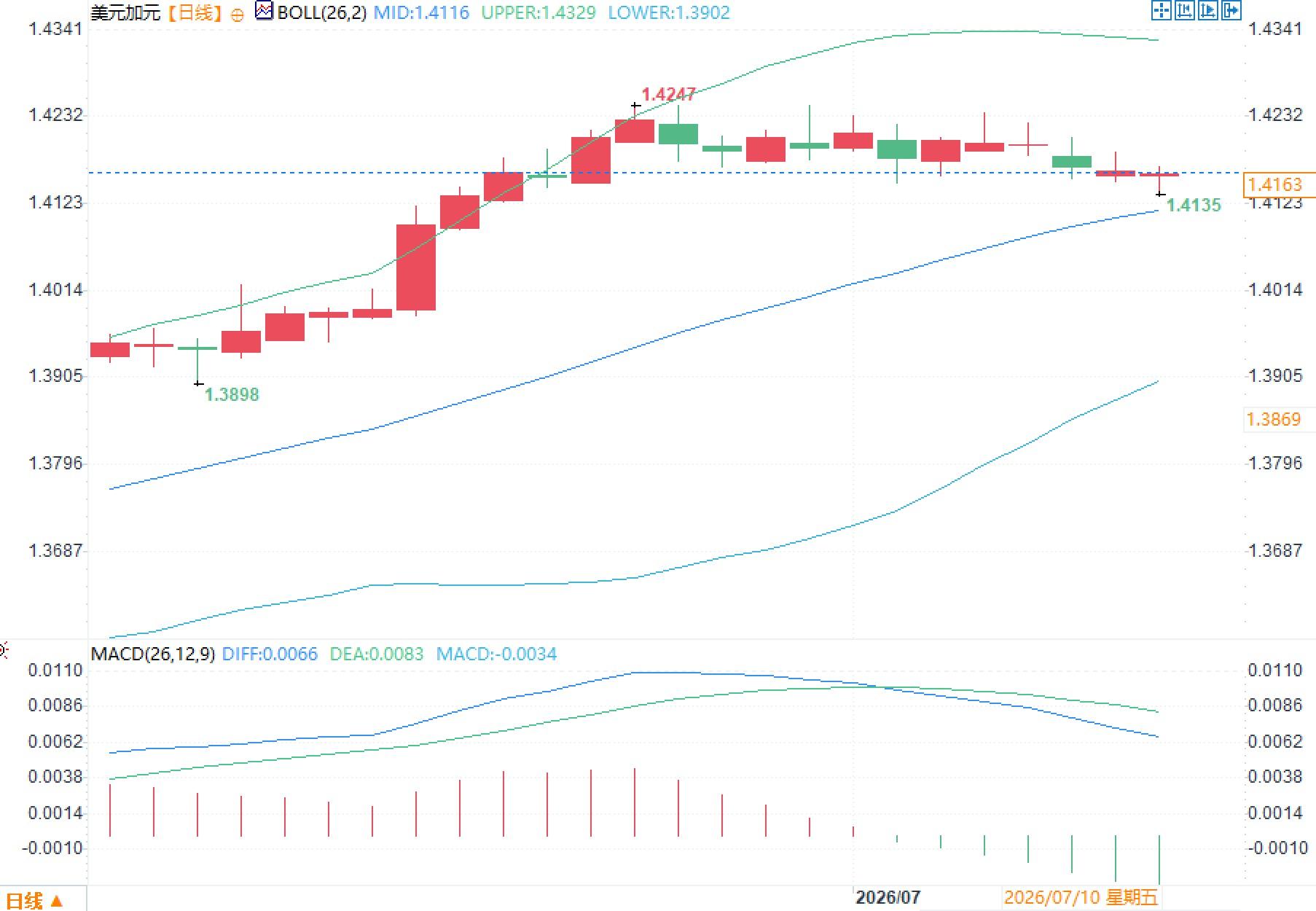
However, the USD/CAD pair remains above 1.41, indicating that labor market data has not yet altered the broader relative interest rate landscape. Oil prices have both improved energy export revenues and increased inflation risks, thus providing the Canadian dollar with support from both commodity attributes and interest rate expectations; however, both of these factors are highly volatile.
The Consumer Price Index (CPI) rose 3.2% year-on-year in May, up from 2.8% in April. Gasoline prices rose 33.2% year-on-year, the main driver of the accelerated overall inflation. Excluding gasoline, inflation was 2.2%, indicating that the pressure has not yet fully spread. In June, the year-on-year growth rate of hourly wages for permanent employees rose to 3.7%, while the growth rate of broad average hourly wages was approximately 3.3%, indicating a moderate wage recovery, but this has not yet reinforced the labor shortage.
China's real GDP grew 0.5% month-on-month in April, and preliminary estimates for May are 0.1%. However, business surveys indicate weakening confidence, slower sales expectations, and lower-than-average employment intentions, with most companies still having spare capacity. Businesses are increasingly expecting increases in input and sales prices, and residents' concerns about inflation exceeding 3% over the next year have also risen slightly. Economic activity is insufficient to support proactive tightening, and energy prices have raised the threshold for an early interest rate cut; the baseline scenario remains at 2.25%. The policy statement warrants closer attention regarding energy transmission, wage stickiness, and excess capacity.
Frequently Asked Questions Question 1: Why can't the increase of 18,200 jobs in Canada be directly regarded as a strong recovery?
A: Almost all new jobs were created part-time, with significant reductions in workforce in goods production and manufacturing, while the service sector and periodic consumer demand contributed more. The data shows that the labor market has not deteriorated rapidly, but it is not enough to indicate that businesses have entered a period of widespread expansion.
Question 2: Does the strengthening of the Canadian dollar mean that the market has shifted to expectations of interest rate hikes?
A: A more accurate explanation is that the probability of a recent interest rate cut has decreased. Short-term yields have only risen slightly, the policy rate is still higher than the 2-year Treasury yield, the market has not yet formed a sustained interest rate hike path, and current pricing is still centered on the interest rate being maintained on July 15.
Question 3: Which variables are most likely to change market sentiment next?
A: The key factors are June inflation, the duration of energy price increases, and whether full-time employment and manufacturing jobs can recover. If inflation spreads while employment remains stable, the policy tone may be more cautious; if energy prices fall and domestic demand remains weak, expectations for easing may re-emerge.
Wholesale and retail employment increased by 16,400, and accommodation and food services employment increased by 14,700; the goods-producing sector lost 43,700 jobs, including a 16,800 loss in manufacturing. Manufacturing has lost approximately 61,000 jobs since January 2025, indicating that external demand, costs, and trade uncertainty continue to weigh on tradable sectors. Public sector employment decreased by 30,500, while private sector employment increased by 31,600; however, the service-oriented and part-time nature of private sector jobs limits the quality of the data.
Following the release of the jobs report, the Canadian dollar strengthened, and the yield on 2-year Canadian government bonds rose slightly to approximately 2.408%, reflecting a reduction in the market's expectation of a near-term rate cut, rather than a significant increase in pricing in a rate hike. The current policy rate is 2.25%, and the Bank of Canada will announce its next interest rate decision on July 15. The June meeting marked the fifth consecutive time the rate was kept unchanged, and the latest data increases the credibility of a sixth instance of no change. The Canadian dollar had previously been pressured by weak growth and unfavorable interest rate differentials; as long as the employment situation does not continue to deteriorate, the market will likely rebalance some of its expectations for further easing.
However, the USD/CAD pair remains above 1.41, indicating that labor market data has not yet altered the broader relative interest rate landscape. Oil prices have both improved energy export revenues and increased inflation risks, thus providing the Canadian dollar with support from both commodity attributes and interest rate expectations; however, both of these factors are highly volatile.
The Consumer Price Index (CPI) rose 3.2% year-on-year in May, up from 2.8% in April. Gasoline prices rose 33.2% year-on-year, the main driver of the accelerated overall inflation. Excluding gasoline, inflation was 2.2%, indicating that the pressure has not yet fully spread. In June, the year-on-year growth rate of hourly wages for permanent employees rose to 3.7%, while the growth rate of broad average hourly wages was approximately 3.3%, indicating a moderate wage recovery, but this has not yet reinforced the labor shortage.
China's real GDP grew 0.5% month-on-month in April, and preliminary estimates for May are 0.1%. However, business surveys indicate weakening confidence, slower sales expectations, and lower-than-average employment intentions, with most companies still having spare capacity. Businesses are increasingly expecting increases in input and sales prices, and residents' concerns about inflation exceeding 3% over the next year have also risen slightly. Economic activity is insufficient to support proactive tightening, and energy prices have raised the threshold for an early interest rate cut; the baseline scenario remains at 2.25%. The policy statement warrants closer attention regarding energy transmission, wage stickiness, and excess capacity.
Frequently Asked Questions Question 1: Why can't the increase of 18,200 jobs in Canada be directly regarded as a strong recovery?
A: Almost all new jobs were created part-time, with significant reductions in workforce in goods production and manufacturing, while the service sector and periodic consumer demand contributed more. The data shows that the labor market has not deteriorated rapidly, but it is not enough to indicate that businesses have entered a period of widespread expansion.
Question 2: Does the strengthening of the Canadian dollar mean that the market has shifted to expectations of interest rate hikes?
A: A more accurate explanation is that the probability of a recent interest rate cut has decreased. Short-term yields have only risen slightly, the policy rate is still higher than the 2-year Treasury yield, the market has not yet formed a sustained interest rate hike path, and current pricing is still centered on the interest rate being maintained on July 15.
Question 3: Which variables are most likely to change market sentiment next?
A: The key factors are June inflation, the duration of energy price increases, and whether full-time employment and manufacturing jobs can recover. If inflation spreads while employment remains stable, the policy tone may be more cautious; if energy prices fall and domestic demand remains weak, expectations for easing may re-emerge.
- Risk Warning and Disclaimer
- The market involves risk, and trading may not be suitable for all investors. This article is for reference only and does not constitute personal investment advice, nor does it take into account certain users’ specific investment objectives, financial situation, or other needs. Any investment decisions made based on this information are at your own risk.