One chart: Baltic Dry Index rises weekly; strong performance of Capesize vessels leads market upward.
2026-07-10 23:48:25
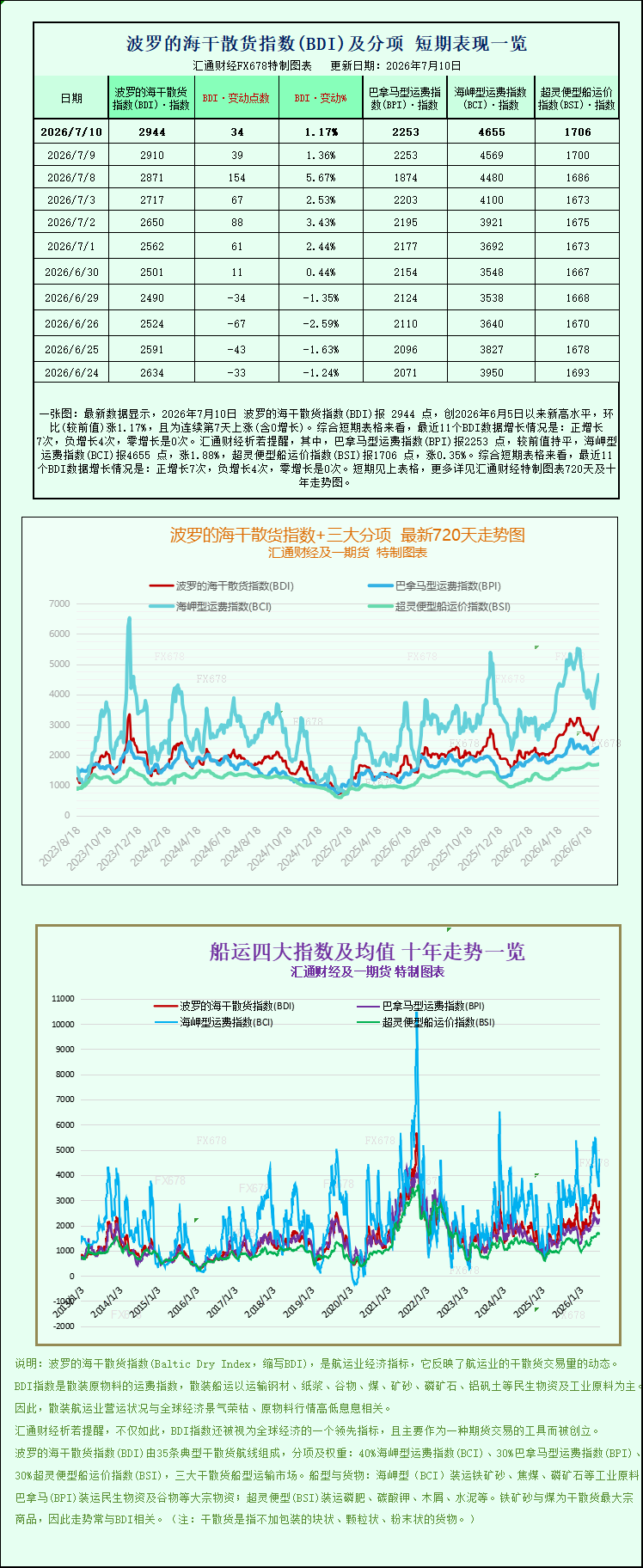
The latest data shows that the Baltic Dry Index (BDI) reached 2944 points on July 10, 2026, a new high since June 5, 2026, up 1.17% month-on-month, marking the 7th consecutive day of increase (including zero growth). Looking at the short-term charts, the recent 11 BDI data points show: 7 positive increases, 4 negative increases, and 0 zero increases. Specifically, the Panamax Freight Index (BPI) was 2253 points, unchanged from the previous value; the Capesize Freight Index (BCI) was 4655 points, up 1.88%; and the Supramax Freight Index (BSI) was 1706 points, up 0.35%. For detailed 720-day and 10-year trend charts of the Baltic Dry Index and its three main sub-indices, please refer to the specially designed charts.
The international dry bulk shipping market has recently seen a significant recovery, with the Baltic Dry Index continuing its upward trend on Friday, successfully achieving a weekly gain. The core driver of this market rebound is the substantial strengthening of Capesize vessel freight rates, coupled with positive support from the iron ore spot market and a recovery in global bulk cargo trade demand, leading to an overall positive market trend across all dry bulk vessel types. This sustained recovery in the shipping market's prosperity has laid a solid foundation for a strong start to the third quarter.
Data shows that the Baltic Dry Index (BADI), which tracks freight rates for the three major dry bulk carrier types—Capesize, Panamax, and Supramax—rose unilaterally on Friday, climbing 34 points, or 1.2%, to close at 2944 points. On a weekly basis, the index saw a cumulative increase of 8.4% this week, demonstrating a strong rebound and ending the previous weak market trend, fully reflecting the overall recovery in demand in the dry bulk shipping market. The indices for different vessel types showed significant divergence, with major carriers leading the gains, and large Capesize vessels becoming the absolute core pillar of this market rally.
As the core vessel type carrying ultra-large bulk cargoes such as iron ore and coal, the Capesize market performed particularly well this week, with gains far exceeding those of other vessel types. The Baltic Capesize Index (BACI) rose 86 points on Friday, a single-day increase of 1.9%, closing firmly above the 4655-point mark; the cumulative weekly gain surged to 13.5%, becoming the core driver of the overall market index's rise. Revenue data also confirms the strong performance of Capesize vessels. The average daily revenue of Capesize vessels on the spot shipping route (BATCA), which mainly transports 150,000-ton iron ore and ocean-going coal, increased by $780 per day, reaching a latest daily revenue of $38,711. The profitability per vessel continues to climb, and the profitability of shipping companies has significantly improved.
The strong rebound in Capesize vessel prices is inextricably linked to favorable support from the upstream iron ore spot market. International iron ore futures prices rose in tandem on Friday, with improved supply and demand fundamentals providing solid support for the shipping market. Specifically, Australian mines entered a seasonal decline in shipments, slowing the pace of spot iron ore supply in the short term and leading to a continued rise in market freight premiums. Simultaneously, major Chinese ports began a destocking cycle, with port iron ore inventories continuing to decline, and downstream steel companies gradually releasing their restocking demand, driving a concentrated recovery in demand for ocean-going iron ore orders. As the core cargo type transported by Capesize vessels, the recovery in iron ore trade directly boosted demand for large dry bulk carriers, pushing freight rates higher. Meanwhile, stable global energy demand and resilient international coal demand in the ocean further solidified the market fundamentals for Capesize vessels.
The medium-sized Panamax market remained relatively stable this week, underperforming the large Capesize market. Data shows that the Panamax Index (BPNI) was essentially flat on Friday, closing at 2253 points with no significant daily fluctuations, but still achieving a cumulative weekly gain of 2.3%, maintaining a steady recovery trend. This vessel type mainly transports 60,000 to 70,000 tons of bulk cargo such as thermal coal and grain. Its average daily revenue declined slightly, with the latest daily revenue falling to around US$20,273. The core reason for the stable market is that the global grain trade has stabilized, coal procurement demand in the Asia-Pacific and Europe/America regions has recovered moderately, and the overall supply and demand situation is relatively balanced without significant fluctuations, thus the market is mainly characterized by steady growth.
The small Supramax vessel market continued its moderate upward trend, maintaining a steady pace. The Baltic Supramax Index (BSIS) rose slightly by 6 points on Friday, a daily increase of 0.4%, closing at 1706 points, with a cumulative weekly gain of 2%, achieving a steady climb. Smaller vessels, with their advantages of flexible transport and suitability for short-haul and regional trade, have seen a continued slight recovery, supported by global regional bulk cargo trade and demand for small-volume coal and building material transportation. Although the increase was not as large as that of larger vessels, the market showed strong resilience and an overall recovery trend.
Overall, the Baltic Dry Market this week exhibited a structural trend of "large vessels leading the gains, while medium and small vessels saw steady increases." Capesize vessels experienced explosive growth driven by improved iron ore fundamentals, contributing to a significant rise in the overall market index. Currently, global bulk commodity trade demand continues to recover, domestic port destocking and downstream restocking are ongoing, and coupled with the support of overseas seasonal trade cycles, the fundamentals of the dry bulk shipping market remain positive. Going forward, the market should focus on changes in Sino-Australian iron ore shipping orders, global coal demand fluctuations, and international commodity price volatility. These factors will continue to dominate freight rate trends, and the recovery trend in the shipping market is expected to continue.
The international dry bulk shipping market has recently seen a significant recovery, with the Baltic Dry Index continuing its upward trend on Friday, successfully achieving a weekly gain. The core driver of this market rebound is the substantial strengthening of Capesize vessel freight rates, coupled with positive support from the iron ore spot market and a recovery in global bulk cargo trade demand, leading to an overall positive market trend across all dry bulk vessel types. This sustained recovery in the shipping market's prosperity has laid a solid foundation for a strong start to the third quarter.
Data shows that the Baltic Dry Index (BADI), which tracks freight rates for the three major dry bulk carrier types—Capesize, Panamax, and Supramax—rose unilaterally on Friday, climbing 34 points, or 1.2%, to close at 2944 points. On a weekly basis, the index saw a cumulative increase of 8.4% this week, demonstrating a strong rebound and ending the previous weak market trend, fully reflecting the overall recovery in demand in the dry bulk shipping market. The indices for different vessel types showed significant divergence, with major carriers leading the gains, and large Capesize vessels becoming the absolute core pillar of this market rally.
As the core vessel type carrying ultra-large bulk cargoes such as iron ore and coal, the Capesize market performed particularly well this week, with gains far exceeding those of other vessel types. The Baltic Capesize Index (BACI) rose 86 points on Friday, a single-day increase of 1.9%, closing firmly above the 4655-point mark; the cumulative weekly gain surged to 13.5%, becoming the core driver of the overall market index's rise. Revenue data also confirms the strong performance of Capesize vessels. The average daily revenue of Capesize vessels on the spot shipping route (BATCA), which mainly transports 150,000-ton iron ore and ocean-going coal, increased by $780 per day, reaching a latest daily revenue of $38,711. The profitability per vessel continues to climb, and the profitability of shipping companies has significantly improved.
The strong rebound in Capesize vessel prices is inextricably linked to favorable support from the upstream iron ore spot market. International iron ore futures prices rose in tandem on Friday, with improved supply and demand fundamentals providing solid support for the shipping market. Specifically, Australian mines entered a seasonal decline in shipments, slowing the pace of spot iron ore supply in the short term and leading to a continued rise in market freight premiums. Simultaneously, major Chinese ports began a destocking cycle, with port iron ore inventories continuing to decline, and downstream steel companies gradually releasing their restocking demand, driving a concentrated recovery in demand for ocean-going iron ore orders. As the core cargo type transported by Capesize vessels, the recovery in iron ore trade directly boosted demand for large dry bulk carriers, pushing freight rates higher. Meanwhile, stable global energy demand and resilient international coal demand in the ocean further solidified the market fundamentals for Capesize vessels.
The medium-sized Panamax market remained relatively stable this week, underperforming the large Capesize market. Data shows that the Panamax Index (BPNI) was essentially flat on Friday, closing at 2253 points with no significant daily fluctuations, but still achieving a cumulative weekly gain of 2.3%, maintaining a steady recovery trend. This vessel type mainly transports 60,000 to 70,000 tons of bulk cargo such as thermal coal and grain. Its average daily revenue declined slightly, with the latest daily revenue falling to around US$20,273. The core reason for the stable market is that the global grain trade has stabilized, coal procurement demand in the Asia-Pacific and Europe/America regions has recovered moderately, and the overall supply and demand situation is relatively balanced without significant fluctuations, thus the market is mainly characterized by steady growth.
The small Supramax vessel market continued its moderate upward trend, maintaining a steady pace. The Baltic Supramax Index (BSIS) rose slightly by 6 points on Friday, a daily increase of 0.4%, closing at 1706 points, with a cumulative weekly gain of 2%, achieving a steady climb. Smaller vessels, with their advantages of flexible transport and suitability for short-haul and regional trade, have seen a continued slight recovery, supported by global regional bulk cargo trade and demand for small-volume coal and building material transportation. Although the increase was not as large as that of larger vessels, the market showed strong resilience and an overall recovery trend.
Overall, the Baltic Dry Market this week exhibited a structural trend of "large vessels leading the gains, while medium and small vessels saw steady increases." Capesize vessels experienced explosive growth driven by improved iron ore fundamentals, contributing to a significant rise in the overall market index. Currently, global bulk commodity trade demand continues to recover, domestic port destocking and downstream restocking are ongoing, and coupled with the support of overseas seasonal trade cycles, the fundamentals of the dry bulk shipping market remain positive. Going forward, the market should focus on changes in Sino-Australian iron ore shipping orders, global coal demand fluctuations, and international commodity price volatility. These factors will continue to dominate freight rate trends, and the recovery trend in the shipping market is expected to continue.
- Risk Warning and Disclaimer
- The market involves risk, and trading may not be suitable for all investors. This article is for reference only and does not constitute personal investment advice, nor does it take into account certain users’ specific investment objectives, financial situation, or other needs. Any investment decisions made based on this information are at your own risk.