July 13 Financial Breakfast: Gold bulls face a dilemma as the US and Iran clash over the weekend, with Iran issuing a strong statement that "non-compliance with the agreement will be met with retaliation," causing oil prices to surge.
2026-07-13 07:19:32
On Monday (July 13, Beijing time) in early Asian trading, spot gold was trading around $4,070 per ounce, as the escalation of tensions between the US and Iran over the weekend strengthened inflation expectations, which in turn solidified market expectations for the Federal Reserve to tighten monetary policy, thus limiting gold's gains. US crude oil opened more than 3% higher, trading around $73.66 per barrel. Over the weekend, the US launched three rounds of attacks on Iran, and the Iranian Revolutionary Guard announced the closure of the Strait of Hormuz. At the same time, the Iranian Foreign Ministry responded to the US, stating that non-compliance with the agreement would inevitably lead to retaliation.


U.S. stocks rose on Friday, with the S&P 500 closing up 0.42% at 7,575.39, just 0.45% shy of its record closing high set on June 2. The Nasdaq and Dow Jones Industrial Average rose 0.29% to close at 26,281.61 and 52,637.01, respectively. For the week, the S&P 500 gained 1.2%, the Nasdaq climbed 1.7%, and the Dow fell slightly by 0.5%.
Artificial intelligence trading has returned to the spotlight, with South Korea's SK Hynix making a high-profile debut on Nasdaq. Its American Depositary Receipts (ADRs) were priced at $149 per share, raising over $26 billion. The ADRs closed at $170 on their first day of trading, 13% higher than the offering price. This high-profile debut boosted market optimism for memory chip manufacturers, and the Philadelphia Semiconductor Index rose for the third consecutive trading day, gaining 0.06%.
Investors are awaiting the start of the second-quarter earnings season next week, with major U.S. banks leading the way with their results. Analysts expect S&P 500 companies to see a 24% year-over-year increase in earnings, with technology companies expected to be the main driver of growth. Terry Sandven, chief equity strategist at Bank of America Wealth Management, points out that this quarter's earnings threshold is very high and there is little room for error. Bank earnings will help provide insights into economic strength and consumer and business trends.
The June inflation data to be released this week will provide new clues to the direction of the Federal Reserve's monetary policy. Meanwhile, Federal Reserve Chairman Warsh is scheduled to testify before the House Financial Services Committee, and the market will continue to assess economic fundamentals and policy prospects.
Spot gold fell 1.34% last week, closing below $4,120 per ounce. Escalating tensions between the US and Iran led investors to avoid precious metals, while supply concerns pushed up oil prices and strengthened inflation expectations, thereby reinforcing market expectations for the Federal Reserve to tighten monetary policy.
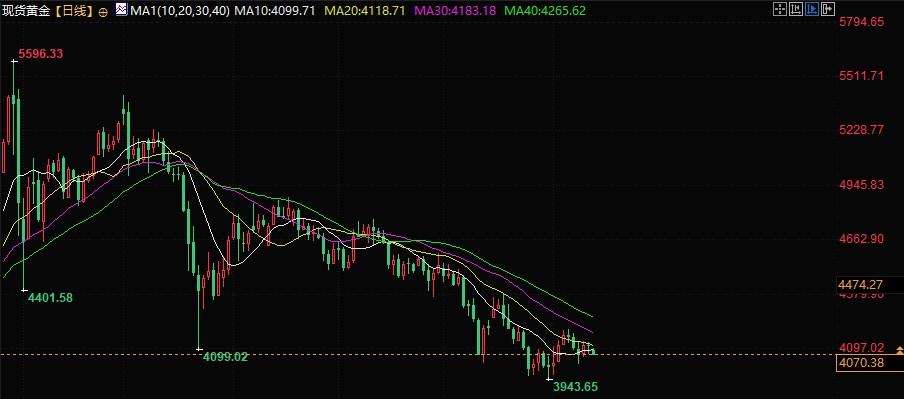
Bart Melek, global head of commodities strategy at TD Securities, pointed out that the renewed escalation of tensions between the US and Iran has made investors generally unwilling to hold gold and silver, which is the main reason for the decline in gold prices towards the $4,100 level. The firm also stated that the recent escalation of hostility between the US and Iran may overturn the International Energy Agency's forecast of a significant surplus in the oil market next year. Rising energy prices have further exacerbated inflation concerns and strengthened expectations of central bank interest rate hikes. The CME FedWatch tool shows that traders currently expect a 69% probability of a rate hike in September.
Investors are closely watching this week's inflation data and Federal Reserve Chairman Warsh's testimony for further clues about the direction of monetary policy. Meanwhile, gold prices traded at a significant discount in the Indian market last week, while demand in the Chinese market remained stable after the People's Bank of China reported that its gold reserves saw their largest monthly increase in over two and a half years in June. In other precious metals, spot silver fell 0.7% to $59.56, platinum rose 0.4% to $1616.72, and palladium rose 2.2% to $1274.50.
Oil prices rose sharply last week, with Brent crude up 5.65% to settle at $75.99 a barrel and WTI crude up nearly 4%, although it fell slightly on Friday to settle at $71.51 a barrel. This pattern of "Friday pullback followed by a big weekly gain" clearly reflects the market's back-and-forth struggle between geopolitical risk premiums and short-term easing signals.
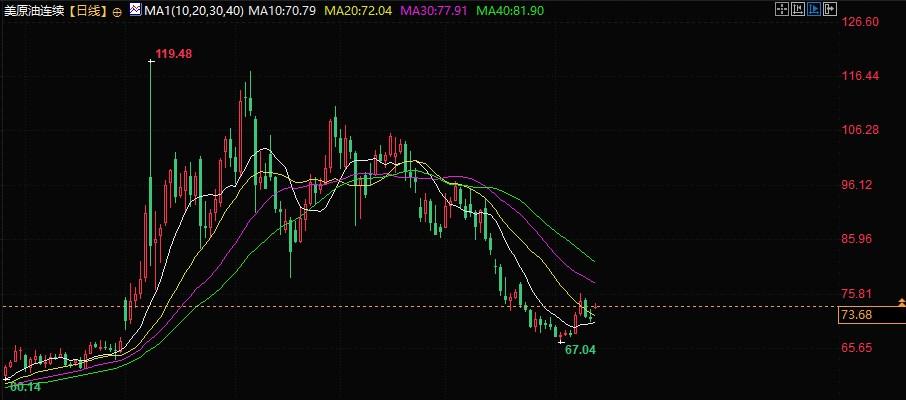
Tensions between the US and Iran escalated again over the weekend. At 2:45 a.m. local time on July 12, US Central Command forces, acting on orders from US President Trump, launched the third round of attacks against Iran this week.
The Iranian Islamic Revolutionary Guard Corps Navy announced early on the 12th that the Strait of Hormuz would be closed immediately, and no ships would be allowed to pass through.
Ali Safari, an advisor to the Iranian Foreign Ministry spokesman, warned that the recent US military strikes "will not go unpunished" and accused the US of failing to fulfill its commitments under the memorandum of understanding signed on June 16.
Safari emphasized that the memorandum clearly assigns the responsibility for the "future arrangements in the Strait of Hormuz" to Iran, and that it needs to be formulated in consultation with countries such as Oman; however, the southern shipping route opened under pressure from the United States not only hinders the implementation of the agreement, but also leads to serious security risks (such as ships turning off their navigation systems to pass through, which is an irresponsible act).
He demanded that the United States make a choice: either abide by the agreement signed 23 days ago or completely abandon its commitments; and declared that Iran's strength far exceeded the United States' expectations and that it was ready for war.
Although the US dollar index closed higher last week, its overall trend was weak, ultimately settling at 100.95. The minutes of last week's Federal Reserve meeting clearly revealed a clear division among policymakers regarding the interest rate path. Half of the officials favored maintaining the current interest rate, while the other half believed a rate hike was appropriate. The core innovation of the minutes lay in its use of a scenario-based decision-making framework, rather than traditional risk management terminology.
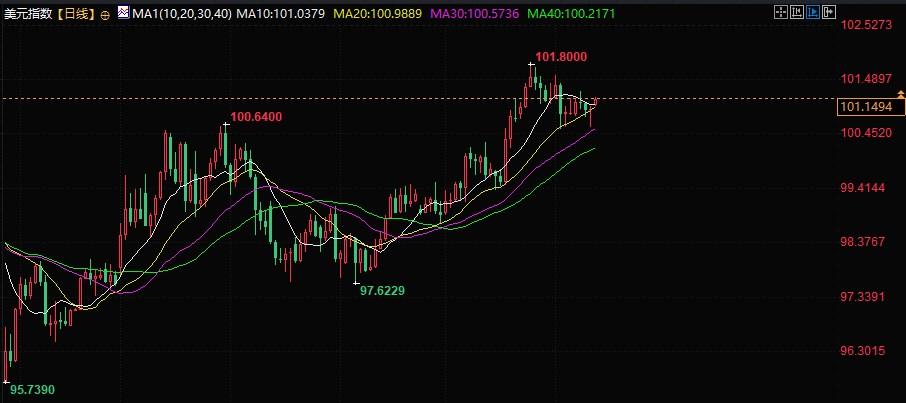
The dollar fell 0.38% against the yen on Friday, closing at 161.73, marking its biggest one-day drop in over a week. This volatility was directly triggered by a public statement from Japanese Finance Minister Satsuki Katayama: the government plans to guide the world's largest pension fund—the Government Pension Investment Fund of Japan (GPIF)—to "significantly" increase its allocation to domestic financial assets. The market interprets this move as potentially triggering a large-scale repatriation of funds from overseas to Japan, thereby directly boosting demand for the yen.
However, Eugene Epstein, head of trading at Moneycorp, pointed out that this is currently only an "urging" rather than an informal instruction, and the fluctuation range is only about 1 yen. It is worth noting that this round of yen appreciation is widespread, with the euro/yen and pound/yen both falling by about 0.5%. Previously, the yen had been hovering near 40-year lows, and traders were highly wary of the risk of intervention.
Goldman Sachs analysts believe that while macroeconomic factors continue to pressure the yen to weaken, capital inflows are one of the most credible paths to help the yen escape its severely undervalued state.
Investors are focused on this week's inflation data and Federal Reserve Chairman Warsh's testimony for further clues about the direction of monetary policy.
US launches third attack on Iran this week
According to the latest statement from the U.S. Central Command on social media, at 7:15 PM ET on July 11 (2:45 AM local time in Iran on July 12, 7:15 AM Beijing time), U.S. Central Command forces, acting on orders from U.S. President Trump, launched the third round of attacks against Iran this week. The statement said, "Previously, the Iranian Islamic Revolutionary Guard Corps attacked a Cypriot-flagged container ship sailing in the Strait of Hormuz. One civilian crew member is missing, and the ship is unable to continue sailing due to fire and severe damage to the engine room. Iran, previously held accountable for attacks on merchant ships, was given another opportunity to demonstrate its compliance with the Memorandum of Understanding, but it has again failed to comply. In response, the United States is continuing to weaken Iran's ability to attack civilian crew members and merchant ships freely passing through the Strait, making it pay a heavy price." (CCTV International News)
The Iranian Revolutionary Guard announced the closure of the Strait of Hormuz.
The Iranian Islamic Revolutionary Guard Corps Navy announced early on the 12th that the Strait of Hormuz was closed immediately, prohibiting any vessels from passing through. The statement said that Iran had previously announced that any foreign interference in the Strait of Hormuz or the illegal designation of shipping routes would be met with a "resolute response." Given the insecurity caused by illegal foreign interference, the Strait of Hormuz is closed immediately until further notice and the United States ceases its interference in the region. The statement said that several hours earlier, several vessels attempted to navigate along routes not approved by Iran, ignoring Iranian warnings and prompting them to correct their course. One vessel, which had its Automatic Identification System (AIS) disabled, was hit by warning shots and forced to stop. The statement also warned that if the United States uses this incident as a pretext to launch new attacks against Iran, Iran will respond forcefully, targeting more US bases in the Middle East. (Xinhua)
Iran responds strongly to the US: Failure to abide by the agreement will inevitably lead to retaliation.
Ali Safari, an advisor to the Iranian Foreign Ministry spokesman, warned that the recent US military strikes "will not go unpunished," and accused the US of failing to fulfill its commitments under the memorandum of understanding signed on June 16. Safari emphasized that the memorandum explicitly assigns responsibility for the "future arrangements in the Strait of Hormuz" to Iran, requiring consultation with Oman and other countries; however, the southern shipping route opened under US pressure not only hinders the implementation of the agreement but also poses serious security risks (such as ships disabling navigation systems, an irresponsible act). He demanded that the US choose: either abide by the agreement signed 23 days ago or completely renege on its commitments; and declared that Iran's strength far exceeds the US's expectations and that it is prepared for war.
Commercial shipping traffic in the Strait of Hormuz has decreased significantly.
On March 12, local time, commercial shipping traffic through the Strait of Hormuz dropped sharply after Iran announced its renewed closure. Data from Iranian sources, citing commercial shipping tracking, showed that only 11 commercial vessels passed through the Strait of Hormuz in the past 24 hours, including 8 oil tankers and 3 cargo ships. Early on March 12, local time, the Iranian Islamic Revolutionary Guard Corps Navy issued a statement saying it fired warning shots at a vessel in the Strait of Hormuz. The statement said that the Strait of Hormuz would be temporarily closed until further notice because the current insecurity was "caused by illegal interference by foreign forces." No vessels are allowed to pass through until the United States ends its intervention in the region. (CCTV News)
Iranian military: Iran has control over the Strait of Hormuz; any US violation will be met with a response.
Iranian military spokesman Akraminia reiterated on Sunday that, according to the Islamabad Memorandum of Understanding, the responsibility for maritime traffic management in the Strait of Hormuz rests with Iran; the US attempt to impose unauthorized shipping lanes in the south violates the commitments of the memorandum, and the US has a long history of failing to fulfill international agreements. Iran is pursuing a peaceful and cooperative approach, working with Oman to develop joint navigation arrangements in the strait; US interference undermines regional security, and Iran urges Washington to abide by the memorandum, respect regional stability, and consider the interests of all countries. The spokesman warned that every US attack on Iranian islands, coastlines, or military facilities will be met with a resolute response (the operation on Saturday night was immediately retaliated against); the Iranian armed forces have continuously strengthened their combat readiness and updated their operational plans before and after the ceasefire, demanding that the US cease its destructive intervention in the region.
Japan's GPIF plans to significantly increase the proportion of domestic assets and alternative investments.
The Japanese government plans to increase the allocation of alternative investments, such as unlisted stocks and real estate, in the world's largest pension fund, the Government Pension Investment Fund (GPIF), aiming to broaden its investment scope and diversify risk. Finance Minister Katsunobu Kato stated on Friday that the government will guide the $1.8 trillion GPIF and other national pension funds to "significantly" increase their investments in domestic assets, a statement that immediately sent the yen and Japanese government bond prices soaring. As of March, alternative investments accounted for only 1.7% of GPIF's assets, far below the 5% allowable limit; a government panel will soon submit a report recommending that this proportion be increased to close to 5% to optimize asset structure and reduce overall investment risk.
Iranian Parliament Speaker Says the Era of Unilateral Agreements is Over
Iranian Parliament Speaker Mohammad Ghalibaf posted on social media that the era of unilateral agreements is over. He stated that Iran had previously demanded that relevant parties fulfill their promises and obligations, or face consequences, and that "now it's time to face reality." Ghalibaf also attached a portion of Article 5 from the previous 14 Memoranda of Understanding. According to his published content, this article emphasizes the resumption of navigation through the Strait of Hormuz, subject to "arrangements made by the Iranian side." (CCTV International News)
China's thermal insulation materials have entered the world's top tier.
Why is rocket recovery so difficult? "The requirement is that it must not burn up, and it needs to be reused after its return. The difficulty of reuse far exceeds that of single-use materials!" Academician He Xiaodong of the Chinese Academy of Engineering succinctly pointed out the core challenge of rocket recovery. When the heat-insulating material was thoroughly heated in a furnace at over 1000 degrees Celsius, it was taken out without deformation. Even more unbelievable is that it could be picked up by hand! "When it was taken out, the heat inside couldn't be continuously dissipated, and the edges were already blackened, indicating that the heat had dissipated. Therefore, this material has excellent heat insulation performance," Academician He Xiaodong stated. He added that China is already among the world's leaders in heat insulation materials, reaching the world's top tier. (CCTV Finance)
my country's port cargo and container throughput will remain the world's largest by 2025.
In 2025, my country's port cargo throughput reached 18.3 billion tons, and container throughput reached 354 million TEUs, ranking first in the world. This information was obtained by reporters from the Ministry of Transport on the 11th. That morning, the Ministry of Transport held the main event for the 2026 China Maritime Day in Beijing, releasing the latest industry policies and practical achievements, and inviting representatives from the shipping industry to share their stories. Since the 14th Five-Year Plan, my country's comprehensive shipping strength has reached a new level. my country's international shipping volume accounts for one-third of global shipping volume, and the scale of Chinese-owned shipping fleets reaches 490 million deadweight tons. Sixty automated terminals have been built and put into operation nationwide. The fastest single-machine operation efficiency of automated terminals in Shanghai Port and Qingdao Port exceeds 60 TEUs per hour, which is currently the highest level of port loading and unloading efficiency in the world. The national electronic waterway map coverage is nearly 20,000 kilometers, and a unified electronic waterway map for the Yangtze River system, connecting main and tributary rivers and integrating the sea, has been basically completed; electronic waterway maps have been fully implemented on the Xijiang River main line and the Jiangsu section of the Beijing-Hangzhou Grand Canal. (Xinhua News Agency)
Key Focus Today
stock market
U.S. stocks rose on Friday, with the S&P 500 closing up 0.42% at 7,575.39, just 0.45% shy of its record closing high set on June 2. The Nasdaq and Dow Jones Industrial Average rose 0.29% to close at 26,281.61 and 52,637.01, respectively. For the week, the S&P 500 gained 1.2%, the Nasdaq climbed 1.7%, and the Dow fell slightly by 0.5%.
Artificial intelligence trading has returned to the spotlight, with South Korea's SK Hynix making a high-profile debut on Nasdaq. Its American Depositary Receipts (ADRs) were priced at $149 per share, raising over $26 billion. The ADRs closed at $170 on their first day of trading, 13% higher than the offering price. This high-profile debut boosted market optimism for memory chip manufacturers, and the Philadelphia Semiconductor Index rose for the third consecutive trading day, gaining 0.06%.
Investors are awaiting the start of the second-quarter earnings season next week, with major U.S. banks leading the way with their results. Analysts expect S&P 500 companies to see a 24% year-over-year increase in earnings, with technology companies expected to be the main driver of growth. Terry Sandven, chief equity strategist at Bank of America Wealth Management, points out that this quarter's earnings threshold is very high and there is little room for error. Bank earnings will help provide insights into economic strength and consumer and business trends.
The June inflation data to be released this week will provide new clues to the direction of the Federal Reserve's monetary policy. Meanwhile, Federal Reserve Chairman Warsh is scheduled to testify before the House Financial Services Committee, and the market will continue to assess economic fundamentals and policy prospects.
Gold Market
Spot gold fell 1.34% last week, closing below $4,120 per ounce. Escalating tensions between the US and Iran led investors to avoid precious metals, while supply concerns pushed up oil prices and strengthened inflation expectations, thereby reinforcing market expectations for the Federal Reserve to tighten monetary policy.
Bart Melek, global head of commodities strategy at TD Securities, pointed out that the renewed escalation of tensions between the US and Iran has made investors generally unwilling to hold gold and silver, which is the main reason for the decline in gold prices towards the $4,100 level. The firm also stated that the recent escalation of hostility between the US and Iran may overturn the International Energy Agency's forecast of a significant surplus in the oil market next year. Rising energy prices have further exacerbated inflation concerns and strengthened expectations of central bank interest rate hikes. The CME FedWatch tool shows that traders currently expect a 69% probability of a rate hike in September.
Investors are closely watching this week's inflation data and Federal Reserve Chairman Warsh's testimony for further clues about the direction of monetary policy. Meanwhile, gold prices traded at a significant discount in the Indian market last week, while demand in the Chinese market remained stable after the People's Bank of China reported that its gold reserves saw their largest monthly increase in over two and a half years in June. In other precious metals, spot silver fell 0.7% to $59.56, platinum rose 0.4% to $1616.72, and palladium rose 2.2% to $1274.50.
oil market
Oil prices rose sharply last week, with Brent crude up 5.65% to settle at $75.99 a barrel and WTI crude up nearly 4%, although it fell slightly on Friday to settle at $71.51 a barrel. This pattern of "Friday pullback followed by a big weekly gain" clearly reflects the market's back-and-forth struggle between geopolitical risk premiums and short-term easing signals.
Tensions between the US and Iran escalated again over the weekend. At 2:45 a.m. local time on July 12, US Central Command forces, acting on orders from US President Trump, launched the third round of attacks against Iran this week.
The Iranian Islamic Revolutionary Guard Corps Navy announced early on the 12th that the Strait of Hormuz would be closed immediately, and no ships would be allowed to pass through.
Ali Safari, an advisor to the Iranian Foreign Ministry spokesman, warned that the recent US military strikes "will not go unpunished" and accused the US of failing to fulfill its commitments under the memorandum of understanding signed on June 16.
Safari emphasized that the memorandum clearly assigns the responsibility for the "future arrangements in the Strait of Hormuz" to Iran, and that it needs to be formulated in consultation with countries such as Oman; however, the southern shipping route opened under pressure from the United States not only hinders the implementation of the agreement, but also leads to serious security risks (such as ships turning off their navigation systems to pass through, which is an irresponsible act).
He demanded that the United States make a choice: either abide by the agreement signed 23 days ago or completely abandon its commitments; and declared that Iran's strength far exceeded the United States' expectations and that it was ready for war.
Foreign exchange market
Although the US dollar index closed higher last week, its overall trend was weak, ultimately settling at 100.95. The minutes of last week's Federal Reserve meeting clearly revealed a clear division among policymakers regarding the interest rate path. Half of the officials favored maintaining the current interest rate, while the other half believed a rate hike was appropriate. The core innovation of the minutes lay in its use of a scenario-based decision-making framework, rather than traditional risk management terminology.
The dollar fell 0.38% against the yen on Friday, closing at 161.73, marking its biggest one-day drop in over a week. This volatility was directly triggered by a public statement from Japanese Finance Minister Satsuki Katayama: the government plans to guide the world's largest pension fund—the Government Pension Investment Fund of Japan (GPIF)—to "significantly" increase its allocation to domestic financial assets. The market interprets this move as potentially triggering a large-scale repatriation of funds from overseas to Japan, thereby directly boosting demand for the yen.
However, Eugene Epstein, head of trading at Moneycorp, pointed out that this is currently only an "urging" rather than an informal instruction, and the fluctuation range is only about 1 yen. It is worth noting that this round of yen appreciation is widespread, with the euro/yen and pound/yen both falling by about 0.5%. Previously, the yen had been hovering near 40-year lows, and traders were highly wary of the risk of intervention.
Goldman Sachs analysts believe that while macroeconomic factors continue to pressure the yen to weaken, capital inflows are one of the most credible paths to help the yen escape its severely undervalued state.
Investors are focused on this week's inflation data and Federal Reserve Chairman Warsh's testimony for further clues about the direction of monetary policy.
International News
US launches third attack on Iran this week
According to the latest statement from the U.S. Central Command on social media, at 7:15 PM ET on July 11 (2:45 AM local time in Iran on July 12, 7:15 AM Beijing time), U.S. Central Command forces, acting on orders from U.S. President Trump, launched the third round of attacks against Iran this week. The statement said, "Previously, the Iranian Islamic Revolutionary Guard Corps attacked a Cypriot-flagged container ship sailing in the Strait of Hormuz. One civilian crew member is missing, and the ship is unable to continue sailing due to fire and severe damage to the engine room. Iran, previously held accountable for attacks on merchant ships, was given another opportunity to demonstrate its compliance with the Memorandum of Understanding, but it has again failed to comply. In response, the United States is continuing to weaken Iran's ability to attack civilian crew members and merchant ships freely passing through the Strait, making it pay a heavy price." (CCTV International News)
The Iranian Revolutionary Guard announced the closure of the Strait of Hormuz.
The Iranian Islamic Revolutionary Guard Corps Navy announced early on the 12th that the Strait of Hormuz was closed immediately, prohibiting any vessels from passing through. The statement said that Iran had previously announced that any foreign interference in the Strait of Hormuz or the illegal designation of shipping routes would be met with a "resolute response." Given the insecurity caused by illegal foreign interference, the Strait of Hormuz is closed immediately until further notice and the United States ceases its interference in the region. The statement said that several hours earlier, several vessels attempted to navigate along routes not approved by Iran, ignoring Iranian warnings and prompting them to correct their course. One vessel, which had its Automatic Identification System (AIS) disabled, was hit by warning shots and forced to stop. The statement also warned that if the United States uses this incident as a pretext to launch new attacks against Iran, Iran will respond forcefully, targeting more US bases in the Middle East. (Xinhua)
Iran responds strongly to the US: Failure to abide by the agreement will inevitably lead to retaliation.
Ali Safari, an advisor to the Iranian Foreign Ministry spokesman, warned that the recent US military strikes "will not go unpunished," and accused the US of failing to fulfill its commitments under the memorandum of understanding signed on June 16. Safari emphasized that the memorandum explicitly assigns responsibility for the "future arrangements in the Strait of Hormuz" to Iran, requiring consultation with Oman and other countries; however, the southern shipping route opened under US pressure not only hinders the implementation of the agreement but also poses serious security risks (such as ships disabling navigation systems, an irresponsible act). He demanded that the US choose: either abide by the agreement signed 23 days ago or completely renege on its commitments; and declared that Iran's strength far exceeds the US's expectations and that it is prepared for war.
Commercial shipping traffic in the Strait of Hormuz has decreased significantly.
On March 12, local time, commercial shipping traffic through the Strait of Hormuz dropped sharply after Iran announced its renewed closure. Data from Iranian sources, citing commercial shipping tracking, showed that only 11 commercial vessels passed through the Strait of Hormuz in the past 24 hours, including 8 oil tankers and 3 cargo ships. Early on March 12, local time, the Iranian Islamic Revolutionary Guard Corps Navy issued a statement saying it fired warning shots at a vessel in the Strait of Hormuz. The statement said that the Strait of Hormuz would be temporarily closed until further notice because the current insecurity was "caused by illegal interference by foreign forces." No vessels are allowed to pass through until the United States ends its intervention in the region. (CCTV News)
Iranian military: Iran has control over the Strait of Hormuz; any US violation will be met with a response.
Iranian military spokesman Akraminia reiterated on Sunday that, according to the Islamabad Memorandum of Understanding, the responsibility for maritime traffic management in the Strait of Hormuz rests with Iran; the US attempt to impose unauthorized shipping lanes in the south violates the commitments of the memorandum, and the US has a long history of failing to fulfill international agreements. Iran is pursuing a peaceful and cooperative approach, working with Oman to develop joint navigation arrangements in the strait; US interference undermines regional security, and Iran urges Washington to abide by the memorandum, respect regional stability, and consider the interests of all countries. The spokesman warned that every US attack on Iranian islands, coastlines, or military facilities will be met with a resolute response (the operation on Saturday night was immediately retaliated against); the Iranian armed forces have continuously strengthened their combat readiness and updated their operational plans before and after the ceasefire, demanding that the US cease its destructive intervention in the region.
Japan's GPIF plans to significantly increase the proportion of domestic assets and alternative investments.
The Japanese government plans to increase the allocation of alternative investments, such as unlisted stocks and real estate, in the world's largest pension fund, the Government Pension Investment Fund (GPIF), aiming to broaden its investment scope and diversify risk. Finance Minister Katsunobu Kato stated on Friday that the government will guide the $1.8 trillion GPIF and other national pension funds to "significantly" increase their investments in domestic assets, a statement that immediately sent the yen and Japanese government bond prices soaring. As of March, alternative investments accounted for only 1.7% of GPIF's assets, far below the 5% allowable limit; a government panel will soon submit a report recommending that this proportion be increased to close to 5% to optimize asset structure and reduce overall investment risk.
Iranian Parliament Speaker Says the Era of Unilateral Agreements is Over
Iranian Parliament Speaker Mohammad Ghalibaf posted on social media that the era of unilateral agreements is over. He stated that Iran had previously demanded that relevant parties fulfill their promises and obligations, or face consequences, and that "now it's time to face reality." Ghalibaf also attached a portion of Article 5 from the previous 14 Memoranda of Understanding. According to his published content, this article emphasizes the resumption of navigation through the Strait of Hormuz, subject to "arrangements made by the Iranian side." (CCTV International News)
Domestic News
China's thermal insulation materials have entered the world's top tier.
Why is rocket recovery so difficult? "The requirement is that it must not burn up, and it needs to be reused after its return. The difficulty of reuse far exceeds that of single-use materials!" Academician He Xiaodong of the Chinese Academy of Engineering succinctly pointed out the core challenge of rocket recovery. When the heat-insulating material was thoroughly heated in a furnace at over 1000 degrees Celsius, it was taken out without deformation. Even more unbelievable is that it could be picked up by hand! "When it was taken out, the heat inside couldn't be continuously dissipated, and the edges were already blackened, indicating that the heat had dissipated. Therefore, this material has excellent heat insulation performance," Academician He Xiaodong stated. He added that China is already among the world's leaders in heat insulation materials, reaching the world's top tier. (CCTV Finance)
my country's port cargo and container throughput will remain the world's largest by 2025.
In 2025, my country's port cargo throughput reached 18.3 billion tons, and container throughput reached 354 million TEUs, ranking first in the world. This information was obtained by reporters from the Ministry of Transport on the 11th. That morning, the Ministry of Transport held the main event for the 2026 China Maritime Day in Beijing, releasing the latest industry policies and practical achievements, and inviting representatives from the shipping industry to share their stories. Since the 14th Five-Year Plan, my country's comprehensive shipping strength has reached a new level. my country's international shipping volume accounts for one-third of global shipping volume, and the scale of Chinese-owned shipping fleets reaches 490 million deadweight tons. Sixty automated terminals have been built and put into operation nationwide. The fastest single-machine operation efficiency of automated terminals in Shanghai Port and Qingdao Port exceeds 60 TEUs per hour, which is currently the highest level of port loading and unloading efficiency in the world. The national electronic waterway map coverage is nearly 20,000 kilometers, and a unified electronic waterway map for the Yangtze River system, connecting main and tributary rivers and integrating the sea, has been basically completed; electronic waterway maps have been fully implemented on the Xijiang River main line and the Jiangsu section of the Beijing-Hangzhou Grand Canal. (Xinhua News Agency)
- Risk Warning and Disclaimer
- The market involves risk, and trading may not be suitable for all investors. This article is for reference only and does not constitute personal investment advice, nor does it take into account certain users’ specific investment objectives, financial situation, or other needs. Any investment decisions made based on this information are at your own risk.