A renewed round of fighting between the US and Iran over the weekend dampened risk appetite, causing the Australian dollar to fall below the 0.6950 level.
2026-07-13 08:11:29
On Monday (July 13) in early Asian trading, the Australian dollar weakened against the US dollar, trading around 0.6940 and falling below 0.6950.
The renewed escalation of geopolitical risks has dampened market risk appetite, putting pressure on the Australian dollar, a typical risk currency.
However, the recent hawkish signals from the Reserve Bank of Australia are providing a floor for the Australian dollar – Assistant Governor Hunt made it clear last week that if oil price shocks push up inflation expectations, further tightening of monetary policy may be necessary.
The renewed escalation of the US-Iran conflict over the weekend was a key factor weighing on the Australian dollar. US Central Command launched a new round of strikes against Iran on Sunday, targeting Iran's ability to threaten civilian vessels in the Strait of Hormuz. This was another military operation following several days of airstrikes, demonstrating that Washington's pressure strategy against Iran continues.
Iran's response was swift and forceful—the Islamic Revolutionary Guard Corps launched retaliatory drone and missile attacks against several US allies in the Middle East, targeting Kuwait, Jordan, and Qatar. This signifies that the geographical scope of the conflict is expanding from the Strait of Hormuz to a wider region, increasing both the breadth and depth of geopolitical risks.
For the Australian dollar, the deteriorating situation in the Middle East has a negative impact through two channels: first, the general decline in global risk appetite has led investors to reduce their holdings of risk currencies and increase their holdings of safe-haven assets; second, tensions in the Strait of Hormuz have pushed up energy prices, which may drag down the global economic growth outlook, and Australia, as a resource-exporting economy, is highly sensitive to global growth expectations.
Despite geopolitical risks putting pressure on the Australian dollar, the Reserve Bank of Australia's recent hawkish stance is limiting its downside.
Assistant Governor Hunt made it clear last week that the committee would “take the necessary action” to bring inflation back to the target level, and warned that if oil price shocks push up inflation expectations, “some tightening may be necessary.”
This statement contrasts sharply with the relatively dovish tone of Federal Reserve officials, providing structural support for the Australian dollar in terms of interest rate differentials.
To date, the Reserve Bank of Australia (RBA) has implemented three interest rate hikes this year, each by 25 basis points, raising the official cash rate to 4.35%. Based on ASX 30-day interbank cash rate futures pricing, the market currently expects a 19% probability of a rate hike to 4.60% at the August meeting.
While a 19% probability isn't high, its directional significance is more important—the market is pricing in a rate hike rather than a rate cut, contrasting with the decreasing probability of a rate hike in the Federal Reserve's market pricing. If subsequent Australian inflation or employment data are stronger than expected, the rising expectation of a rate hike could become a significant catalyst for a rebound in the Australian dollar.
Looking ahead, the Australian dollar is likely to fluctuate within the 0.6900-0.6980 range against the US dollar in the short term, with the direction depending on the evolution of two major variables.
On the upside, if there are signs of easing tensions in the Middle East, a recovery in risk appetite could push the Australian dollar to rebound to 0.6980 or even 0.7000. If Australian inflation data exceeds expectations and increases the probability of an August rate hike, the Australian dollar could also receive independent policy support.
On the downside, if the US-Iran conflict continues to escalate, a further deterioration in risk appetite could push the Australian dollar to test the 0.6900 or even 0.6850 area.
Furthermore, the US CPI data released on Tuesday is also a key external variable—if the CPI exceeds expectations, it could reignite expectations of a Fed rate hike, thereby reversing the current weakness of the US dollar and putting additional pressure on the Australian dollar. In the current environment, the Australian dollar's exchange rate against the US dollar will continue to depend on the balance of power between "geopolitical risk suppression" and "policy divergence support."
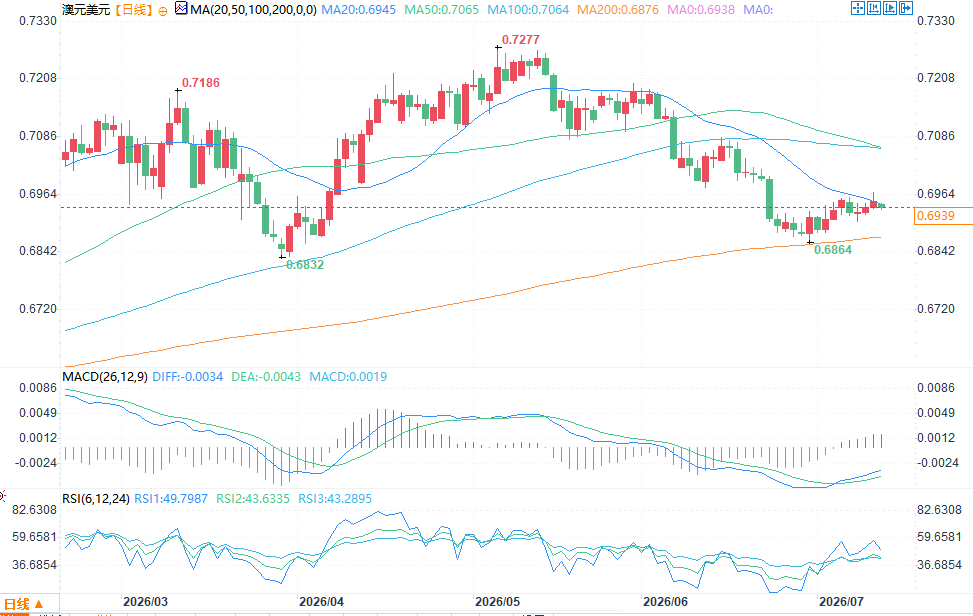
(AUD/USD daily chart, source: FX678)
At 7:53 AM Beijing time on July 13, the Australian dollar was trading at 0.6939/40 against the US dollar.
The renewed escalation of geopolitical risks has dampened market risk appetite, putting pressure on the Australian dollar, a typical risk currency.
However, the recent hawkish signals from the Reserve Bank of Australia are providing a floor for the Australian dollar – Assistant Governor Hunt made it clear last week that if oil price shocks push up inflation expectations, further tightening of monetary policy may be necessary.
Geopolitics: New round of fighting between the US and Iran over the weekend dampened risk appetite and pressured the Australian dollar.
The renewed escalation of the US-Iran conflict over the weekend was a key factor weighing on the Australian dollar. US Central Command launched a new round of strikes against Iran on Sunday, targeting Iran's ability to threaten civilian vessels in the Strait of Hormuz. This was another military operation following several days of airstrikes, demonstrating that Washington's pressure strategy against Iran continues.
Iran's response was swift and forceful—the Islamic Revolutionary Guard Corps launched retaliatory drone and missile attacks against several US allies in the Middle East, targeting Kuwait, Jordan, and Qatar. This signifies that the geographical scope of the conflict is expanding from the Strait of Hormuz to a wider region, increasing both the breadth and depth of geopolitical risks.
For the Australian dollar, the deteriorating situation in the Middle East has a negative impact through two channels: first, the general decline in global risk appetite has led investors to reduce their holdings of risk currencies and increase their holdings of safe-haven assets; second, tensions in the Strait of Hormuz have pushed up energy prices, which may drag down the global economic growth outlook, and Australia, as a resource-exporting economy, is highly sensitive to global growth expectations.
Reserve Bank of Australia: Hawkish tone provides bottom support
Despite geopolitical risks putting pressure on the Australian dollar, the Reserve Bank of Australia's recent hawkish stance is limiting its downside.
Assistant Governor Hunt made it clear last week that the committee would “take the necessary action” to bring inflation back to the target level, and warned that if oil price shocks push up inflation expectations, “some tightening may be necessary.”
This statement contrasts sharply with the relatively dovish tone of Federal Reserve officials, providing structural support for the Australian dollar in terms of interest rate differentials.
To date, the Reserve Bank of Australia (RBA) has implemented three interest rate hikes this year, each by 25 basis points, raising the official cash rate to 4.35%. Based on ASX 30-day interbank cash rate futures pricing, the market currently expects a 19% probability of a rate hike to 4.60% at the August meeting.
While a 19% probability isn't high, its directional significance is more important—the market is pricing in a rate hike rather than a rate cut, contrasting with the decreasing probability of a rate hike in the Federal Reserve's market pricing. If subsequent Australian inflation or employment data are stronger than expected, the rising expectation of a rate hike could become a significant catalyst for a rebound in the Australian dollar.
Outlook: The tug-of-war between geopolitical risks and policy divergence
Looking ahead, the Australian dollar is likely to fluctuate within the 0.6900-0.6980 range against the US dollar in the short term, with the direction depending on the evolution of two major variables.
On the upside, if there are signs of easing tensions in the Middle East, a recovery in risk appetite could push the Australian dollar to rebound to 0.6980 or even 0.7000. If Australian inflation data exceeds expectations and increases the probability of an August rate hike, the Australian dollar could also receive independent policy support.
On the downside, if the US-Iran conflict continues to escalate, a further deterioration in risk appetite could push the Australian dollar to test the 0.6900 or even 0.6850 area.
Furthermore, the US CPI data released on Tuesday is also a key external variable—if the CPI exceeds expectations, it could reignite expectations of a Fed rate hike, thereby reversing the current weakness of the US dollar and putting additional pressure on the Australian dollar. In the current environment, the Australian dollar's exchange rate against the US dollar will continue to depend on the balance of power between "geopolitical risk suppression" and "policy divergence support."
(AUD/USD daily chart, source: FX678)
At 7:53 AM Beijing time on July 13, the Australian dollar was trading at 0.6939/40 against the US dollar.
- Risk Warning and Disclaimer
- The market involves risk, and trading may not be suitable for all investors. This article is for reference only and does not constitute personal investment advice, nor does it take into account certain users’ specific investment objectives, financial situation, or other needs. Any investment decisions made based on this information are at your own risk.