How can the Bank of Japan send "hidden" signals of interest rate hikes without giving a timetable?
2026-07-13 08:13:34
On Monday (July 13) in early Asian trading, the US dollar fluctuated at high levels against the Japanese yen, currently trading below the 162 level.
According to sources, the Bank of Japan may slightly raise its economic growth forecast for fiscal year 2026 at its policy meeting ending on July 31, while moderately lowering its short-term inflation outlook due to falling oil prices.
However, this adjustment is not expected to change the central bank's wary stance on inflation risks—any downward revision of inflation will be framed as a reflection of falling oil prices, rather than a softening of policy. The market widely expects the Bank of Japan to keep its short-term policy rate unchanged at 1% at its July meeting, but most analysts still predict another rate hike to 1.25% before the end of the year.
The Bank of Japan will release its quarterly economic and price outlook report on July 31, and the market will be closely watching for clues regarding the timing and pace of further interest rate hikes.
Sources familiar with the matter said the central bank may slightly raise its 2026 fiscal year economic growth forecast from 0.5% in April to reflect strong AI demand and the positive impact of lower fuel costs; at the same time, it may moderately lower its core inflation forecast from 2.8% in April, mainly because the initial peace agreement between the US and Iran in early June triggered a sharp drop in oil prices.
The Bank of Japan's main reason for potentially raising its economic growth forecast for fiscal year 2026 comes from two aspects.
First, the continued strong global demand for AI is driving up the prices and output of semiconductor chips and electronic devices, which, according to insiders, could eventually translate into higher prices for consumer goods.
Secondly, the decline in fuel costs has eased the energy expenditure burden on businesses and households, providing marginal support for consumption and investment.
However, sources also pointed out that while the drop in oil prices has reduced downside risks to the economy to some extent, previously high import costs will continue to exert upward pressure on prices—a view shared by the three sources. This means that the Bank of Japan's optimistic adjustment to economic growth will be moderate and cautious, and will not change its basic assessment of the strength of the overall economic recovery.
Regarding inflation, the Bank of Japan may moderately lower its core inflation forecast for fiscal year 2026 from the 2.8% projected in April. The main reason for the downward revision is that the preliminary peace agreement between the US and Iran in early June triggered a sharp drop in oil prices. This external shock lowered energy prices in the short term, thus having a downward effect on the overall inflation reading.
However, sources emphasized that this downward revision will not change the Bank of Japan's wary stance on inflation risks. Three major upside risks remain: a weak yen continues to push up import prices, stable wage growth is gradually being transmitted to service prices, and the energy shock triggered by the Middle East war continues to spread to broader commodity prices through cost-push channels.
Even Domino Asada, a member of the central bank considered dovish, said this week that the transmission of rising oil prices is "progressing at a relatively rapid pace" and could lead to a broad-based increase in commodity prices.
It is worth noting that although wholesale inflation surged to 7.1% in June (reflecting businesses passing on higher raw material costs), core consumer inflation has remained below the central bank’s 2% target for four consecutive months due to government fuel subsidies.
However, the Bank of Japan has made it clear that many businesses are likely to raise prices for food and daily necessities starting in the summer, meaning that a rebound in consumer inflation may only be a matter of time.
The Bank of Japan is expected to keep its policy rate unchanged at 1% at its two-day policy meeting on July 30-31, marking its first policy assessment since raising rates to their highest level in 31 years in June. The central bank will likely maintain its cautious stance on inflation risks and largely continue its policy guidance of "continuing to raise rates," but may avoid providing a specific timetable for rate hikes.
Sources familiar with the matter said the central bank’s lack of a clear signal on when to raise interest rates in its guidance could cause the yen to continue to fluctuate around the July 30-31 meeting – investors will have to interpret the overall tone of the quarterly report to infer the policy direction rather than relying on a specific point in time.
However, most analysts surveyed still expect the Bank of Japan to raise interest rates again to 1.25% by the end of the year. Persistently high wholesale inflation (up 7.1% year-on-year in June) will continue to put pressure on the central bank to maintain a hawkish guidance, even if overall consumer inflation remains below target.
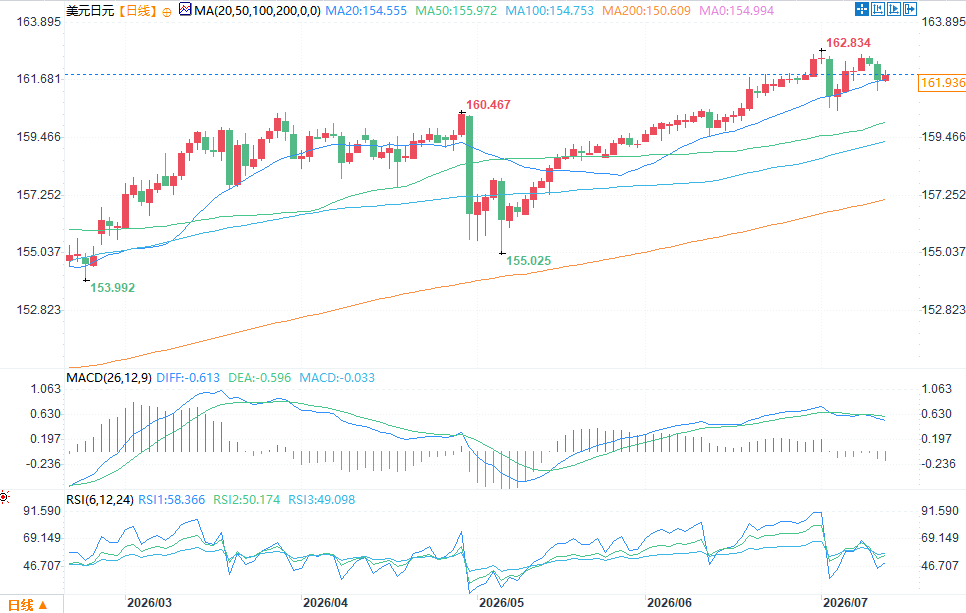
(USD/JPY daily chart, source: FX678)
At 8:08 AM Beijing time on July 13, the USD/JPY exchange rate was 161.93/94.
According to sources, the Bank of Japan may slightly raise its economic growth forecast for fiscal year 2026 at its policy meeting ending on July 31, while moderately lowering its short-term inflation outlook due to falling oil prices.
However, this adjustment is not expected to change the central bank's wary stance on inflation risks—any downward revision of inflation will be framed as a reflection of falling oil prices, rather than a softening of policy. The market widely expects the Bank of Japan to keep its short-term policy rate unchanged at 1% at its July meeting, but most analysts still predict another rate hike to 1.25% before the end of the year.
The Bank of Japan will release its quarterly economic and price outlook report on July 31, and the market will be closely watching for clues regarding the timing and pace of further interest rate hikes.
Sources familiar with the matter said the central bank may slightly raise its 2026 fiscal year economic growth forecast from 0.5% in April to reflect strong AI demand and the positive impact of lower fuel costs; at the same time, it may moderately lower its core inflation forecast from 2.8% in April, mainly because the initial peace agreement between the US and Iran in early June triggered a sharp drop in oil prices.
Growth Outlook: Upward Revision Driven by AI Demand and Declining Fuel Costs
The Bank of Japan's main reason for potentially raising its economic growth forecast for fiscal year 2026 comes from two aspects.
First, the continued strong global demand for AI is driving up the prices and output of semiconductor chips and electronic devices, which, according to insiders, could eventually translate into higher prices for consumer goods.
Secondly, the decline in fuel costs has eased the energy expenditure burden on businesses and households, providing marginal support for consumption and investment.
However, sources also pointed out that while the drop in oil prices has reduced downside risks to the economy to some extent, previously high import costs will continue to exert upward pressure on prices—a view shared by the three sources. This means that the Bank of Japan's optimistic adjustment to economic growth will be moderate and cautious, and will not change its basic assessment of the strength of the overall economic recovery.
Inflation assessment: Short-term downward revision but no change in vigilance.
Regarding inflation, the Bank of Japan may moderately lower its core inflation forecast for fiscal year 2026 from the 2.8% projected in April. The main reason for the downward revision is that the preliminary peace agreement between the US and Iran in early June triggered a sharp drop in oil prices. This external shock lowered energy prices in the short term, thus having a downward effect on the overall inflation reading.
However, sources emphasized that this downward revision will not change the Bank of Japan's wary stance on inflation risks. Three major upside risks remain: a weak yen continues to push up import prices, stable wage growth is gradually being transmitted to service prices, and the energy shock triggered by the Middle East war continues to spread to broader commodity prices through cost-push channels.
Even Domino Asada, a member of the central bank considered dovish, said this week that the transmission of rising oil prices is "progressing at a relatively rapid pace" and could lead to a broad-based increase in commodity prices.
It is worth noting that although wholesale inflation surged to 7.1% in June (reflecting businesses passing on higher raw material costs), core consumer inflation has remained below the central bank’s 2% target for four consecutive months due to government fuel subsidies.
However, the Bank of Japan has made it clear that many businesses are likely to raise prices for food and daily necessities starting in the summer, meaning that a rebound in consumer inflation may only be a matter of time.
Policy Outlook: Rates to remain unchanged in July, but strong expectations for another rate hike before the end of the year.
The Bank of Japan is expected to keep its policy rate unchanged at 1% at its two-day policy meeting on July 30-31, marking its first policy assessment since raising rates to their highest level in 31 years in June. The central bank will likely maintain its cautious stance on inflation risks and largely continue its policy guidance of "continuing to raise rates," but may avoid providing a specific timetable for rate hikes.
Sources familiar with the matter said the central bank’s lack of a clear signal on when to raise interest rates in its guidance could cause the yen to continue to fluctuate around the July 30-31 meeting – investors will have to interpret the overall tone of the quarterly report to infer the policy direction rather than relying on a specific point in time.
However, most analysts surveyed still expect the Bank of Japan to raise interest rates again to 1.25% by the end of the year. Persistently high wholesale inflation (up 7.1% year-on-year in June) will continue to put pressure on the central bank to maintain a hawkish guidance, even if overall consumer inflation remains below target.
(USD/JPY daily chart, source: FX678)
At 8:08 AM Beijing time on July 13, the USD/JPY exchange rate was 161.93/94.
- Risk Warning and Disclaimer
- The market involves risk, and trading may not be suitable for all investors. This article is for reference only and does not constitute personal investment advice, nor does it take into account certain users’ specific investment objectives, financial situation, or other needs. Any investment decisions made based on this information are at your own risk.