Cooling US inflation weakened the dollar, while high gasoline prices supported the Canadian dollar, with the USD/CAD pair hovering around 1.4050.
2026-07-16 13:46:12
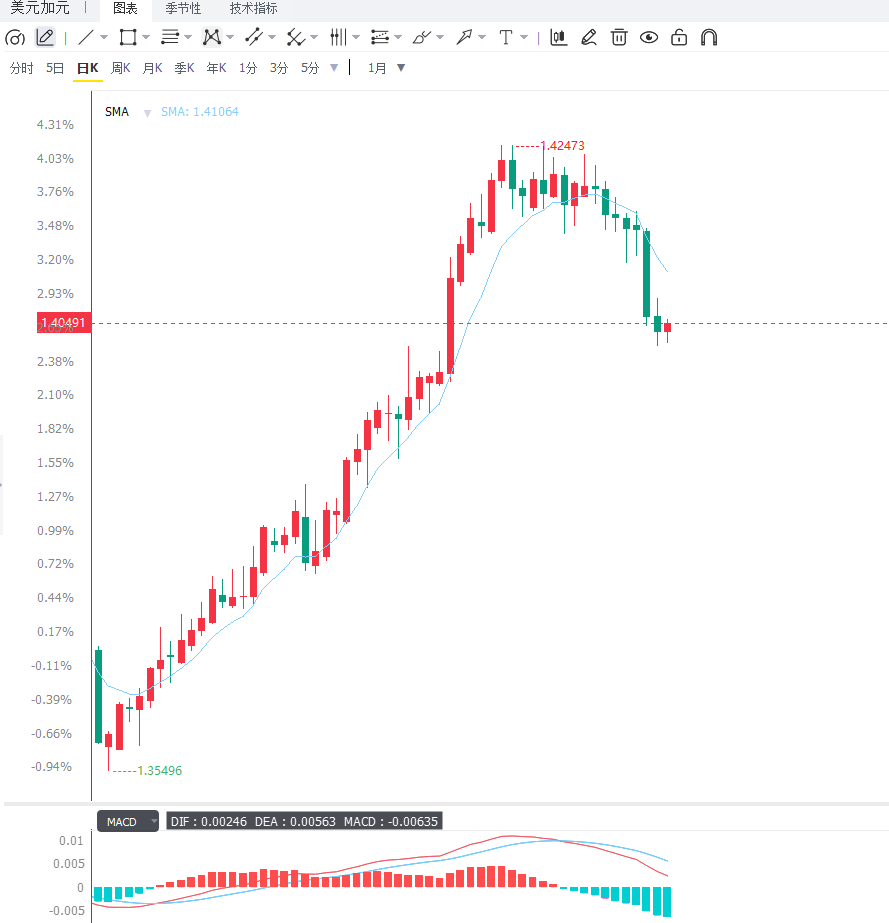
The US dollar/Canadian dollar pair remained range-bound in Asian trading on Thursday, hovering around 1.4050, near a four-week low reached in the previous session. While market trading was relatively cautious, fundamentals remained favorable for the Canadian dollar, and the overall trend for the USD/CAD pair continued to weaken.  The US dollar has been under continued pressure recently, mainly due to cooling US inflation data. Data released by the US Bureau of Labor Statistics showed that the US Producer Price Index (PPI) fell 0.3% month-on-month in June, lower than the revised 0.6% increase in the previous month; the year-on-year growth rate slowed to 5.5% , also lower than the market expectation of 6.2%. The previously released Consumer Price Index (CPI) also fell short of market expectations. The consecutive declines in inflation data further reduced market expectations for a short-term interest rate hike by the Federal Reserve, causing the US dollar index to fall to a near one-month low. With the market expecting the Federal Reserve to keep interest rates unchanged at its July policy meeting, the dollar's interest rate advantage has weakened, leading to adjustments in the dollar against most major currencies, thus providing some support for the Canadian dollar. On the other hand, the continued strength of international oil prices further boosted the Canadian dollar. As Canada is a major global oil exporter, rising oil prices typically improve Canadian export revenue and enhance the attractiveness of the Canadian dollar. Recent escalation of tensions between the US and Iran has raised market concerns about potential disruptions to oil supplies in the Middle East, keeping international oil prices at near one-month highs. The US and Iran continued their latest military operations this week, exchanging airstrikes and missile attacks, significantly escalating regional tensions. Meanwhile, the US military intensified its operations to ensure shipping safety near the Strait of Hormuz, while Iran continued its countermeasures. The Strait of Hormuz handles approximately 20% of global seaborne crude oil transport, and supply risks continue to support international oil prices. Rising oil prices not only benefit the Canadian dollar but also bring renewed focus to global inflation risks. If energy prices remain high, major central banks may need to maintain higher interest rates for an extended period, which is one of the key reasons why the USD/CAD exchange rate has not experienced a further rapid decline. Furthermore, although the Bank of Canada has previously signaled a relatively cautious policy stance, the fundamentals of the Canadian dollar have clearly improved against the backdrop of rising oil prices. The market believes that as long as international oil prices remain strong, the Canadian dollar will continue to receive support. Next, investors will focus on the upcoming US June retail sales data to further assess US consumer demand and economic resilience. Strong data could revive the US dollar; conversely, weak data could lead to further testing of recent lows for the USD/CAD exchange rate. From a daily chart perspective, the USD/CAD pair has been declining recently after breaking below several short-term moving averages, currently consolidating around 1.4050, with an overall weak trend. The MACD indicator remains below the zero line, indicating that bearish momentum remains dominant, but the green bars have narrowed, suggesting that the short-term decline is beginning to slow. The 60-day moving average has turned downwards, putting pressure on the exchange rate. Key resistance levels to watch are 1.4100, 1.4160, and 1.4220; key support levels are 1.4000, 1.3950, and 1.3900. A break below the 1.4000 level could lead to further downward movement. From a 4-hour chart perspective, the USD/CAD pair is maintaining a low-level consolidation pattern. Short-term moving averages are gradually flattening, the MACD golden cross at a low level has limited momentum, and the RSI indicator is in neutral territory, indicating a strong wait-and-see attitude in the market. If international oil prices continue to rise and US economic data is weak, the exchange rate may test support around 1.4000; if US retail sales data is stronger than expected and the US dollar experiences a technical rebound, it may retest resistance around 1.4100.
  Editor's Summary: The USD/CAD pair has been under continued pressure recently, primarily due to a combination of factors including cooling US inflation, declining expectations of a Fed rate hike, and support for the Canadian dollar from rising international oil prices. Currently, the market has lowered its expectations for the US dollar's interest rate advantage while remaining optimistic about the positive impact of oil prices on the Canadian economy and the Canadian dollar. Future price movements will continue to be influenced by US economic data, the Middle East situation, and changes in the international oil market. If oil prices remain high and US economic data continues to weaken, the USD/CAD pair may have further downside potential; however, if the US economy performs better than expected and energy market risks ease, the exchange rate may experience a period of recovery. Investors should pay close attention to the breakout of the key support level of 1.4000 and the resistance zone of 1.4100.
The US dollar has been under continued pressure recently, mainly due to cooling US inflation data. Data released by the US Bureau of Labor Statistics showed that the US Producer Price Index (PPI) fell 0.3% month-on-month in June, lower than the revised 0.6% increase in the previous month; the year-on-year growth rate slowed to 5.5% , also lower than the market expectation of 6.2%. The previously released Consumer Price Index (CPI) also fell short of market expectations. The consecutive declines in inflation data further reduced market expectations for a short-term interest rate hike by the Federal Reserve, causing the US dollar index to fall to a near one-month low. With the market expecting the Federal Reserve to keep interest rates unchanged at its July policy meeting, the dollar's interest rate advantage has weakened, leading to adjustments in the dollar against most major currencies, thus providing some support for the Canadian dollar. On the other hand, the continued strength of international oil prices further boosted the Canadian dollar. As Canada is a major global oil exporter, rising oil prices typically improve Canadian export revenue and enhance the attractiveness of the Canadian dollar. Recent escalation of tensions between the US and Iran has raised market concerns about potential disruptions to oil supplies in the Middle East, keeping international oil prices at near one-month highs. The US and Iran continued their latest military operations this week, exchanging airstrikes and missile attacks, significantly escalating regional tensions. Meanwhile, the US military intensified its operations to ensure shipping safety near the Strait of Hormuz, while Iran continued its countermeasures. The Strait of Hormuz handles approximately 20% of global seaborne crude oil transport, and supply risks continue to support international oil prices. Rising oil prices not only benefit the Canadian dollar but also bring renewed focus to global inflation risks. If energy prices remain high, major central banks may need to maintain higher interest rates for an extended period, which is one of the key reasons why the USD/CAD exchange rate has not experienced a further rapid decline. Furthermore, although the Bank of Canada has previously signaled a relatively cautious policy stance, the fundamentals of the Canadian dollar have clearly improved against the backdrop of rising oil prices. The market believes that as long as international oil prices remain strong, the Canadian dollar will continue to receive support. Next, investors will focus on the upcoming US June retail sales data to further assess US consumer demand and economic resilience. Strong data could revive the US dollar; conversely, weak data could lead to further testing of recent lows for the USD/CAD exchange rate. From a daily chart perspective, the USD/CAD pair has been declining recently after breaking below several short-term moving averages, currently consolidating around 1.4050, with an overall weak trend. The MACD indicator remains below the zero line, indicating that bearish momentum remains dominant, but the green bars have narrowed, suggesting that the short-term decline is beginning to slow. The 60-day moving average has turned downwards, putting pressure on the exchange rate. Key resistance levels to watch are 1.4100, 1.4160, and 1.4220; key support levels are 1.4000, 1.3950, and 1.3900. A break below the 1.4000 level could lead to further downward movement. From a 4-hour chart perspective, the USD/CAD pair is maintaining a low-level consolidation pattern. Short-term moving averages are gradually flattening, the MACD golden cross at a low level has limited momentum, and the RSI indicator is in neutral territory, indicating a strong wait-and-see attitude in the market. If international oil prices continue to rise and US economic data is weak, the exchange rate may test support around 1.4000; if US retail sales data is stronger than expected and the US dollar experiences a technical rebound, it may retest resistance around 1.4100. Editor's Summary: The USD/CAD pair has been under continued pressure recently, primarily due to a combination of factors including cooling US inflation, declining expectations of a Fed rate hike, and support for the Canadian dollar from rising international oil prices. Currently, the market has lowered its expectations for the US dollar's interest rate advantage while remaining optimistic about the positive impact of oil prices on the Canadian economy and the Canadian dollar. Future price movements will continue to be influenced by US economic data, the Middle East situation, and changes in the international oil market. If oil prices remain high and US economic data continues to weaken, the USD/CAD pair may have further downside potential; however, if the US economy performs better than expected and energy market risks ease, the exchange rate may experience a period of recovery. Investors should pay close attention to the breakout of the key support level of 1.4000 and the resistance zone of 1.4100.
- Risk Warning and Disclaimer
- The market involves risk, and trading may not be suitable for all investors. This article is for reference only and does not constitute personal investment advice, nor does it take into account certain users’ specific investment objectives, financial situation, or other needs. Any investment decisions made based on this information are at your own risk.