US consumer data failed to boost prices, and the US-Iran conflict remains unresolved, causing gold prices to fall below $4,000.
2026-07-16 21:06:12
Gold prices continued to weaken during the European and American trading sessions on Thursday (July 16), falling below 4,000 points and triggering stop-loss orders. Currently trading around 3,993, down 1.62%, the price action between the US and Iran has escalated further, with Iran threatening to close the Bab el-Mandeb Strait. US President Trump publicly stated on Tuesday that if diplomatic negotiations fail to make progress, the US military will focus its attacks on key infrastructure in Iran next week, including power plants and bridges , to completely paralyze Iran's basic operations. Faced with this explicit threat from the US, Iran has designated the Strait of Hormuz as an inviolable strategic red line. Senior military officials have publicly stated that if the US attacks Iranian infrastructure, Iranian armed forces will completely destroy all US-related facilities in the Middle East and will not allow any external countries to interfere in shipping affairs across the strait. Even more concerning for the global energy market is the latest key intelligence: three sources confirmed that Iranian officials have finalized a countermeasure plan involving proxies and have formally issued a secret order to the Houthi rebels in Yemen, instructing them to immediately close the Bab el-Mandeb Strait should the US attack Iranian power infrastructure. The plan has been discussed within the Iranian leadership, and the relevant instructions have been fully transmitted to the Houthi rebels. Sources have not yet clarified whether this instruction followed Trump's threat to strike power facilities. The Bab el-Mandeb Strait is a vital shipping route from the Red Sea to the Indian Ocean, through which a large volume of crude oil, refined oil, and trade cargo ships pass. If it is restricted simultaneously with the Strait of Hormuz, over 20% of global maritime oil transport will be disrupted, directly creating a supply gap far exceeding previous oil crises. Oil prices are highly likely to surge, significantly increasing global inflationary pressures. Currently, Iran has launched multiple counterattacks against several Gulf states, and the geopolitical risk premium has not been fully priced in by the market. Sporadic diplomatic attempts to ease tensions are unlikely to reverse the tense situation. 
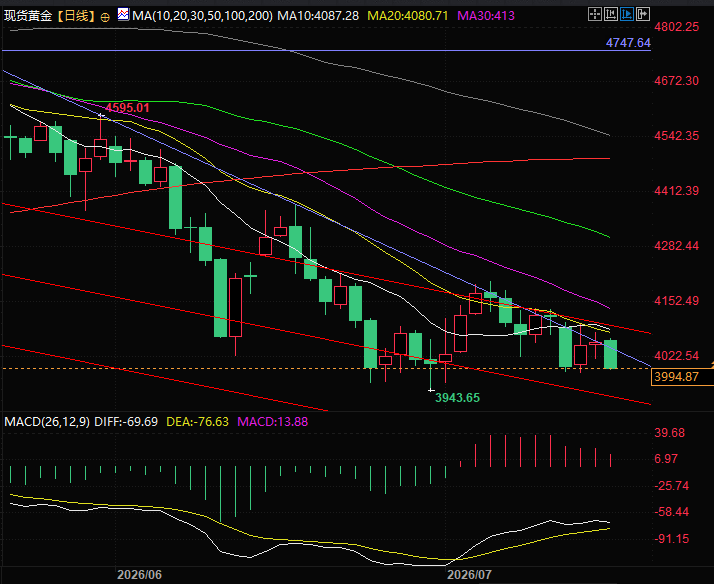 (Spot gold daily chart, source: EasyTrade) At 21:01 Beijing time, spot gold is currently trading at $3993 per ounce.
US retail sales data released, weaker-than-expected, had limited impact on gold prices.
Amid geopolitical risks dominating market pricing, the US June retail sales data was officially released. While the overall data met market expectations, the core retail sales control group's month-on-month performance fell short. The market had anticipated a -0.1% decline, but the actual figure was -0.2%. Since this data reflects a mild slowdown rather than a sharp decline, and geopolitical risks dominated safe-haven pricing, it did not significantly drive gold prices. A key indicator for judging the momentum of the US economy is the three-month annualized average of the retail sales control group. In May, this figure surged to over 9%, reaching a new high since June 2022. The slight decline in June is merely a normal correction after the spring consumption surge and does not indicate a sustained downward trend in consumption. Meanwhile, the overall expectation for US Q2 GDP remains robust, and the slight weakness in June retail sales will not disrupt market pricing before the Q2 GDP release on July 30th. Even with potential suppressive factors such as the fading of tax rebate benefits, slowing real wages, and rising household debt burdens, core consumption, after excluding volatility, remains resilient.Analysts predict a prolonged stalemate in the conflict: ground warfare is unlikely, and the situation faces two potential outcomes.
Multiple geopolitical and commodity research institutions have reached a consensus on the long-term trajectory of the US-Iran conflict: Simply relying on aerial bombardment will not allow the US to gain control of the Strait of Hormuz. To completely dismantle Iran's strategic containment based on the Kharg Island oil hub and force Iran to compromise, only a large-scale ground war can achieve this. However, the US currently lacks the comprehensive conditions to wage a ground war. From a military perspective, Iran's vast territory, complex mountainous terrain, and extensive underground fortifications allow for the rapid mobilization of millions of militia for homeland resistance. Even with the integration of existing US Army and Marine Corps forces, it is insufficient to support a ground invasion covering the entire territory of Iran; a prolonged war would incur unbearable personnel and financial losses. From a political and public opinion perspective, Trump is acting cautiously under the constraints of the War Powers Act. The existing US industrial and logistical systems cannot support an indefinite Middle East conflict. The continued war will erode domestic public support, making it difficult to sustain until the midterm elections, let alone the 2028 presidential election. Even if the US launches a surprise attack on Kharg Island to tighten the oil blockade, the Iranian Revolutionary Guard's willingness to comply is extremely low, and even if a temporary agreement is reached, it is unlikely to be adhered to in the long term.Summarize:
Given the near impossibility of a ground war, future scenarios present two possible outcomes. The first is a significant compromise by the US, reducing the scope of its airstrikes and returning to a negotiation framework to engage in diplomatic consultations with Iran, exchanging diplomatic concessions for stable navigation in the Strait. The second is that Iran maintains a hardline stance on Strait control, continuing to use proxies to counterbalance US shipping, while actively easing diplomatic relations with global energy-importing countries to avoid simultaneous pressure from all oil-consuming nations, thus maintaining control of the Strait through a balanced diplomatic approach. Both outcomes require compromise from the US. However, Trump continues to cultivate a tough image, and with election pressures making compromise unlikely in the short term, geopolitical tensions will persist, leading to a weakening of gold prices. (Spot gold daily chart, source: EasyTrade) At 21:01 Beijing time, spot gold is currently trading at $3993 per ounce.
- Risk Warning and Disclaimer
- The market involves risk, and trading may not be suitable for all investors. This article is for reference only and does not constitute personal investment advice, nor does it take into account certain users’ specific investment objectives, financial situation, or other needs. Any investment decisions made based on this information are at your own risk.