Gold and silver prices both fell: Expectations of a Fed rate cut faded after data release.
2026-07-16 23:44:11
On Thursday (July 16), spot gold and silver prices weakened significantly during the US trading session. Rising US Treasury yields, a stabilizing and rebounding US dollar index, and renewed geopolitical risks in the Strait of Hormuz offset the support for precious metals from this week's cooling inflation data. Spot gold traded around $4,015 per ounce, down approximately 1.11% on the day; spot silver was quoted around $55.44, down 2.27% on the day.  Gold traded between $3973 and $4067 in early trading, hitting a new intraday low and breaking below the $4000 mark for the first time in this correction. Silver traded between approximately $55.80 and $58.04 in early trading, effectively breaking below the key buying support level of $57.15 and falling sharply below the moving averages of $58.97 and $60.45. Following the release of the latest economic data, market trading logic shifted, with the fervor surrounding the easing measures driven by the Consumer Price Index (CPI) and Producer Price Index (PPI) cooling significantly. While the overall CPI fell 0.4% month-on-month in June, and the PPI for end-user demand declined by 0.3%, the retail sales and initial jobless claims data released today showed no signs of recession in the US economy. Retail sales rose 0.2% month-on-month in June, in line with market expectations; initial jobless claims fell by 8,000 to 208,000, a 10-week low, below the market expectation of 218,000. Influenced by data, the market's one-sided bet on the Federal Reserve's interest rate has come to an end: the market still expects the Fed to keep interest rates unchanged at its July 29 meeting, with a probability of nearly 90%; however, the 10-year Treasury yield has rebounded to around 4.57%, the 2-year Treasury yield is at 4.16%, and the US dollar index has risen slightly to 100.54. Weakening inflation provides underlying support for gold, but resilient consumer data, low unemployment claims, and firm Treasury yields continue to suppress the upside potential of gold prices. The current shipping situation in the Strait of Hormuz can be summarized as follows: although the channel is still navigable, it is under high-intensity military standoff and blockade risk throughout, making the shipping environment far from stable. The US has expanded its strikes against northern Iran and seized an oil tanker that the US claims attempted to break through the blockade; Iran, in turn, continues to use missiles and drones to attack pro-US targets in Bahrain, Jordan, and Kuwait. International oil prices rose again, with Brent crude around $86 and West Texas Intermediate (WTI) crude around $80.40, as traders priced in the potential risks of shipping disruptions in the Strait of Hormuz. Geopolitical tensions have a two-way impact on gold: the Strait of Hormuz crisis will boost safe-haven buying of gold, but higher oil prices will reignite market concerns about inflation, supporting US Treasury yields and limiting the upside potential of precious metals. The overall trading pattern for major asset classes is clear: oil is strong, bonds are under pressure, the dollar is strong, and silver is underperforming gold. Traders are closely monitoring subsequent changes in market expectations for Fed interest rates after the release of retail and unemployment data, speeches by Fed officials, and whether there will be further disruptions to shipping in the Strait of Hormuz. If US Treasury yields continue to decline, gold will have a smooth upward channel and is expected to retest the $4070-$4103 resistance range; if oil prices surge again, the market will refocus on whether energy inflation can offset the positive impact of the cooling CPI and PPI in June. Key Market Trends in Commodities, Forex, and Bonds WTI crude oil prices on the New York Mercantile Exchange strengthened, reaching $80.40 per barrel; Brent crude oil prices were around $86 per barrel. The US dollar index strengthened, trading around 100.71. The benchmark 10-year US Treasury yield remained around 4.57%. Gold Technical Analysis
 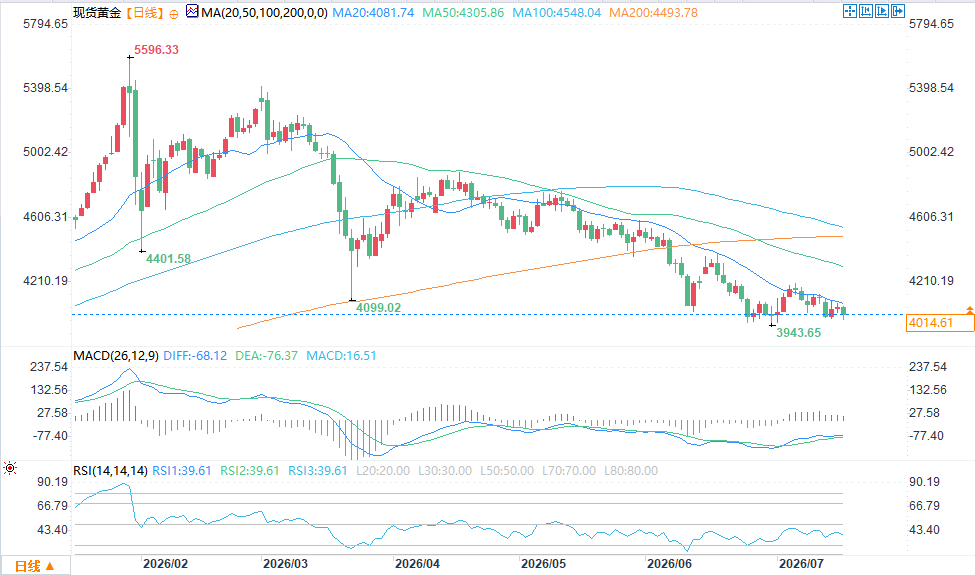 Spot gold is currently dominated by short-term bears. Gold prices broke below the $4,000 mark and tested $3,973, with the triple bottom support around $3,959 returning to market focus. The bulls' short-term upside target is to recover $4,044; a sustained move above this level would challenge the 50-period moving average at $4,094, with a further target of $4,140. The bears' short-term downside target is a break below $3,959; a decisive break below this level would see deeper support at $3,942, followed by a test of $3,886. First resistance is at $4,044, and the second resistance is at $4,094; first support is at $3,973, and the second support is at $3,959. Silver Technical Analysis
 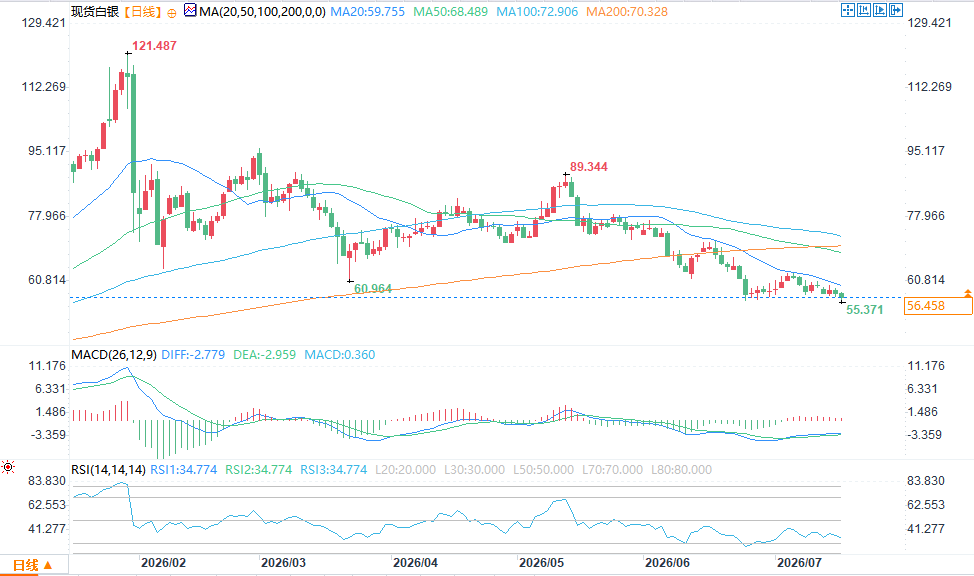 Short-term bears also hold the upper hand in spot silver. Silver prices have fallen below $57.15, approaching the previously marked stop-loss zone of $56.50. The short-term upside target for silver bulls is a return to $57.52; a hold above that level would target $58.83, with a further target of $60.41. The short-term downside target for bears is a break below $56.50; deeper downside targets are $55.60 and $55.00. First resistance is at $57.52, second resistance at $58.83; first support is at $56.50, second support at $55.60.
Gold traded between $3973 and $4067 in early trading, hitting a new intraday low and breaking below the $4000 mark for the first time in this correction. Silver traded between approximately $55.80 and $58.04 in early trading, effectively breaking below the key buying support level of $57.15 and falling sharply below the moving averages of $58.97 and $60.45. Following the release of the latest economic data, market trading logic shifted, with the fervor surrounding the easing measures driven by the Consumer Price Index (CPI) and Producer Price Index (PPI) cooling significantly. While the overall CPI fell 0.4% month-on-month in June, and the PPI for end-user demand declined by 0.3%, the retail sales and initial jobless claims data released today showed no signs of recession in the US economy. Retail sales rose 0.2% month-on-month in June, in line with market expectations; initial jobless claims fell by 8,000 to 208,000, a 10-week low, below the market expectation of 218,000. Influenced by data, the market's one-sided bet on the Federal Reserve's interest rate has come to an end: the market still expects the Fed to keep interest rates unchanged at its July 29 meeting, with a probability of nearly 90%; however, the 10-year Treasury yield has rebounded to around 4.57%, the 2-year Treasury yield is at 4.16%, and the US dollar index has risen slightly to 100.54. Weakening inflation provides underlying support for gold, but resilient consumer data, low unemployment claims, and firm Treasury yields continue to suppress the upside potential of gold prices. The current shipping situation in the Strait of Hormuz can be summarized as follows: although the channel is still navigable, it is under high-intensity military standoff and blockade risk throughout, making the shipping environment far from stable. The US has expanded its strikes against northern Iran and seized an oil tanker that the US claims attempted to break through the blockade; Iran, in turn, continues to use missiles and drones to attack pro-US targets in Bahrain, Jordan, and Kuwait. International oil prices rose again, with Brent crude around $86 and West Texas Intermediate (WTI) crude around $80.40, as traders priced in the potential risks of shipping disruptions in the Strait of Hormuz. Geopolitical tensions have a two-way impact on gold: the Strait of Hormuz crisis will boost safe-haven buying of gold, but higher oil prices will reignite market concerns about inflation, supporting US Treasury yields and limiting the upside potential of precious metals. The overall trading pattern for major asset classes is clear: oil is strong, bonds are under pressure, the dollar is strong, and silver is underperforming gold. Traders are closely monitoring subsequent changes in market expectations for Fed interest rates after the release of retail and unemployment data, speeches by Fed officials, and whether there will be further disruptions to shipping in the Strait of Hormuz. If US Treasury yields continue to decline, gold will have a smooth upward channel and is expected to retest the $4070-$4103 resistance range; if oil prices surge again, the market will refocus on whether energy inflation can offset the positive impact of the cooling CPI and PPI in June. Key Market Trends in Commodities, Forex, and Bonds WTI crude oil prices on the New York Mercantile Exchange strengthened, reaching $80.40 per barrel; Brent crude oil prices were around $86 per barrel. The US dollar index strengthened, trading around 100.71. The benchmark 10-year US Treasury yield remained around 4.57%. Gold Technical Analysis Spot gold is currently dominated by short-term bears. Gold prices broke below the $4,000 mark and tested $3,973, with the triple bottom support around $3,959 returning to market focus. The bulls' short-term upside target is to recover $4,044; a sustained move above this level would challenge the 50-period moving average at $4,094, with a further target of $4,140. The bears' short-term downside target is a break below $3,959; a decisive break below this level would see deeper support at $3,942, followed by a test of $3,886. First resistance is at $4,044, and the second resistance is at $4,094; first support is at $3,973, and the second support is at $3,959. Silver Technical Analysis Short-term bears also hold the upper hand in spot silver. Silver prices have fallen below $57.15, approaching the previously marked stop-loss zone of $56.50. The short-term upside target for silver bulls is a return to $57.52; a hold above that level would target $58.83, with a further target of $60.41. The short-term downside target for bears is a break below $56.50; deeper downside targets are $55.60 and $55.00. First resistance is at $57.52, second resistance at $58.83; first support is at $56.50, second support at $55.60.
- Risk Warning and Disclaimer
- The market involves risk, and trading may not be suitable for all investors. This article is for reference only and does not constitute personal investment advice, nor does it take into account certain users’ specific investment objectives, financial situation, or other needs. Any investment decisions made based on this information are at your own risk.