Crude oil trading alert: Crude oil prices surged and then retreated, facing a directional decision point near the downtrend line.
2026-07-21 09:42:13
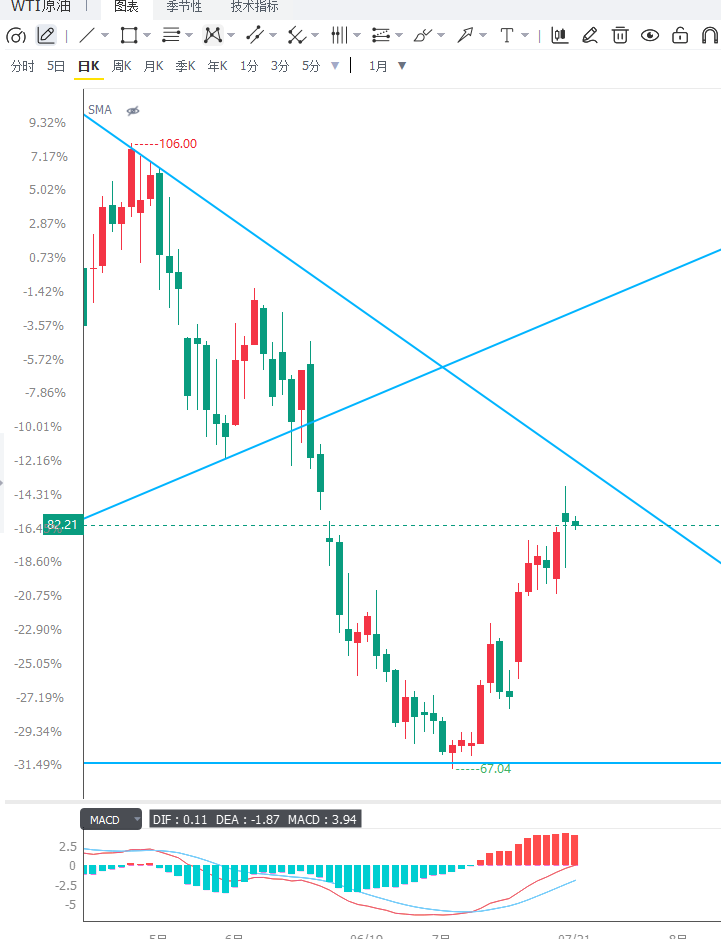
U.S. West Texas Intermediate (WTI) crude oil prices fell for a second consecutive trading day in Asian trading on Tuesday, trading around $82.20 per barrel. The recent decline in oil prices was mainly due to a temporary improvement in market risk sentiment, as investors began to digest expectations of easing supply pressures from potential diplomatic de-escalation. Iran stated that mediators had proposed a plan to ease tensions, and some market observers even believed that a short-term ceasefire was possible. This news reduced the risk premium previously in the oil market due to concerns about supply disruptions, leading to a temporary pullback in oil prices.  However, the crude oil market has not completely escaped supply risks. Recent ongoing regional military action continues to influence market expectations, entering its tenth consecutive day, raising concerns about potential further disruptions to energy infrastructure and transportation routes. The core contradiction in current oil price movements lies in the interplay between expectations of diplomatic easing and the risk of supply disruptions . On the one hand, if tensions ease, the market may continue to reduce risk premiums, pushing crude oil prices further down; on the other hand, if the conflict continues to escalate, supply concerns could quickly reignite oil price increases. Recent heightened market risk sentiment is closely related to changes in the regional security situation. Previously, the US stated that its actions were a response to casualties, but the market is concerned that subsequent reactions could lead to broader instability. Meanwhile, energy transportation security has become a key focus for the crude oil market. Some armed groups have announced restrictions on Saudi Arabian maritime activities, causing the market to refocus on the Red Sea route and Middle Eastern energy transportation risks. The Strait of Hormuz remains one of the most sensitive supply nodes in the global energy market. This region carries crucial global energy transportation, and any significant disruption to shipping could rapidly tighten global crude oil supply expectations. Market data shows that recent commercial shipping activity has been affected, with some shipping companies taking detours or delays, leading to increased concerns about future supply stability. Shipping risks in the Strait of Hormuz remain a significant factor supporting crude oil prices . From a global energy market perspective, oil prices are currently influenced by multiple factors. Besides regional risks, investors are also focused on changes in global crude oil inventories, production policies of major oil-producing countries, and the global economic growth outlook. If diplomatic negotiations progress, the market may refocus on weak demand and inventory pressures, potentially leading to further price corrections. However, if tensions continue to escalate, supply risks could regain dominance, pushing WTI to retest higher levels. The market is currently awaiting more information on supply recovery, shipping conditions, and diplomatic progress. Investors will also be watching the U.S. Energy Information Administration (EIA) inventory data to determine if there have been changes in actual supply. The daily chart for WTI crude oil shows that after breaking through the $80 area, prices have remained high and are currently fluctuating around $82. The overall trend remains in a consolidation phase after the rise, but short-term momentum has weakened. The key support level to watch is the psychological level of $80.00, which is also a crucial defense line for the recent breakout area. A break below this level could lead to further testing of the support around $78.50. The first resistance level to watch is $83.50; a break above this level could challenge the $85.00 to $86.00 range. The daily chart shows that crude oil is still supported by geopolitical risk premiums, but prices need new bullish factors to restore upward momentum. On the 4-hour chart, WTI prices have recently formed a volatile pullback pattern, testing moving average support after a short-term decline from highs. The MACD indicator shows a pullback signal, indicating that upward momentum is dissipating; the RSI indicator has fallen to neutral territory, suggesting that market buying enthusiasm has cooled somewhat. If oil prices can hold the support around $81, a short-term rebound may occur, retesting the resistance above $83; however, a break below $80 could open up further downside potential, with a target around $78. The short-term direction still depends on diplomatic news and changes in supply risks.
  In summary , WTI crude oil is currently under the dual influence of declining risk premiums and rising supply concerns. Signals of diplomatic easing have pushed oil prices down in the short term, but continued regional tensions and energy transportation risks prevent the market from completely alleviating supply concerns. In the short term, oil price movements remain highly dependent on developments in the situation. If diplomatic progress rapidly de-escalates risks, WTI may continue to decline; however, if transportation routes are disrupted or supply risks escalate, crude oil prices may regain upward momentum. The market will need to focus on shipping conditions in the Strait of Hormuz, progress in diplomatic negotiations, and changes in US crude oil inventories. In a highly volatile environment, oil prices may still exhibit rapid and volatile movements; investors should pay close attention to changes in key support and resistance levels.
However, the crude oil market has not completely escaped supply risks. Recent ongoing regional military action continues to influence market expectations, entering its tenth consecutive day, raising concerns about potential further disruptions to energy infrastructure and transportation routes. The core contradiction in current oil price movements lies in the interplay between expectations of diplomatic easing and the risk of supply disruptions . On the one hand, if tensions ease, the market may continue to reduce risk premiums, pushing crude oil prices further down; on the other hand, if the conflict continues to escalate, supply concerns could quickly reignite oil price increases. Recent heightened market risk sentiment is closely related to changes in the regional security situation. Previously, the US stated that its actions were a response to casualties, but the market is concerned that subsequent reactions could lead to broader instability. Meanwhile, energy transportation security has become a key focus for the crude oil market. Some armed groups have announced restrictions on Saudi Arabian maritime activities, causing the market to refocus on the Red Sea route and Middle Eastern energy transportation risks. The Strait of Hormuz remains one of the most sensitive supply nodes in the global energy market. This region carries crucial global energy transportation, and any significant disruption to shipping could rapidly tighten global crude oil supply expectations. Market data shows that recent commercial shipping activity has been affected, with some shipping companies taking detours or delays, leading to increased concerns about future supply stability. Shipping risks in the Strait of Hormuz remain a significant factor supporting crude oil prices . From a global energy market perspective, oil prices are currently influenced by multiple factors. Besides regional risks, investors are also focused on changes in global crude oil inventories, production policies of major oil-producing countries, and the global economic growth outlook. If diplomatic negotiations progress, the market may refocus on weak demand and inventory pressures, potentially leading to further price corrections. However, if tensions continue to escalate, supply risks could regain dominance, pushing WTI to retest higher levels. The market is currently awaiting more information on supply recovery, shipping conditions, and diplomatic progress. Investors will also be watching the U.S. Energy Information Administration (EIA) inventory data to determine if there have been changes in actual supply. The daily chart for WTI crude oil shows that after breaking through the $80 area, prices have remained high and are currently fluctuating around $82. The overall trend remains in a consolidation phase after the rise, but short-term momentum has weakened. The key support level to watch is the psychological level of $80.00, which is also a crucial defense line for the recent breakout area. A break below this level could lead to further testing of the support around $78.50. The first resistance level to watch is $83.50; a break above this level could challenge the $85.00 to $86.00 range. The daily chart shows that crude oil is still supported by geopolitical risk premiums, but prices need new bullish factors to restore upward momentum. On the 4-hour chart, WTI prices have recently formed a volatile pullback pattern, testing moving average support after a short-term decline from highs. The MACD indicator shows a pullback signal, indicating that upward momentum is dissipating; the RSI indicator has fallen to neutral territory, suggesting that market buying enthusiasm has cooled somewhat. If oil prices can hold the support around $81, a short-term rebound may occur, retesting the resistance above $83; however, a break below $80 could open up further downside potential, with a target around $78. The short-term direction still depends on diplomatic news and changes in supply risks. In summary , WTI crude oil is currently under the dual influence of declining risk premiums and rising supply concerns. Signals of diplomatic easing have pushed oil prices down in the short term, but continued regional tensions and energy transportation risks prevent the market from completely alleviating supply concerns. In the short term, oil price movements remain highly dependent on developments in the situation. If diplomatic progress rapidly de-escalates risks, WTI may continue to decline; however, if transportation routes are disrupted or supply risks escalate, crude oil prices may regain upward momentum. The market will need to focus on shipping conditions in the Strait of Hormuz, progress in diplomatic negotiations, and changes in US crude oil inventories. In a highly volatile environment, oil prices may still exhibit rapid and volatile movements; investors should pay close attention to changes in key support and resistance levels.
- Risk Warning and Disclaimer
- The market involves risk, and trading may not be suitable for all investors. This article is for reference only and does not constitute personal investment advice, nor does it take into account certain users’ specific investment objectives, financial situation, or other needs. Any investment decisions made based on this information are at your own risk.