Gold prices have been fluctuating around $4,000, and a short-term bottoming out and rebound is expected.
2026-07-21 10:10:17
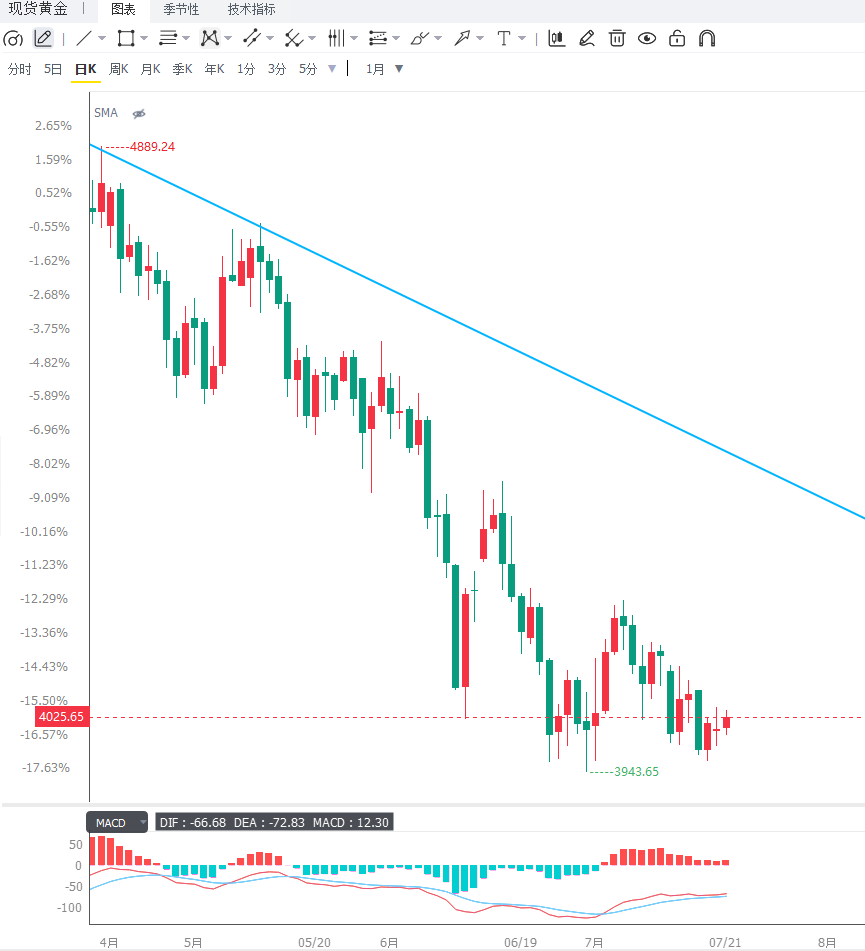
International gold prices (XAU/USD) rebounded slightly in early Asian trading on Tuesday, after briefly falling to around $4,000 before recovering to $4,020. Market sentiment was significantly influenced by changes in the energy market. As tensions escalated in the Middle East, oil prices were supported, and investors renewed concerns about potential resurgence of global inflationary pressures, thereby diminishing gold's appeal as a non-yielding asset.  The US has recently launched a new round of actions against relevant targets, raising market concerns that tensions could further impact energy supply stability. Rising energy prices typically push up inflation expectations through production costs, transportation costs, and consumer prices, potentially prompting major central banks to maintain a more cautious monetary policy stance. Market analysts point out that rising oil prices are reinforcing expectations of a prolonged period of high inflation, and gold and oil prices have recently shown a certain negative correlation . When crude oil prices rise rapidly, investors tend to increase their expectations of central banks maintaining tight monetary policies, pushing up bond yields and thus increasing the opportunity cost of holding gold. UBS analyst Giovanni Stanovo stated that the gold market is currently closely watching developments in the Middle East, with investors assessing the impact of energy price changes on inflation and monetary policy. If crude oil continues to rise, the market may further bet on major economies' central banks maintaining restrictive interest rates for an extended period, which will put pressure on gold. Meanwhile, expectations regarding Federal Reserve policy are also a significant factor influencing gold prices. Previous cooling of US inflation data has reduced the market's likelihood of a near-term Fed rate hike, but investors still believe there is room for further policy tightening before the end of the year. The market generally expects the Federal Reserve to maintain stable interest rates at its next meeting, but the expectation of at least one rate hike throughout the year has not completely subsided. Federal Reserve official Beth Hammark recently delivered a hawkish speech, emphasizing that inflation risks remain and stating that if price pressures persist, the Fed may need to further raise interest rates to control inflation. She pointed out that energy prices, supply chain costs, insurance costs, and investments related to artificial intelligence data centers could all bring new price pressures. The market believes that Hammark's remarks reinforced concerns within the Fed about "inflation lasting longer than expected." This has provided some support for the US dollar, with the dollar index remaining relatively strong, further suppressing the price of dollar-denominated gold. From a global market perspective, gold is currently facing a complex interplay of factors. On the one hand, escalating geopolitical risks may increase safe-haven flows into the gold market; on the other hand, rising oil prices have fueled inflation concerns, potentially pushing interest rate expectations higher again, putting pressure on gold. Furthermore, the dollar's performance remains a crucial variable determining the short-term direction of gold. Investors are currently focusing on three aspects: first, whether the energy market continues to rise; second, whether subsequent US inflation data shows fluctuations; and finally, further statements from Federal Reserve officials regarding the future path of interest rates. If inflationary pressures resurface, the Federal Reserve may maintain its tightening policy for a longer period, limiting the upside potential for gold. Looking at the daily chart, XAU/USD has entered a consolidation phase after recently retreating from its highs, currently testing the psychological support zone around $4000. The overall trend remains range-bound, but short-term momentum has clearly weakened. If gold can hold the $4000 level and stabilize above $4050, it may attract some buying interest, with resistance at the $4100-$4150 area. A break below $4000 could lead to further testing of the $3950 support zone. The daily moving average structure indicates that gold needs to regain support from short-term moving averages to resume its upward trend. On the 4-hour chart, after a continuous decline, the short-term rebound in gold prices has been limited, and the market is in a weak consolidation pattern. The MACD indicator formed a death cross at a high level and continues to move downwards, indicating that short-term selling pressure remains; the RSI indicator is close to the neutral zone, suggesting that the market is not severely oversold and further correction is still possible. If the price breaks through $4,050 and stabilizes, a short-term technical correction may occur; however, if it falls below $4,000, it may open up room for a pullback to the $3,950 or even $3,900 area.
  Editor's Summary: Gold is currently in a tug-of-war between safe-haven demand and high interest rate pressures. Escalating tensions in the Middle East have boosted market risk appetite, providing some support for gold. However, inflationary pressures from rising oil prices may push the Federal Reserve to maintain a hawkish stance, thus limiting the upside potential for gold. In the short term, the $4,000 level will be a key focus for the market. Gold's future direction will depend on energy price trends, US inflation data, and policy signals from the Federal Reserve. If crude oil continues to rise and drives up inflation expectations, gold may continue to face downward pressure; however, if risk events escalate and trigger safe-haven inflows, gold still has the opportunity to rebound. Close attention should be paid to the dollar's performance and changes in interest rate expectations to find a market equilibrium in a highly volatile environment.
The US has recently launched a new round of actions against relevant targets, raising market concerns that tensions could further impact energy supply stability. Rising energy prices typically push up inflation expectations through production costs, transportation costs, and consumer prices, potentially prompting major central banks to maintain a more cautious monetary policy stance. Market analysts point out that rising oil prices are reinforcing expectations of a prolonged period of high inflation, and gold and oil prices have recently shown a certain negative correlation . When crude oil prices rise rapidly, investors tend to increase their expectations of central banks maintaining tight monetary policies, pushing up bond yields and thus increasing the opportunity cost of holding gold. UBS analyst Giovanni Stanovo stated that the gold market is currently closely watching developments in the Middle East, with investors assessing the impact of energy price changes on inflation and monetary policy. If crude oil continues to rise, the market may further bet on major economies' central banks maintaining restrictive interest rates for an extended period, which will put pressure on gold. Meanwhile, expectations regarding Federal Reserve policy are also a significant factor influencing gold prices. Previous cooling of US inflation data has reduced the market's likelihood of a near-term Fed rate hike, but investors still believe there is room for further policy tightening before the end of the year. The market generally expects the Federal Reserve to maintain stable interest rates at its next meeting, but the expectation of at least one rate hike throughout the year has not completely subsided. Federal Reserve official Beth Hammark recently delivered a hawkish speech, emphasizing that inflation risks remain and stating that if price pressures persist, the Fed may need to further raise interest rates to control inflation. She pointed out that energy prices, supply chain costs, insurance costs, and investments related to artificial intelligence data centers could all bring new price pressures. The market believes that Hammark's remarks reinforced concerns within the Fed about "inflation lasting longer than expected." This has provided some support for the US dollar, with the dollar index remaining relatively strong, further suppressing the price of dollar-denominated gold. From a global market perspective, gold is currently facing a complex interplay of factors. On the one hand, escalating geopolitical risks may increase safe-haven flows into the gold market; on the other hand, rising oil prices have fueled inflation concerns, potentially pushing interest rate expectations higher again, putting pressure on gold. Furthermore, the dollar's performance remains a crucial variable determining the short-term direction of gold. Investors are currently focusing on three aspects: first, whether the energy market continues to rise; second, whether subsequent US inflation data shows fluctuations; and finally, further statements from Federal Reserve officials regarding the future path of interest rates. If inflationary pressures resurface, the Federal Reserve may maintain its tightening policy for a longer period, limiting the upside potential for gold. Looking at the daily chart, XAU/USD has entered a consolidation phase after recently retreating from its highs, currently testing the psychological support zone around $4000. The overall trend remains range-bound, but short-term momentum has clearly weakened. If gold can hold the $4000 level and stabilize above $4050, it may attract some buying interest, with resistance at the $4100-$4150 area. A break below $4000 could lead to further testing of the $3950 support zone. The daily moving average structure indicates that gold needs to regain support from short-term moving averages to resume its upward trend. On the 4-hour chart, after a continuous decline, the short-term rebound in gold prices has been limited, and the market is in a weak consolidation pattern. The MACD indicator formed a death cross at a high level and continues to move downwards, indicating that short-term selling pressure remains; the RSI indicator is close to the neutral zone, suggesting that the market is not severely oversold and further correction is still possible. If the price breaks through $4,050 and stabilizes, a short-term technical correction may occur; however, if it falls below $4,000, it may open up room for a pullback to the $3,950 or even $3,900 area. Editor's Summary: Gold is currently in a tug-of-war between safe-haven demand and high interest rate pressures. Escalating tensions in the Middle East have boosted market risk appetite, providing some support for gold. However, inflationary pressures from rising oil prices may push the Federal Reserve to maintain a hawkish stance, thus limiting the upside potential for gold. In the short term, the $4,000 level will be a key focus for the market. Gold's future direction will depend on energy price trends, US inflation data, and policy signals from the Federal Reserve. If crude oil continues to rise and drives up inflation expectations, gold may continue to face downward pressure; however, if risk events escalate and trigger safe-haven inflows, gold still has the opportunity to rebound. Close attention should be paid to the dollar's performance and changes in interest rate expectations to find a market equilibrium in a highly volatile environment.
- Risk Warning and Disclaimer
- The market involves risk, and trading may not be suitable for all investors. This article is for reference only and does not constitute personal investment advice, nor does it take into account certain users’ specific investment objectives, financial situation, or other needs. Any investment decisions made based on this information are at your own risk.