Why is the exchange rate fluctuating at high levels despite signs of stabilizing employment in the UK?
2026-07-21 15:44:14
On Tuesday, July 21, the British pound was trading around 1.3450 against the US dollar. The exchange rate has retreated slightly from its recent high of 1.3557, but remains significantly above the Bollinger Band's middle line. The latest UK employment data released a combination of signals: stabilizing labor demand and easing wage pressures. Meanwhile, the fiscal deficit exceeded budget forecasts, making the new government's policy costs and financing discipline key variables again crucial for pound pricing. The market is reassessing the policy threshold for the Bank of England's July 30 meeting, and the pound has shifted from a one-sided upward trend to a rebalancing at higher levels in the short term. 
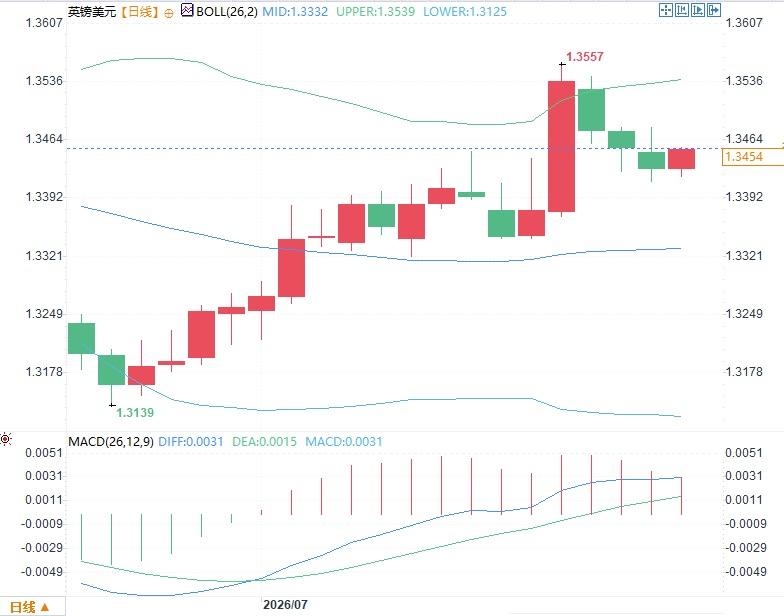 The MACD fast line remains above the slow line, and the histogram remains positive, but the recent rate of expansion has slowed, indicating that the medium-term upward structure has not been broken, although the marginal momentum is significantly weaker than during the upward surge. The area between 1.3539 and 1.3557 forms a dense resistance zone above, while 1.3390 to 1.3332 is a crucial area to observe whether the high-level consolidation will turn into a deeper correction. The current price of around 1.3450 is between these two levels, reflecting that the market has not yet formed a new directional consensus among the three factors of cooling wages, policy interest rates, and fiscal risks.
Employment data has stabilized, but this is not enough to confirm a renewed expansion in demand.
The UK's payrolls list showed a decrease of only 4,000 jobs in June, less than the market's previous forecast of 8,000, while the previous month's figure reversed to an increase of 3,000. Job vacancies remained around 712,000 in the three months to June, and the unemployment rate remained at 4.9%. These figures suggest that the pace of job cuts is slowing, and the most severe contraction in the labor market may have passed, but stability does not equate to renewed expansion. In particular, the unemployment rate for the 16-24 age group rose to 16.4%, reflecting an uneven recovery in employment across industries and age groups. Statistical agencies also cautioned that the quality of some survey samples has declined, therefore single-month data should not be given excessive weight. For the pound, a smaller-than-expected drop in employment can alleviate concerns about a rapid economic slowdown, but its positive effect is constrained by slowing wages. The foreign exchange market is more concerned with whether labor shortages will continue to create inflationary stickiness through wages and service prices than with the number of jobs themselves. Current data suggests the answer is negative.Private sector wages have fallen to low levels, and the Bank of England's policy constraints are beginning to loosen.
In the three months to May, wages excluding bonuses rose 3.4% year-on-year, while private sector wages rose 2.9%, the lowest level since October 2020. Previously released data for the period to April also showed that regular wage growth was 3.4%, while the real increase after adjusting for the cost of living was only 0.1%. Wage growth has gradually shifted from being an inflation driver to a consumption support driver, and the risk of secondary transmission to service prices is decreasing. In June, the Bank of England voted 7-2 to keep the interest rate unchanged at 3.75%, with two other members favoring a rate hike to 4%, indicating that rising energy prices continue to keep policymakers on edge. Stabilizing employment demand and continued wage cooling mean that the July meeting will not face a simple decision about raising or lowering interest rates, but rather a trade-off between energy costs and endogenous inflation. If wages, hiring, and service prices cool simultaneously, the necessity of maintaining high interest rates will decrease; if an energy shock pushes up inflation expectations again, a policy shift may still be delayed. This means that the pound's interest rate advantage has not disappeared, but the room for further expansion is limited. A stronger exchange rate requires stronger UK data relative to the external economy, not just the Bank of England temporarily maintaining interest rates.Fiscal deficits are more likely to amplify the volatility of the pound than employment data.
In the first three months of the 2026-2027 fiscal year, UK public sector borrowing reached £57.6 billion, £2.7 billion higher than budget forecasts. The deficit in June alone fell to £16 billion, with the improvement mainly attributed to a £5.3 billion year-on-year decrease in debt interest costs. This improvement is relatively temporary and cannot be directly interpreted as a reversal of fiscal trends. Prior to this, cumulative borrowing up to May had reached £46.3 billion, an increase of £8.9 billion year-on-year and £7.7 billion higher than the budget path. Revenue performance was not weak, with fiscal revenue in the first three months exceeding forecasts by £2.4 billion. However, expenditures exceeded forecasts by £3.6 billion, indicating that the main contradiction stemmed from the allocation of funds among interest, public services, welfare, and new policies. Arrangements such as the abolition of VAT on energy bills can alleviate household cash flow pressures, but they also require the government to demonstrate a stable and verifiable source of funding. The market's real focus is whether policies will expand the structural deficit and whether fiscal rules can provide sufficient buffers. Previous statements regarding potential greater flexibility in budget rules have put pressure on UK government bonds, indicating that the foreign exchange market remains highly sensitive to commitments without funding coverage. The pound is currently trading not only on economic growth and interest rate differentials, but also on long-term financing costs. If rising government bond yields are seen as compensation for fiscal risk rather than improved growth, higher yields may not support the pound and could instead increase its risk discount.The technical structure has entered a period of consolidation at high levels, with 1.3557 becoming a key reference point.
The daily chart shows that the British pound rebounded against the US dollar from around 1.3139, reaching a high of 1.3557, before falling back to around 1.3450. The Bollinger Band middle line is around 1.3332, the upper line is around 1.3539, and the lower line is around 1.3125. The exchange rate briefly broke through the upper band before returning to the channel, which usually indicates that the trend momentum remains, but the short-term price action shows a mean reversion after overextending. Improved fundamental expectations have already been partially reflected in the previous rise, and further pricing requires confirmation from new data. The MACD fast line remains above the slow line, and the histogram remains positive, but the recent rate of expansion has slowed, indicating that the medium-term upward structure has not been broken, although the marginal momentum is significantly weaker than during the upward surge. The area between 1.3539 and 1.3557 forms a dense resistance zone above, while 1.3390 to 1.3332 is a crucial area to observe whether the high-level consolidation will turn into a deeper correction. The current price of around 1.3450 is between these two levels, reflecting that the market has not yet formed a new directional consensus among the three factors of cooling wages, policy interest rates, and fiscal risks.
- Risk Warning and Disclaimer
- The market involves risk, and trading may not be suitable for all investors. This article is for reference only and does not constitute personal investment advice, nor does it take into account certain users’ specific investment objectives, financial situation, or other needs. Any investment decisions made based on this information are at your own risk.