Supply risks in the Strait of Hormuz are escalating, with Goldman Sachs predicting Brent crude prices may break $120 in the fourth quarter.
2026-07-21 15:46:15
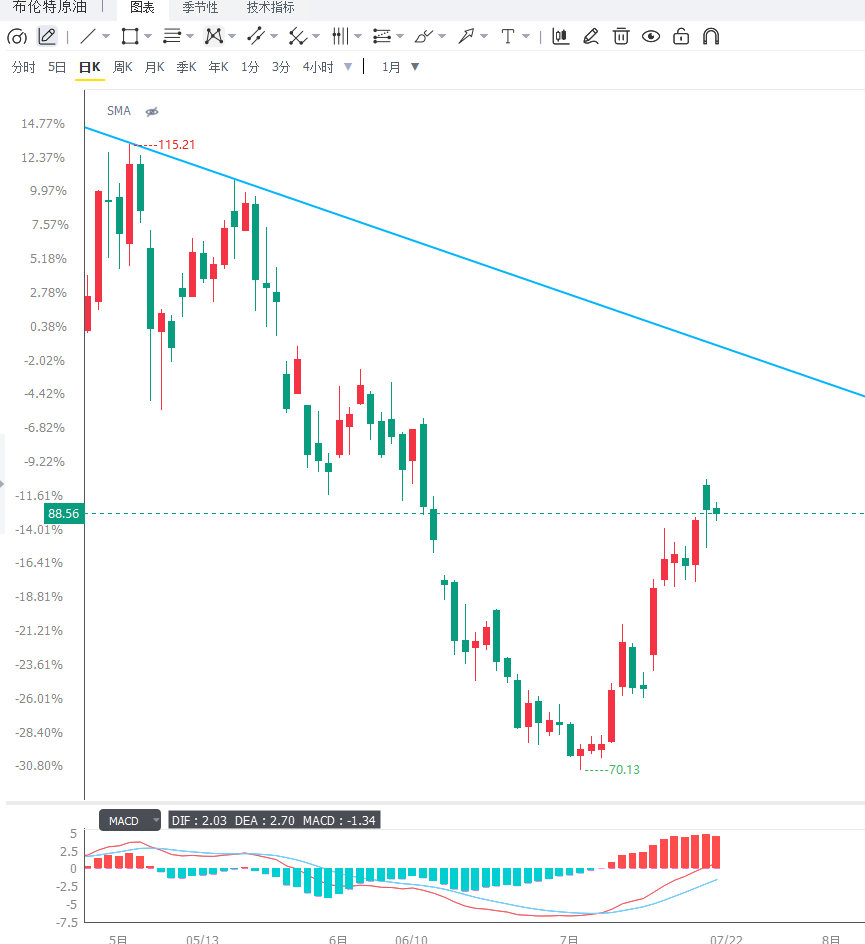
The international oil market has recently been driven again by supply risks. Goldman Sachs stated that if the disruption to oil transportation through the Strait of Hormuz continues, Brent crude prices could rise above $120 per barrel in the fourth quarter of this year. However, the firm emphasized that this scenario is not currently the primary forecast, but rather an extreme case of a further deterioration in supply risks.  In a recent report, Goldman Sachs analysts, including Dan Struvevin, pointed out that escalating tensions in the Middle East and declining oil shipments in the Persian Gulf are driving international oil prices higher again. Market data shows that oil flows in the Persian Gulf have now fallen to below 45% of pre-conflict levels , significantly increasing supply-side uncertainty. The Strait of Hormuz, a vital global energy transport route, has a significant impact on the international crude oil market if its stability is maintained. Continued disruptions to shipping in the region could rapidly tighten global crude oil supply and drive market repricing. Goldman Sachs' current baseline forecast remains cautious. The firm expects Brent crude to trade at around $80 per barrel in the fourth quarter and average around $75 per barrel next year, assuming a gradual easing of tensions in the Middle East. However, Goldman Sachs notes that current oil price forecasts face risks that are clearly skewed upwards, primarily due to the potential for further disruptions to shipping in the Strait of Hormuz and the Red Sea. For the crude oil market, supply risks are often quickly reflected in prices. Even if actual supply has not yet decreased significantly, traders will factor in risk premiums as long as the market anticipates potential future transport disruptions. The recent rise in oil prices reflects this logic. Investors are not only focused on changes in crude oil production, but also on the safety of transportation routes, inventory levels, and the supply capacity of major oil-producing countries. Meanwhile, rising oil prices may also affect global inflation expectations. As a significant inflationary factor, persistently high energy prices could force major central banks to maintain restrictive monetary policies for a longer period, thus impacting the global economic growth outlook. In the US, the market continues to focus on the impact of energy price changes on the Federal Reserve's policy path. If a rapid rise in oil prices leads to a resurgence of inflation, the market may increase its expectations for high interest rates or even further tightening. The European market also faces energy cost pressures. The European economy is highly dependent on external energy supplies, and rising crude oil prices could increase business costs and affect consumer confidence. However, the market also needs to recognize that whether oil prices can sustain a significant rise depends on the actual extent of supply disruptions. If diplomatic channels make progress and shipping gradually resumes, the current risk premium may decline rapidly, and oil prices may return to fundamental trading. Currently, the crude oil market is trading two scenarios: one is a supply recovery after the situation eases, with oil prices returning to around $80; the other is continued transportation disruptions, with supply risks pushing oil prices to higher levels. Brent crude oil's daily chart shows that prices have recently strengthened due to supply risks and are maintaining a high-level consolidation structure. The first resistance level to watch is the $90 area; a break above this level could lead to a test of the $95 psychological level. Higher resistance is seen around $100. On the downside, the first support level to watch is $80, a key level where bulls and bears have been battling recently; a break below this level could lead to a pullback to test support around $77 and $75. The daily trend indicates that oil prices remain supported by geopolitical risks, but new supply-side catalysts are needed to confirm further upside potential. Looking at the 4-hour chart, Brent crude oil maintains a slightly bullish trend in the short term, with prices remaining at a high level supported by risk premiums. The MACD indicator remains in positive territory, but upward momentum has slowed; the RSI indicator is in bullish territory, indicating that buying pressure remains dominant, but there is short-term downward pressure. A break above $90 could open up further upside potential; a break below $80 could lead to a technical correction. Short-term direction still depends on shipping conditions in the Strait of Hormuz, diplomatic progress, and changes in market risk sentiment.
  Editor's Summary: Goldman Sachs' forecast of Brent crude breaking through $120 reflects the market's high level of concern about supply risks, but this scenario remains an extreme risk assumption. The core variable in current oil price movements is not simply changes in demand, but rather whether shipping in the Strait of Hormuz and the Red Sea continues to be affected. In the short term, the crude oil market remains in a risk premium-driven phase. If supply disruptions persist, oil prices may continue to rise, exacerbating global inflationary pressures; however, if the situation eases, the market may quickly reduce the risk premium, bringing oil prices back to fundamentals. Investors should focus on the recovery of energy transportation, changes in global inventories, and supply adjustments by major oil-producing countries. In a highly volatile environment, the possibility of both rising and rapid price corrections exists simultaneously, further enhancing the importance of market risk management.
In a recent report, Goldman Sachs analysts, including Dan Struvevin, pointed out that escalating tensions in the Middle East and declining oil shipments in the Persian Gulf are driving international oil prices higher again. Market data shows that oil flows in the Persian Gulf have now fallen to below 45% of pre-conflict levels , significantly increasing supply-side uncertainty. The Strait of Hormuz, a vital global energy transport route, has a significant impact on the international crude oil market if its stability is maintained. Continued disruptions to shipping in the region could rapidly tighten global crude oil supply and drive market repricing. Goldman Sachs' current baseline forecast remains cautious. The firm expects Brent crude to trade at around $80 per barrel in the fourth quarter and average around $75 per barrel next year, assuming a gradual easing of tensions in the Middle East. However, Goldman Sachs notes that current oil price forecasts face risks that are clearly skewed upwards, primarily due to the potential for further disruptions to shipping in the Strait of Hormuz and the Red Sea. For the crude oil market, supply risks are often quickly reflected in prices. Even if actual supply has not yet decreased significantly, traders will factor in risk premiums as long as the market anticipates potential future transport disruptions. The recent rise in oil prices reflects this logic. Investors are not only focused on changes in crude oil production, but also on the safety of transportation routes, inventory levels, and the supply capacity of major oil-producing countries. Meanwhile, rising oil prices may also affect global inflation expectations. As a significant inflationary factor, persistently high energy prices could force major central banks to maintain restrictive monetary policies for a longer period, thus impacting the global economic growth outlook. In the US, the market continues to focus on the impact of energy price changes on the Federal Reserve's policy path. If a rapid rise in oil prices leads to a resurgence of inflation, the market may increase its expectations for high interest rates or even further tightening. The European market also faces energy cost pressures. The European economy is highly dependent on external energy supplies, and rising crude oil prices could increase business costs and affect consumer confidence. However, the market also needs to recognize that whether oil prices can sustain a significant rise depends on the actual extent of supply disruptions. If diplomatic channels make progress and shipping gradually resumes, the current risk premium may decline rapidly, and oil prices may return to fundamental trading. Currently, the crude oil market is trading two scenarios: one is a supply recovery after the situation eases, with oil prices returning to around $80; the other is continued transportation disruptions, with supply risks pushing oil prices to higher levels. Brent crude oil's daily chart shows that prices have recently strengthened due to supply risks and are maintaining a high-level consolidation structure. The first resistance level to watch is the $90 area; a break above this level could lead to a test of the $95 psychological level. Higher resistance is seen around $100. On the downside, the first support level to watch is $80, a key level where bulls and bears have been battling recently; a break below this level could lead to a pullback to test support around $77 and $75. The daily trend indicates that oil prices remain supported by geopolitical risks, but new supply-side catalysts are needed to confirm further upside potential. Looking at the 4-hour chart, Brent crude oil maintains a slightly bullish trend in the short term, with prices remaining at a high level supported by risk premiums. The MACD indicator remains in positive territory, but upward momentum has slowed; the RSI indicator is in bullish territory, indicating that buying pressure remains dominant, but there is short-term downward pressure. A break above $90 could open up further upside potential; a break below $80 could lead to a technical correction. Short-term direction still depends on shipping conditions in the Strait of Hormuz, diplomatic progress, and changes in market risk sentiment. Editor's Summary: Goldman Sachs' forecast of Brent crude breaking through $120 reflects the market's high level of concern about supply risks, but this scenario remains an extreme risk assumption. The core variable in current oil price movements is not simply changes in demand, but rather whether shipping in the Strait of Hormuz and the Red Sea continues to be affected. In the short term, the crude oil market remains in a risk premium-driven phase. If supply disruptions persist, oil prices may continue to rise, exacerbating global inflationary pressures; however, if the situation eases, the market may quickly reduce the risk premium, bringing oil prices back to fundamentals. Investors should focus on the recovery of energy transportation, changes in global inventories, and supply adjustments by major oil-producing countries. In a highly volatile environment, the possibility of both rising and rapid price corrections exists simultaneously, further enhancing the importance of market risk management.
- Risk Warning and Disclaimer
- The market involves risk, and trading may not be suitable for all investors. This article is for reference only and does not constitute personal investment advice, nor does it take into account certain users’ specific investment objectives, financial situation, or other needs. Any investment decisions made based on this information are at your own risk.