With 43 basis points already priced in, is the euro approaching its most dangerous moment?
2026-07-21 18:58:14
On Tuesday, July 21, the euro was trading around 1.1425 against the US dollar. The exchange rate has been consolidating around 1.14 for the past two weeks. While US inflation cooled significantly in June, weakening interest rate support for the dollar, shipping risks in the Strait of Hormuz, rising energy prices, and a simultaneous shift in policy expectations towards tightening by central banks in Europe and the US have kept the exchange rate within its range. The core issue in the current market is not a simple shift between strength and weakness, but rather a repricing of the pace of US inflation cooling, European energy import pressures, and safe-haven capital flows. 
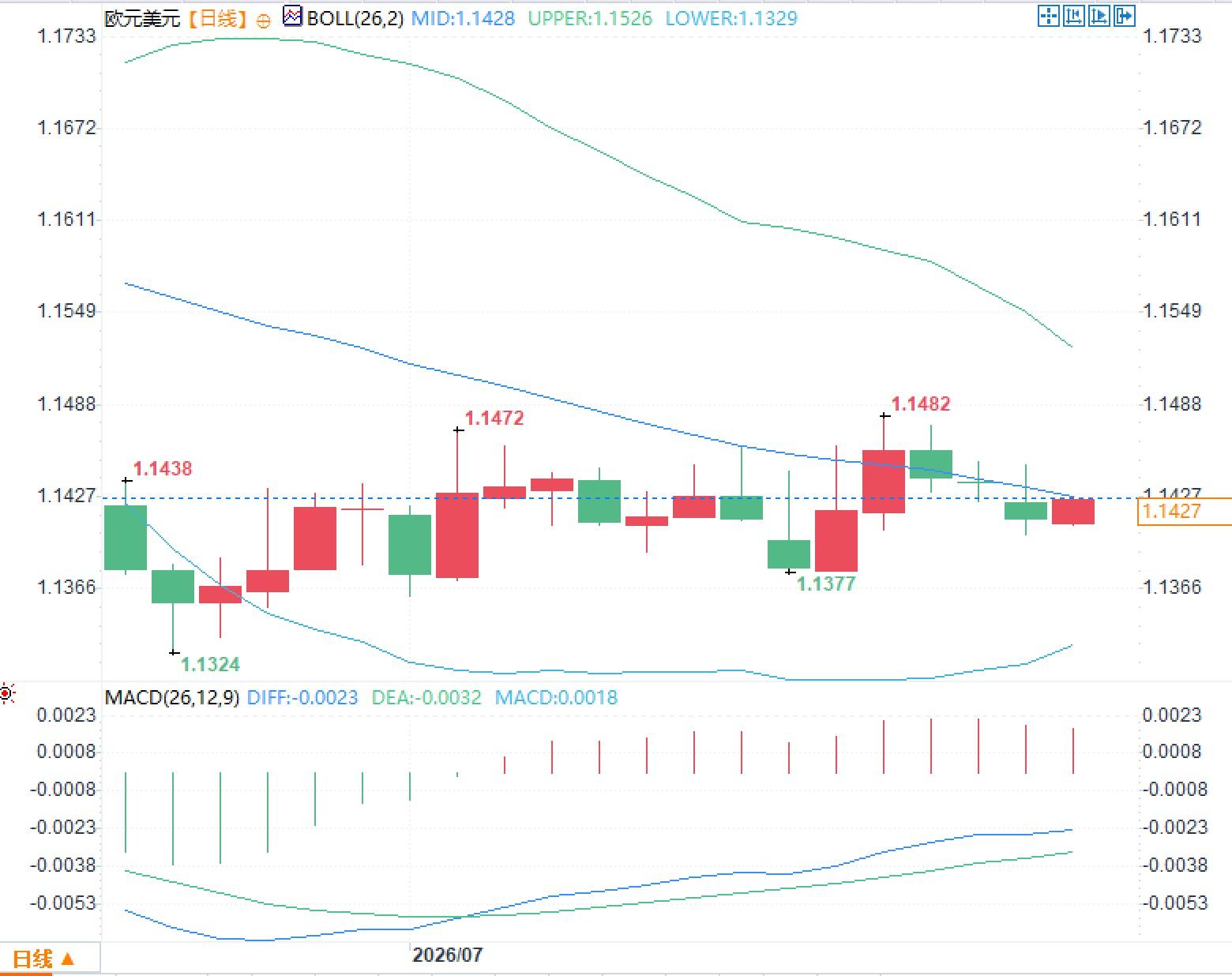 In the MACD indicator, the fast line is at -0.0023, the slow line is at -0.0032, and the histogram value has rebounded to 0.0018. The fast line is above the slow line, reflecting that the previous downward momentum is weakening, but both lines are still below the zero axis, indicating that the corrective nature is stronger than the trend reversal nature. The recent narrowing of the candlestick body and the increase of the upper and lower shadows also show that the bullish and bearish forces are approaching equilibrium around 1.14. Short-term volatility may remain compressed before the ECB meeting, and then amplified by policy wording or the situation in the Taiwan Strait. If the US-Iran ceasefire agreement makes progress, energy risk premiums and the demand for the US dollar as a safe haven may decline simultaneously, but whether the euro can benefit depends on whether the ECB maintains a tight stance. If the conflict escalates and continues to affect energy transportation, the safe-haven attributes of the US dollar may prevail, while the energy import costs faced by Europe will also limit the euro's performance.
US inflation is cooling, but the dollar's interest rate advantage has not disappeared.
The US Consumer Price Index (CPI) fell 0.4% month-over-month in June, but rose 3.5% year-over-year; the core CPI, excluding food and energy, was flat month-over-month but rose 2.6% year-over-year. The data was significantly lower than previous levels, leading the market to lower its expectations for a Fed rate hike in July, and the dollar index also retreated from its recent highs. The Fed's June meeting maintained the target range for the federal funds rate at 3.50% to 3.75%, and the latest policy report still describes inflation as above the 2% target, meaning that a single month's data is insufficient to confirm that price pressures have subsided. The dollar is facing a marginal cooling of interest rate expectations, rather than a complete shift to easing. Especially against the backdrop of disrupted energy transportation, rising oil prices could push up fuel, logistics, and some commodity prices again. Brent crude oil has risen nearly 21% since July, with the recent settlement price reaching $89.22 per barrel. If energy costs remain high, the moderate expectations brought about by the June US inflation data may be partially revised, and the Fed will be more cautious in its statements at subsequent meetings. Therefore, the short-term pressure on the dollar is not contradictory to the limited downside potential in the medium term. The former is driven by inflation data and interest rate futures, while the latter is composed of real interest rate differentials, safe-haven demand, and tail risks of energy inflation. For the euro to achieve a sustained breakout against the dollar, weaker monthly US inflation alone is insufficient.The European Central Bank held rates steady; the real variable will be pricing in September.
The European Central Bank (ECB) will announce its interest rate decision on July 23. The June meeting raised the deposit facility rate, main refinancing rate, and marginal lending rate to 2.25%, 2.40%, and 2.65% respectively, and the market widely expects them to remain unchanged at this meeting. In the latest survey, all economists surveyed expect no rate adjustment in July, but most believe that rising energy prices may prompt the ECB to act again in September. European inflation in June was 2.8% year-on-year, lower than May's 3.2%, but still above the ECB's 2% medium-term target. Looking at the components, service prices contributed 1.51 percentage points to overall inflation, while energy contributed 0.77 percentage points, indicating that price pressures are not entirely explained by short-term energy fluctuations. The coexistence of sticky service inflation and rising energy costs makes it difficult for the ECB to either immediately raise interest rates consecutively or send a clear easing signal. At the press conference following the June meeting, Lagarde emphasized that policy will continue to rely on data and be decided at each meeting, with the goal of stabilizing inflation at 2%. This framework implies that the July meeting's interest rate outcome itself will be limited in its information content. The market is more focused on whether she acknowledges that the energy shock has altered the distribution of inflation risks and whether she leaves clear room for action in September. Currently, the interest rate market has already priced in approximately 43 basis points of further tightening by the end of the year and has placed the main window for the next rate hike in September. Pricing is already tight, and if the press conference fails to provide stronger warnings about inflation, the euro may experience a retracement of expectations; conversely, if the ECB highlights risks related to energy costs, wages, and service prices, the euro's interest rate support will continue.The technical structure indicates that repairs are still underway, but the conditions for a breakthrough are insufficient.
The daily chart shows that the euro rebounded after forming a low of 1.1324 against the US dollar, subsequently encountering resistance multiple times in the 1.1472 to 1.1482 area. The Bollinger Band middle line is at 1.1428, the upper line is at 1.1526, and the lower line is at 1.1329. The current price is basically close to the middle line, indicating that the market is in a directional choice zone, rather than in an acceleration phase of a one-sided trend. In the MACD indicator, the fast line is at -0.0023, the slow line is at -0.0032, and the histogram value has rebounded to 0.0018. The fast line is above the slow line, reflecting that the previous downward momentum is weakening, but both lines are still below the zero axis, indicating that the corrective nature is stronger than the trend reversal nature. The recent narrowing of the candlestick body and the increase of the upper and lower shadows also show that the bullish and bearish forces are approaching equilibrium around 1.14. Short-term volatility may remain compressed before the ECB meeting, and then amplified by policy wording or the situation in the Taiwan Strait. If the US-Iran ceasefire agreement makes progress, energy risk premiums and the demand for the US dollar as a safe haven may decline simultaneously, but whether the euro can benefit depends on whether the ECB maintains a tight stance. If the conflict escalates and continues to affect energy transportation, the safe-haven attributes of the US dollar may prevail, while the energy import costs faced by Europe will also limit the euro's performance.
- Risk Warning and Disclaimer
- The market involves risk, and trading may not be suitable for all investors. This article is for reference only and does not constitute personal investment advice, nor does it take into account certain users’ specific investment objectives, financial situation, or other needs. Any investment decisions made based on this information are at your own risk.