The Australian dollar is caught in a tug-of-war around the 0.70 level, beset by geopolitical pressures and a hawkish stance from the central bank – will Thursday's jobs report break the deadlock?
2026-07-22 08:54:14
On Wednesday (July 22) in early Asian trading, the Australian dollar retreated from its near one-month high of 0.7026 against the US dollar, and is currently trading around 0.7000. This pullback is not accidental – geopolitical events are simultaneously exerting both upward and downward pressure on the Australian dollar, making it difficult for it to establish a clear direction. 
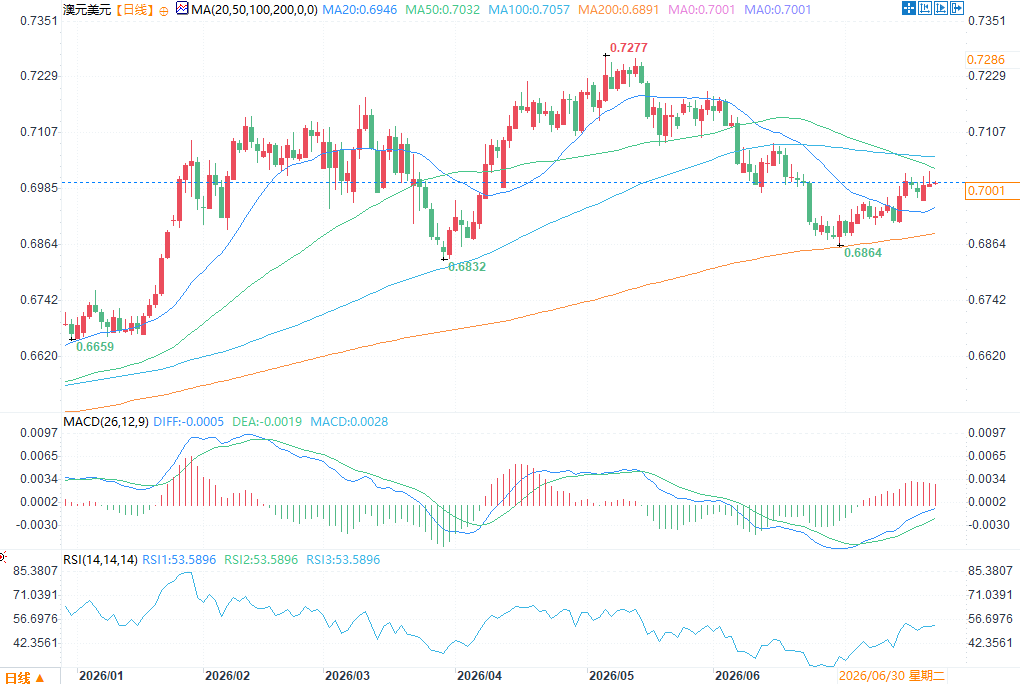 (Australian dollar to US dollar daily chart, source: EasyForex) At 8:47 AM Beijing time on July 22, the Australian dollar was trading at 0.7000/01 against the US dollar.
Two-way tug-of-war: The two-sided effects of geopolitical events on the same ground
The US military strikes against Iran entered their tenth consecutive night, Houthi allies announced a maritime embargo against Saudi Arabia, and oil prices strengthened again—such energy market performance could boost Australian inflation and maintain the Reserve Bank of Australia's (RBA) tightening stance. The RBA's cash rate has risen to 4.35% after three rate hikes this year, and its decision to hold rates steady in June clearly indicated that further rate hikes were still under consideration. Most economists surveyed still expect another rate hike at the August 11 meeting. However, the same geopolitical events also have a dual effect on the Australian dollar. Safe-haven demand and energy-driven inflation risks have led the market to fully price in a Fed rate hike before December, with a probability of about two-thirds before mid-September, and a significant tail-end bet on two rate hikes—a combination that pushed the USD/JPY pair above 163.00 on Tuesday, the first time since 1986. The US weekly hiring index, released on Tuesday, slowed for the fourth consecutive week, the only weakness for the dollar, but the market reacted little to it. When the central banks of two countries adopt a hawkish stance for the same reasons, the interest rate differential fails to provide a directional breakout for the Australian dollar – a perfect description of the current trend.Iron ore prices failed to break the deadlock, with tariffs looming as a drag.
Commodity channels, which typically act as "referees" in such stalemates, are currently stalled. Iron ore has been stuck below $100 per tonne throughout the summer, constrained by increased seaborne supply, pressured steel mill margins in Asia, and port inventories refusing to be depleted. Repeated stimulus promises from Asia remain mere rhetoric until construction demand materializes. Australia's terms of trade have stalled at a time when its currency most needs a boost, with domestic inflation sticking only offsetting external pressures rather than creating a combined effect. The looming threat of tariffs adds a quieter drag to the balance sheet. Washington imposed a new 50% tariff on Canadian goods earlier this week and hinted at imminent action against dozens of trading partners—a small, open economy closely tied to industrial demand in Asia feels the chill without even needing to be on any list. Every risk-sensitive currency carries this pressure into the end of the month, but the Australian dollar, as a proxy currency for global trade, bears more pressure than most.Thursday's jobs report: The first chance to break the deadlock
Thursday's labor market report is the only chance to break the deadlock this week. Market consensus expects June job growth to slow to 15,000 from 40,300 in May, with the unemployment rate remaining at 4.4% and the labor force participation rate steady at 66.7%. Data close to the consensus will keep the August rate hike suspense open and the range intact; a genuine deviation in either direction would finally provide the currency with the domestic driver it has lacked all month. Thursday will also see the release of preliminary July manufacturing, services, and composite purchasing managers' indices—all slightly above the 50.0 mark, just a step away from contraction, meaning a poor month would have a substantial impact.Key variables next week: Australian CPI and the Federal Reserve decision.
The real test will come next week. Australia's June CPI data, which will determine the outlook for an August rate hike, will be released soon, and the Federal Reserve will also announce its latest interest rate decision. At that time, the two core drivers of the Australian dollar exchange rate—Australian domestic inflation path and the Fed's monetary policy signals—will be simultaneously tested by the market. The market generally expects that if the June CPI data shows that inflationary pressures remain above the target range, the probability of a rate hike by the Reserve Bank of Australia (RBA) in August will increase significantly. This would directly boost the Australian dollar exchange rate, providing strong support. Conversely, if the data shows a moderate decline, it may postpone rate hike expectations, putting pressure on the Australian dollar. Regarding the Fed, the interest rate decision and dot plot guidance are closely watched. If the Fed maintains its current interest rate path or releases a more hawkish signal, it will further consolidate the strength of the US dollar, increasing downward pressure on the Australian dollar against the US dollar. Conversely, a dovish shift may alleviate the external headwinds facing the Australian dollar. The combined effect of these two events will significantly amplify the volatility of the Australian dollar exchange rate. Investors should pay close attention to the performance of Australia's core CPI indicators and the Fed Chairman's statements at the press conference. The Australian dollar is currently in a sensitive position, and the results of next week's data and decisions may determine its short-term trend, whether it continues to rebound or returns to a weak range.Technical Analysis
Resistance: The 50-day moving average, slightly above 0.7000, forms a short-term top, followed by selling pressure below 0.7050, with the area broken in June around 0.7100 further up. Support: The first support level is at 0.6950—the starting point of the latest upward move; followed by the 200-day moving average around 0.6900, which is the bottom support of the entire July rebound. Bias: Bearish. Repeated resistance at the 50-day moving average, and the daily stochastic oscillator in deep overbought territory, indicates the path of least resistance is a retest of 0.6950. Only a daily close above 0.7050 would negate this assessment. (Australian dollar to US dollar daily chart, source: EasyForex) At 8:47 AM Beijing time on July 22, the Australian dollar was trading at 0.7000/01 against the US dollar.
- Risk Warning and Disclaimer
- The market involves risk, and trading may not be suitable for all investors. This article is for reference only and does not constitute personal investment advice, nor does it take into account certain users’ specific investment objectives, financial situation, or other needs. Any investment decisions made based on this information are at your own risk.