The widening interest rate differential between the US and Japan, coupled with rising risk aversion, pushed the US dollar to its highest level against the Japanese yen since 1986.
2026-07-22 14:20:14
The dollar traded in a consolidation phase against the yen during Asian trading on Wednesday, holding steady above 163.00 and nearing its highest level since 1986 reached in the previous session. While bulls still hold the upper hand, rising expectations that Japanese authorities might take measures to stabilize the yen are putting some resistance to further gains in the dollar/yen pair.  The recent strengthening of the USD/JPY exchange rate is primarily driven by the divergence in monetary policy between the US and Japan. The market continues to focus on the significant interest rate differential between the two countries, which has also spurred renewed activity in carry trades. Given the yen's long-standing status as a low-yield currency, investors tend to borrow yen and allocate it to higher-yielding dollar assets, further pressuring the yen. The persistently large interest rate differential between the US and Japan, ranging from approximately 250 to 275 basis points, is a crucial fundamental factor driving the USD/JPY's rise . While the Bank of Japan has begun its policy normalization process, raising its short-term policy rate to 1.00% at its June meeting—the highest level since 1995—the Federal Reserve still expects to maintain its benchmark interest rate in the 3.50%-3.75% range at its July meeting, indicating a continued divergence in monetary policy between the two countries. Meanwhile, the ongoing tensions in the Middle East are also exerting a complex influence on the yen. Traditionally, the yen is considered a safe-haven asset, but the current market environment has changed. Given Japan's heavy reliance on key shipping routes for energy imports, geopolitical risks are actually increasing the pressure on the Japanese economy. Especially against the backdrop of escalating shipping risks in the Strait of Hormuz, energy price volatility could exacerbate import cost pressures on Japan. Over 90% of Japan's crude oil imports rely on shipping routes through the Strait of Hormuz, and energy supply risks could further push up inflationary pressures . This has led some investors to reduce their demand for the yen's safe-haven appeal, strengthening the upward momentum of the USD/JPY pair. On the other hand, the US dollar index has risen for four consecutive trading days, providing additional support for the USD/JPY pair. Inflation concerns stemming from rising energy prices have also prompted the market to reassess the Federal Reserve's future policy path. If energy costs continue to push up inflation expectations, the market may increase bets on the Fed maintaining high interest rates or even further tightening policy, thus benefiting the dollar's performance. However, as the USD/JPY pair rises to multi-year highs, the risk of intervention by the Japanese government and the Bank of Japan is increasing. Japanese officials have repeatedly stated that they will closely monitor abnormal fluctuations in the foreign exchange market. If the exchange rate continues to weaken rapidly, the market may reassess the risk of official intervention. Currently, traders are focusing on the Japanese government's stance, speeches by Federal Reserve officials, and developments in the US-Iran situation. With no major US economic data releases on Wednesday, the dollar's short-term movement may be more influenced by policy signals from Federal Reserve officials and global risk events. Overall, while intervention expectations limit the upside potential of USD/JPY, the current interest rate advantage, the strong performance of the US dollar, and energy risks still support a bullish trend for the exchange rate. The short-term upward trend of USD/JPY remains unchanged, but the area above 163 may become a high-concentration area of policy risk . From a daily chart perspective, USD/JPY is currently maintaining a clear upward trend, with the price consistently trading above major moving averages, and the bullish formation remains intact. The recent break above 162 and subsequent testing of the 163 area indicates continued strong buying power. Technically, the MACD remains in a golden cross state, and market momentum is biased towards the bulls, but given that the price is near multi-year highs, there is short-term profit-taking pressure. Resistance is seen at the 164.00 area; a break above this level could lead to a further challenge of the 165.00 psychological level. Support is first seen at 162.00, followed by the area around 160.50. A break below 160 could indicate a significant cooling of the short-term upward trend. From a 4-hour chart perspective, USD/JPY has entered a high-level consolidation phase, with the price fluctuating around 163. Short-term moving averages continue to slope upwards, indicating that bulls still hold the initiative. The RSI indicator remains in the bullish zone but has not shown a clear breakout signal, suggesting the market is awaiting new fundamental catalysts. If the exchange rate holds above 162.50, there is still a chance to test the 164 resistance level in the short term; a break below 162 could trigger a technical pullback, with the target around the 161 support level. Currently, the 4-hour chart shows the upward structure remains valid, but caution is advised regarding potential rapid volatility due to expectations of intervention by Japanese authorities.
 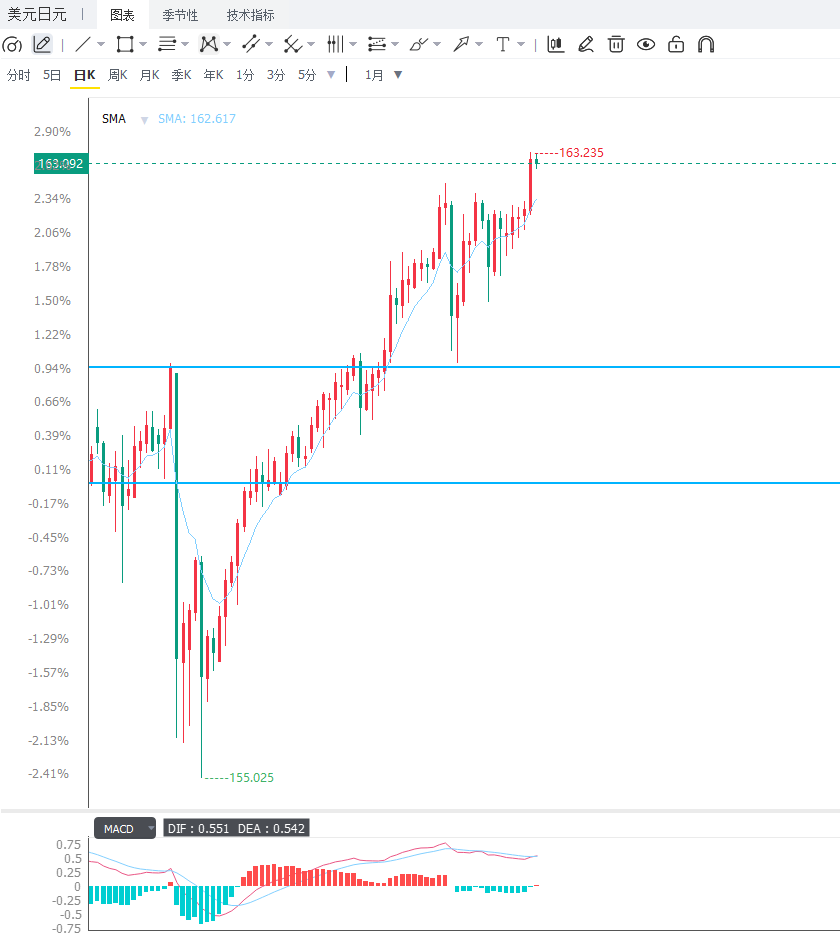 The core logic behind the continued strength of USD/JPY remains the interest rate differential between the US and Japan and the advantage of the US dollar. However, the Bank of Japan's slow pace of policy normalization makes it difficult for the yen to escape its weak position in the short term. Meanwhile, energy supply risks and changing global risk aversion are increasing market volatility, weakening the yen's traditional safe-haven attributes. The future trend of USD/JPY will depend heavily on three factors: the Federal Reserve's policy signals, whether the Japanese government intervenes in the foreign exchange market, and whether global energy market risks escalate further. If the US-Japan interest rate differential remains high, USD/JPY may continue its upward trend; however, as the exchange rate approaches historical highs, the risk of policy intervention is becoming a significant variable limiting further gains. Investors need to pay attention to market reactions in high-level areas and guard against the possibility of both trend continuation and rapid correction occurring simultaneously.
The recent strengthening of the USD/JPY exchange rate is primarily driven by the divergence in monetary policy between the US and Japan. The market continues to focus on the significant interest rate differential between the two countries, which has also spurred renewed activity in carry trades. Given the yen's long-standing status as a low-yield currency, investors tend to borrow yen and allocate it to higher-yielding dollar assets, further pressuring the yen. The persistently large interest rate differential between the US and Japan, ranging from approximately 250 to 275 basis points, is a crucial fundamental factor driving the USD/JPY's rise . While the Bank of Japan has begun its policy normalization process, raising its short-term policy rate to 1.00% at its June meeting—the highest level since 1995—the Federal Reserve still expects to maintain its benchmark interest rate in the 3.50%-3.75% range at its July meeting, indicating a continued divergence in monetary policy between the two countries. Meanwhile, the ongoing tensions in the Middle East are also exerting a complex influence on the yen. Traditionally, the yen is considered a safe-haven asset, but the current market environment has changed. Given Japan's heavy reliance on key shipping routes for energy imports, geopolitical risks are actually increasing the pressure on the Japanese economy. Especially against the backdrop of escalating shipping risks in the Strait of Hormuz, energy price volatility could exacerbate import cost pressures on Japan. Over 90% of Japan's crude oil imports rely on shipping routes through the Strait of Hormuz, and energy supply risks could further push up inflationary pressures . This has led some investors to reduce their demand for the yen's safe-haven appeal, strengthening the upward momentum of the USD/JPY pair. On the other hand, the US dollar index has risen for four consecutive trading days, providing additional support for the USD/JPY pair. Inflation concerns stemming from rising energy prices have also prompted the market to reassess the Federal Reserve's future policy path. If energy costs continue to push up inflation expectations, the market may increase bets on the Fed maintaining high interest rates or even further tightening policy, thus benefiting the dollar's performance. However, as the USD/JPY pair rises to multi-year highs, the risk of intervention by the Japanese government and the Bank of Japan is increasing. Japanese officials have repeatedly stated that they will closely monitor abnormal fluctuations in the foreign exchange market. If the exchange rate continues to weaken rapidly, the market may reassess the risk of official intervention. Currently, traders are focusing on the Japanese government's stance, speeches by Federal Reserve officials, and developments in the US-Iran situation. With no major US economic data releases on Wednesday, the dollar's short-term movement may be more influenced by policy signals from Federal Reserve officials and global risk events. Overall, while intervention expectations limit the upside potential of USD/JPY, the current interest rate advantage, the strong performance of the US dollar, and energy risks still support a bullish trend for the exchange rate. The short-term upward trend of USD/JPY remains unchanged, but the area above 163 may become a high-concentration area of policy risk . From a daily chart perspective, USD/JPY is currently maintaining a clear upward trend, with the price consistently trading above major moving averages, and the bullish formation remains intact. The recent break above 162 and subsequent testing of the 163 area indicates continued strong buying power. Technically, the MACD remains in a golden cross state, and market momentum is biased towards the bulls, but given that the price is near multi-year highs, there is short-term profit-taking pressure. Resistance is seen at the 164.00 area; a break above this level could lead to a further challenge of the 165.00 psychological level. Support is first seen at 162.00, followed by the area around 160.50. A break below 160 could indicate a significant cooling of the short-term upward trend. From a 4-hour chart perspective, USD/JPY has entered a high-level consolidation phase, with the price fluctuating around 163. Short-term moving averages continue to slope upwards, indicating that bulls still hold the initiative. The RSI indicator remains in the bullish zone but has not shown a clear breakout signal, suggesting the market is awaiting new fundamental catalysts. If the exchange rate holds above 162.50, there is still a chance to test the 164 resistance level in the short term; a break below 162 could trigger a technical pullback, with the target around the 161 support level. Currently, the 4-hour chart shows the upward structure remains valid, but caution is advised regarding potential rapid volatility due to expectations of intervention by Japanese authorities. The core logic behind the continued strength of USD/JPY remains the interest rate differential between the US and Japan and the advantage of the US dollar. However, the Bank of Japan's slow pace of policy normalization makes it difficult for the yen to escape its weak position in the short term. Meanwhile, energy supply risks and changing global risk aversion are increasing market volatility, weakening the yen's traditional safe-haven attributes. The future trend of USD/JPY will depend heavily on three factors: the Federal Reserve's policy signals, whether the Japanese government intervenes in the foreign exchange market, and whether global energy market risks escalate further. If the US-Japan interest rate differential remains high, USD/JPY may continue its upward trend; however, as the exchange rate approaches historical highs, the risk of policy intervention is becoming a significant variable limiting further gains. Investors need to pay attention to market reactions in high-level areas and guard against the possibility of both trend continuation and rapid correction occurring simultaneously.
- Risk Warning and Disclaimer
- The market involves risk, and trading may not be suitable for all investors. This article is for reference only and does not constitute personal investment advice, nor does it take into account certain users’ specific investment objectives, financial situation, or other needs. Any investment decisions made based on this information are at your own risk.