The fluctuating Federal Reserve interest rate expectations, coupled with escalating Middle East risks, have caused the US dollar index to oscillate around 101, awaiting directional guidance.
2026-07-22 14:40:14
The US dollar index (DXY) weakened slightly in Asian trading on Wednesday, currently trading around 101.15. The market is reassessing the Federal Reserve's future interest rate path while closely watching the impact of developments in the US-Iran situation on global financial markets and monetary policy expectations. One of the key factors recently weighing on the dollar is that US inflation data came in lower than previously expected. Easing inflationary pressures have reduced investors' bets on further tightening by the Fed, putting some pressure on the dollar against major currencies.  The market widely expects the Federal Reserve to keep interest rates unchanged at its policy meeting on July 29. According to data from the CME Group's FedWatch tool, the market believes there is a 74.9% probability that the Fed will maintain stable interest rates in July, up from 61.5% a month ago. This increased expectation of unchanged interest rates leaves the dollar without new catalysts for short-term gains . However, the dollar's safe-haven appeal remains a focus of market attention. As tensions between the US and Iran continue to escalate, global investors are increasing demand for safe-haven assets, providing some support for the dollar as the world's primary reserve currency. Recent US military actions and Iran's indication of potential retaliatory measures, coupled with the Houthi threat to restrict shipping in the Bab el-Mandeb Strait in Yemen, have further fueled market concerns about global energy supply and international trade risks. The Bab el-Mandeb Strait connects the Red Sea and the Arabian Gulf and is a vital global shipping route. Disruptions to shipping in the region could further drive up energy prices and increase uncertainty in global supply chains . Rising energy prices have a dual impact on the dollar. On the one hand, rising oil prices may increase inflationary pressures, causing the market to reconsider the duration of the Federal Reserve's high interest rate policy, thus supporting the US dollar. On the other hand, rising energy costs may increase global economic pressure, driving capital flows to the US dollar as a safe haven. Some analysts believe that continued tensions in the Middle East typically benefit the US dollar, as it possesses safe-haven attributes, and there is a long-term correlation between the US dollar and international oil price trends. Currently, the US dollar index is under the influence of multiple factors. On the one hand, improved US inflation and expectations of interest rate cuts limit the dollar's rise; on the other hand, geopolitical risks and energy market volatility provide support for the dollar. Future market focus will be on speeches by Federal Reserve officials, US economic data, and whether the situation in the Middle East escalates further. If risk events continue to unfold, the dollar may regain safe-haven buying support; if market risk sentiment improves, the dollar may continue to face downward pressure. From a daily chart perspective, the US dollar index has recently been consolidating in the 100.50 to 101.50 range, and the short-term trend remains in a recovery phase. The price is currently trading near key moving averages, with a relatively balanced force between bulls and bears. The MACD indicator shows that bearish momentum has weakened, but a clear reversal signal has not yet formed. The upside resistance level to watch is the 101.80 area, with further support at 102.50; the downside support levels to watch are first at 100.50, then around 99.80. If the US dollar index breaks through the 102 area, it may open up further upside potential; if it falls below 100.50, it may retest previous lows. From the 4-hour chart, the DXY has recently shown a weak, oscillating trend, with the price repeatedly consolidating around the 101 level. Short-term moving averages are flattening, and the RSI indicator remains in neutral territory, indicating a lack of clear market direction. If the US dollar index regains its footing above 101.50, it may challenge the 102.00 resistance level in the short term; if it falls below 100.80, it may accelerate its decline back to around 100. Currently, the 4-hour chart suggests the market is awaiting new fundamental catalysts, with geopolitical risks and Fed expectations still determining the short-term direction.
 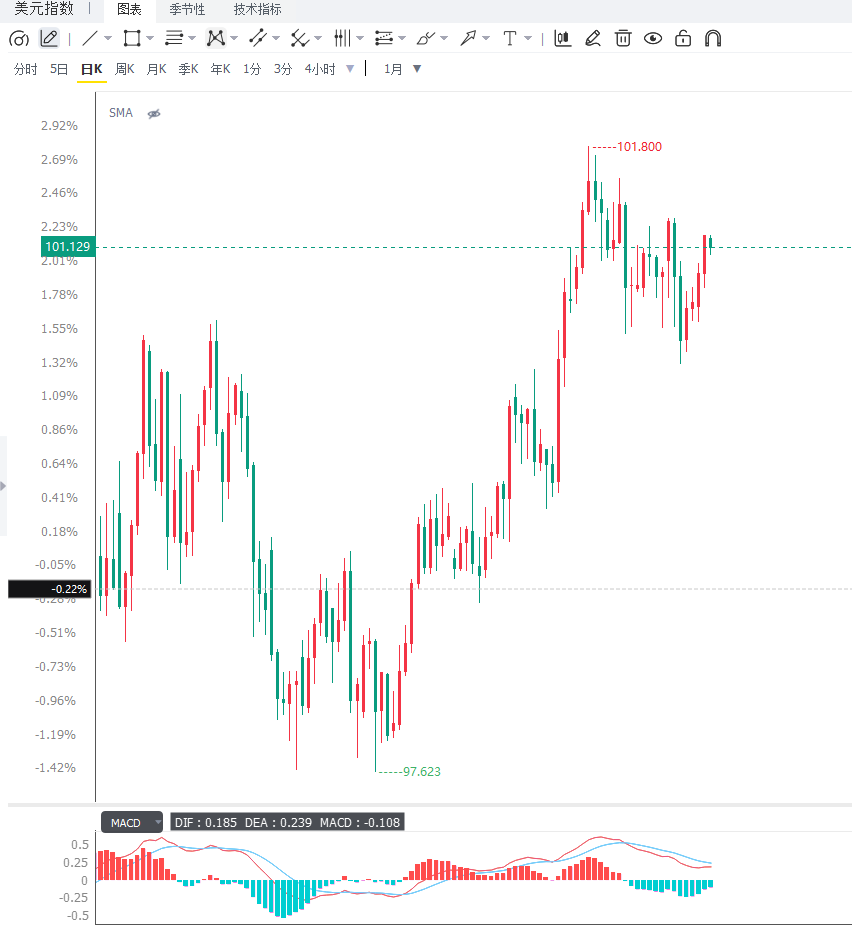 Editor's Summary: The US dollar index is currently caught in a tug-of-war between policy expectations and safe-haven demand. Slowing US inflation has reduced market expectations for further Fed rate hikes, putting pressure on the dollar; however, escalating tensions in the Middle East and energy supply risks have strengthened the dollar's safe-haven value. The future direction of the dollar will depend on Fed policy signals, US economic data, and changes in global risk events. If the market re-enhances expectations of the Fed maintaining high interest rates, the dollar may gain upward momentum; however, if risk sentiment eases and funds flow back into risk assets, the dollar may continue to be under pressure. In the short term, the 101 area will be a crucial technical level for determining the dollar's future direction.
The market widely expects the Federal Reserve to keep interest rates unchanged at its policy meeting on July 29. According to data from the CME Group's FedWatch tool, the market believes there is a 74.9% probability that the Fed will maintain stable interest rates in July, up from 61.5% a month ago. This increased expectation of unchanged interest rates leaves the dollar without new catalysts for short-term gains . However, the dollar's safe-haven appeal remains a focus of market attention. As tensions between the US and Iran continue to escalate, global investors are increasing demand for safe-haven assets, providing some support for the dollar as the world's primary reserve currency. Recent US military actions and Iran's indication of potential retaliatory measures, coupled with the Houthi threat to restrict shipping in the Bab el-Mandeb Strait in Yemen, have further fueled market concerns about global energy supply and international trade risks. The Bab el-Mandeb Strait connects the Red Sea and the Arabian Gulf and is a vital global shipping route. Disruptions to shipping in the region could further drive up energy prices and increase uncertainty in global supply chains . Rising energy prices have a dual impact on the dollar. On the one hand, rising oil prices may increase inflationary pressures, causing the market to reconsider the duration of the Federal Reserve's high interest rate policy, thus supporting the US dollar. On the other hand, rising energy costs may increase global economic pressure, driving capital flows to the US dollar as a safe haven. Some analysts believe that continued tensions in the Middle East typically benefit the US dollar, as it possesses safe-haven attributes, and there is a long-term correlation between the US dollar and international oil price trends. Currently, the US dollar index is under the influence of multiple factors. On the one hand, improved US inflation and expectations of interest rate cuts limit the dollar's rise; on the other hand, geopolitical risks and energy market volatility provide support for the dollar. Future market focus will be on speeches by Federal Reserve officials, US economic data, and whether the situation in the Middle East escalates further. If risk events continue to unfold, the dollar may regain safe-haven buying support; if market risk sentiment improves, the dollar may continue to face downward pressure. From a daily chart perspective, the US dollar index has recently been consolidating in the 100.50 to 101.50 range, and the short-term trend remains in a recovery phase. The price is currently trading near key moving averages, with a relatively balanced force between bulls and bears. The MACD indicator shows that bearish momentum has weakened, but a clear reversal signal has not yet formed. The upside resistance level to watch is the 101.80 area, with further support at 102.50; the downside support levels to watch are first at 100.50, then around 99.80. If the US dollar index breaks through the 102 area, it may open up further upside potential; if it falls below 100.50, it may retest previous lows. From the 4-hour chart, the DXY has recently shown a weak, oscillating trend, with the price repeatedly consolidating around the 101 level. Short-term moving averages are flattening, and the RSI indicator remains in neutral territory, indicating a lack of clear market direction. If the US dollar index regains its footing above 101.50, it may challenge the 102.00 resistance level in the short term; if it falls below 100.80, it may accelerate its decline back to around 100. Currently, the 4-hour chart suggests the market is awaiting new fundamental catalysts, with geopolitical risks and Fed expectations still determining the short-term direction. Editor's Summary: The US dollar index is currently caught in a tug-of-war between policy expectations and safe-haven demand. Slowing US inflation has reduced market expectations for further Fed rate hikes, putting pressure on the dollar; however, escalating tensions in the Middle East and energy supply risks have strengthened the dollar's safe-haven value. The future direction of the dollar will depend on Fed policy signals, US economic data, and changes in global risk events. If the market re-enhances expectations of the Fed maintaining high interest rates, the dollar may gain upward momentum; however, if risk sentiment eases and funds flow back into risk assets, the dollar may continue to be under pressure. In the short term, the 101 area will be a crucial technical level for determining the dollar's future direction.
- Risk Warning and Disclaimer
- The market involves risk, and trading may not be suitable for all investors. This article is for reference only and does not constitute personal investment advice, nor does it take into account certain users’ specific investment objectives, financial situation, or other needs. Any investment decisions made based on this information are at your own risk.