With UK inflation falling to 2.6%, why is the pound facing a more complex pricing moment?
2026-07-22 14:54:17
On Wednesday, July 22, the UK's Consumer Price Index (CPI) rose 2.6% year-on-year in June, lower than the market expectation of 2.7% and also down from 2.8% in May; however, the core CPI, excluding volatile items, was still 2.6% year-on-year, higher than the expected 2.5%. On a month-on-month basis, overall prices rose only 0.1%, while core prices rose 0.3%, also higher than the expected 0.2%. This data combination suggests that the decline in inflation was mainly driven by goods, food, and transportation prices, while demand-sensitive service prices did not cool down accordingly. Following the release of the news, the pound came under pressure against the dollar, with the latest price around 1.3370. 
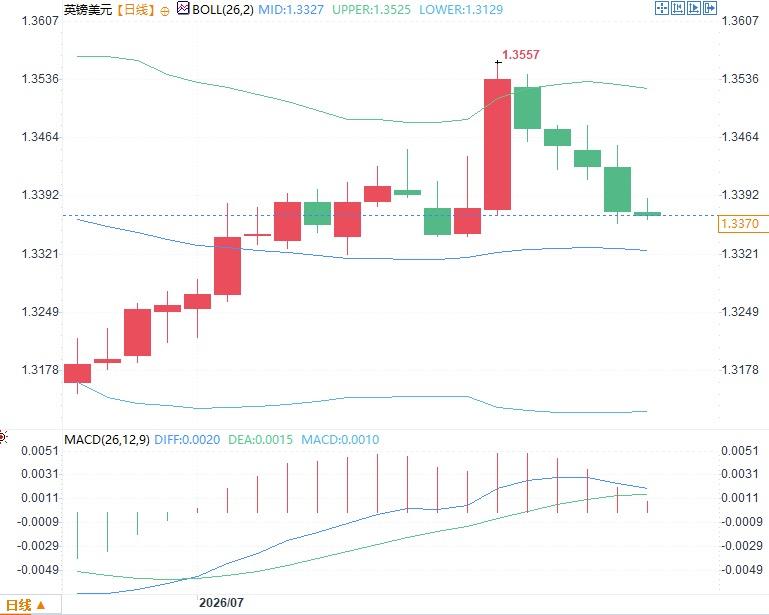 From a technical perspective, 1.3557 has formed a short-term high. After the exchange rate fell back to around 1.337, the 1.3320-1.3330 range corresponds to the Bollinger Band middle line and the previous area of dense trading, which is an important area for the market to judge the nature of this round of correction. The contraction of the MACD histogram indicates that the bullish momentum is weakening, but the indicator has not yet entered a state of obvious bearish expansion. The current structure is more like a rebalancing after the inflationary benefits have been offset by energy and growth risks, rather than a single-direction trend being established.
Commodity inflation has subsided, but service prices remain the real constraint on policy.
In June, the year-on-year increase in commodity prices slowed to 1.7% from 2.0% in May, with food prices falling 0.2% month-on-month and transportation prices declining 0.3%, constituting the main source of the overall decline in inflation. In stark contrast, restaurant and hotel prices rose 1.0% month-on-month, and entertainment and cultural prices rose 0.5%. Service inflation only decreased from 3.7% to 3.6%, higher than the market estimate of 3.5%. For the Bank of England, the policy implications of declining commodity inflation are relatively limited, as commodity prices are more susceptible to fluctuations in supply chains, exchange rates, and international commodity prices; service prices are more determined by wages, rents, insurance, labor-intensive industry costs, and businesses' pricing power. As long as service inflation remains above 3.5%, the credibility of a sustained convergence of core inflation towards the 2% target remains uncertain. More importantly, the 0.3% month-on-month increase in core prices, when converted to a short-term annualized rate, is significantly higher than the mild appearance presented by the year-on-year data. This means that the 2.6% year-on-year increase in core prices is not entirely due to the current easing of price pressures, but still includes base effects.July energy bill increases raise risk of secondary transmission back into pricing.
The UK's energy price ceiling was raised by 13% on July 1st, bringing the typical household's annual bill to £1862, with electricity averaging 26.11 pence per kilowatt-hour and a fixed charge of 57.19 pence per day. Energy price adjustments exhibit a significant lag, typically impacting residential gas, electricity, and transport costs first, then spreading to core services through logistics, catering, accommodation, and business operating costs. Brent crude recently broke through $90 per barrel, with the Middle East conflict pushing up supply risk premiums. While the oil price shock itself may not immediately change the June inflation result, it could raise the price path from July to autumn. If energy costs remain high, businesses may pass on costs by raising menu prices, transport surcharges, and service quotes, making it more difficult for the current 3.6% service inflation to decline rapidly. Therefore, the June data cannot be interpreted as an end to inflation risks. The simultaneous decline in overall inflation and the impending resurgence of energy prices suggests that UK inflation may be on a path of initial decline followed by stabilization, or even a temporary rebound. For the interest rate market, this structure is more complex than simply high inflation, because policymakers must both prevent secondary transmission and consider the cumulative suppression of employment, consumption, and financing activities by high interest rates.The Bank of England's challenge is not whether to shift course, but when to obtain sufficient evidence.
The Bank of England kept its policy rate at 3.75% in June by a 7-2 vote, with two members advocating for a 4% increase, indicating a lack of consensus within the committee regarding inflation risks. The next interest rate decision will be announced on July 30. Higher-than-expected core inflation and insufficient declines in service prices weaken the basis for a rapid easing of policy in the near term, but falling commodity prices and overall inflation limit the need for further tightening. This creates a clear asymmetry in the policy response function. If service inflation remains above 3.5% and energy prices continue to transmit to inflation, the Bank of England is more likely to extend its observation period; only if employment, wages, and consumption weaken significantly will policy discussions likely shift back towards easing. The pound is therefore simultaneously pulled by two forces: the extended period of higher interest rates provides interest rate differential support, but energy import costs, fiscal constraints, and slowing growth weaken the upward momentum of the exchange rate. From a technical perspective, 1.3557 has formed a short-term high. After the exchange rate fell back to around 1.337, the 1.3320-1.3330 range corresponds to the Bollinger Band middle line and the previous area of dense trading, which is an important area for the market to judge the nature of this round of correction. The contraction of the MACD histogram indicates that the bullish momentum is weakening, but the indicator has not yet entered a state of obvious bearish expansion. The current structure is more like a rebalancing after the inflationary benefits have been offset by energy and growth risks, rather than a single-direction trend being established.
- Risk Warning and Disclaimer
- The market involves risk, and trading may not be suitable for all investors. This article is for reference only and does not constitute personal investment advice, nor does it take into account certain users’ specific investment objectives, financial situation, or other needs. Any investment decisions made based on this information are at your own risk.