The Imbalance in Bank of America's Capital Instrument Pricing: What Lies Behind the 186.8 Basis Point Difference?
2026-07-24 21:48:03
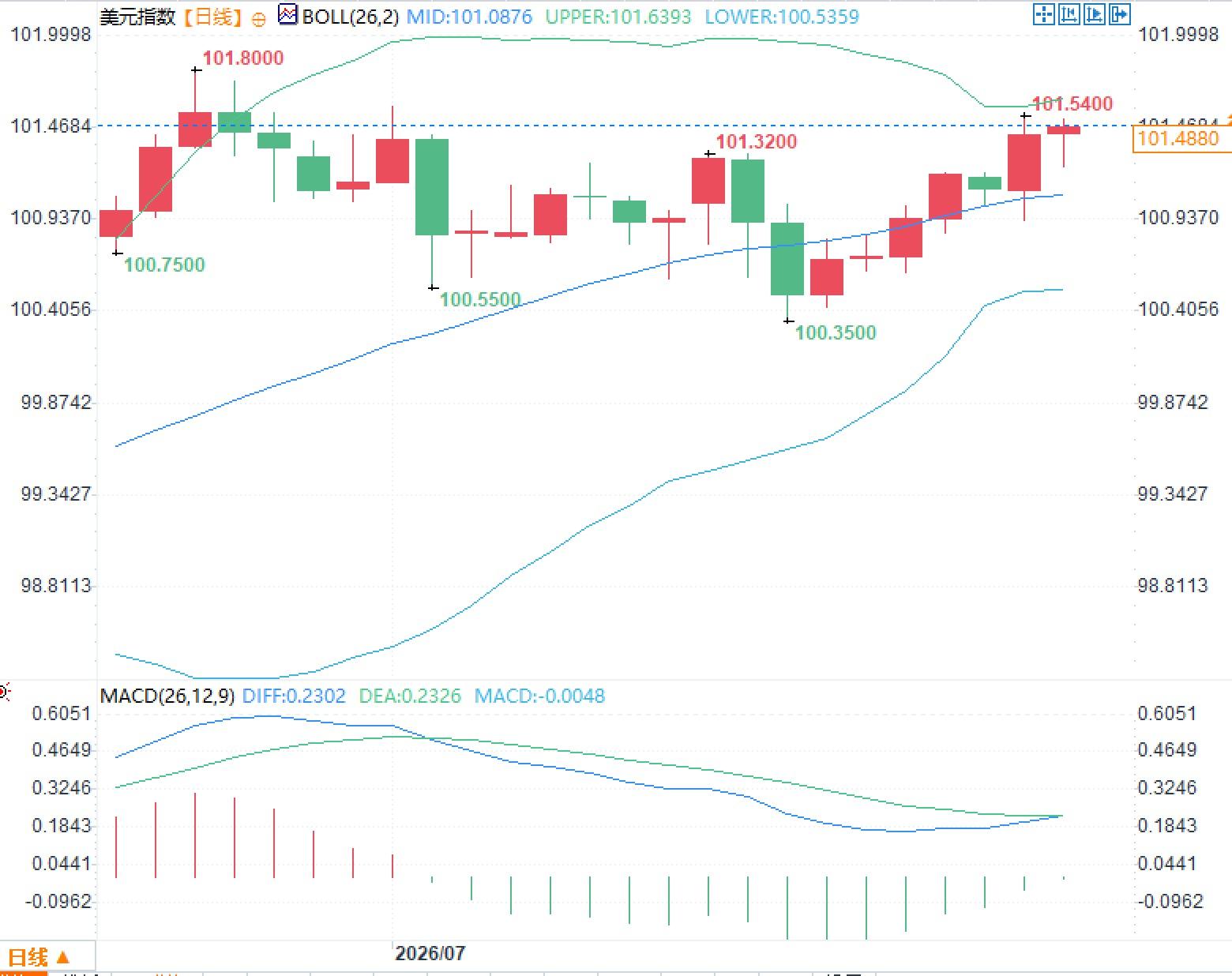
On Friday, July 24, the US dollar index fluctuated around 101.50, slightly higher than the previous trading day. Meanwhile, Brent crude oil rose to around $102 per barrel before falling back to around $98, as inflation expectations resurfaced; the 10-year US Treasury yield rose to around 4.68%, its highest level since May 2025, while the 5-year yield also briefly broke through 4.4% this week. Against this macroeconomic backdrop, US banks are issuing preferred stock at their tightest valuations since the financial crisis. Bank of New York Mellon reduced the 5-year Treasury respec to 186.8 basis points, and Goldman Sachs and Citizen Financial subsequently completed their issuance at near-record low spreads. While the high coupon rates remain attractive on the surface, credit spreads have been compressed to levels that barely compensate for the risk of delayed redemption, creating a stark contrast between strong primary market subscriptions and secondary market underperformance. 
 The core issue in the market is not insufficient bank capital, but rather whether investors are willing to exchange extremely low interest rate spreads for immediate cash flow. If oil prices, inflation expectations, or the Federal Reserve's policy path push up term premiums again, the price sensitivity of preferred shares could increase significantly. At that point, the first thing to be exposed will not be the current coupon payment, but rather the previously overlooked risk of deferred redemption.
The appearance of high yields masks the distortion of interest rate spread pricing.
The total return on bank preferred stock typically consists of two parts: the risk-free rate and the credit spread. Currently, the 5-year Treasury yield is high, and even with a reset spread of less than 200 basis points, the initial coupon rate of new bonds can still reach over 6%, thus easily attracting funds that prefer absolute returns. The problem is that a high absolute coupon rate does not equate to a cheap valuation. Bank of New York Mellon issued $50 million worth of preferred stock at $1,000 per share, totaling $500 million; the average reset spread for similar bank capital instruments this year has fallen to approximately 235 basis points, while the current 186.8 basis points is significantly lower than the market average. This means that the additional risk compensation for investors is shrinking. If Treasury yields decline in the future, but the bank financing environment deteriorates, investors may face both price declines and being forced to hold low-spread assets for an extended period due to issuers' refusal to redeem. Currently, the coupon rate primarily comes from a high benchmark interest rate, rather than from sufficient credit risk compensation.The primary market is booming, but the secondary market immediately issues a warning.
During the book-building process for their new bonds, BNY Mellon and Goldman Sachs lowered their final yields by 22.5 to 25 basis points from their initial guidance, while Citizen Financial also narrowed theirs by 12.5 basis points, indicating that primary market demand significantly exceeded supply. This allowed issuers to obtain lower capital costs. However, all the new bonds fell below par value after listing. BNY Mellon preferred stock fell to approximately $0.993 per dollar par, Goldman Sachs to $0.996, and Citizen Financial to near $0.990. Primary market investors chased coupon rates during the issuance phase, while the secondary market quickly reassessed the excessively narrow spreads, liquidity discounts, and potential deferral risks. This trend did not indicate a sudden deterioration in bank credit, but rather that issuance pricing had approached the limits of what demand could bear. As long as there is a lack of sustained incremental buying, even if the benchmark interest rate remains unchanged, the new bonds may recover to reasonable spreads through price declines.The real risk is not default, but not being redeemed.
Fixed-rate restructured preferred stock typically has an initial redemption date. The market has long established the practice of issuers redeeming and refinancing at maturity, leading some investors to value it as a medium-term bond rather than a perpetual security. However, the redemption right belongs to the issuer, not the investor. After the initial redemption date, the coupon is usually recalculated based on the 5-year Treasury yield plus a fixed spread. When the new bond's restructured spread is only 186.8 basis points, whether the issuer will redeem it in the future depends on the cost of reissuing the preferred stock at that time. If the market-demanded spread rises to 300 basis points, retaining the old bond may be cheaper than issuing a new one, and the issuer will lack the incentive to redeem. Goldman Sachs recently announced the redemption of a batch of 3.65% fixed-rate restructured preferred stock and will redeem several older series in the first quarter of 2026, indicating that in the current financing environment, some institutions still have an incentive to replace high-cost or no longer suitable securities for their capital structure. However, this does not mean that newly issued low-spread securities will necessarily be redeemed in the future. The lower the spread, the longer the tail duration borne by investors.Scarce supply is depressing risk premiums
Large banks are expected to demonstrate strong profitability in the first half of 2026, with major institutions reporting combined quarterly profits of approximately $49 billion, limiting immediate pressure on their balance sheets. Meanwhile, the scale of preferred stock redemptions by banks this year is roughly equivalent to the scale of new issuances, resulting in no significant increase in net preferred stock supply. This scarcity of supply, stable bank profitability, and high benchmark interest rates have collectively created a valuation illusion. Looking solely at coupon rates, yields above 6% are attractive; however, considering only interest rate spreads, investor compensation is at its lowest level since the financial crisis. The US dollar index approaching the upper Bollinger Band and persistently high Treasury yields have further strengthened the demand for high-coupon assets from absolute return investors. The core issue in the market is not insufficient bank capital, but rather whether investors are willing to exchange extremely low interest rate spreads for immediate cash flow. If oil prices, inflation expectations, or the Federal Reserve's policy path push up term premiums again, the price sensitivity of preferred shares could increase significantly. At that point, the first thing to be exposed will not be the current coupon payment, but rather the previously overlooked risk of deferred redemption.
- Risk Warning and Disclaimer
- The market involves risk, and trading may not be suitable for all investors. This article is for reference only and does not constitute personal investment advice, nor does it take into account certain users’ specific investment objectives, financial situation, or other needs. Any investment decisions made based on this information are at your own risk.