August 3rd Financial Breakfast: Trump "slams on the brakes"! Halts strikes against Iran and resumes negotiations; US crude oil gaps down nearly 7%, gold prices also come under pressure.
2026-08-03 06:52:53
On Monday (August 3, Beijing time) in early Asian trading, spot gold was trading around $4066.85 per ounce. The rebound of the US dollar from a more than one-month low put pressure on gold prices, while rising expectations of a Fed rate hike limited gold's gains. Trump said he agreed to cancel strikes against Iran over the weekend, and the US resumed negotiations with Iran on the 3rd, putting pressure on the market. US crude oil opened nearly 7% lower on Monday, once falling below the $80 per barrel mark, reaching a low of $78.78 per barrel, and is currently trading around $80.81 per barrel. 
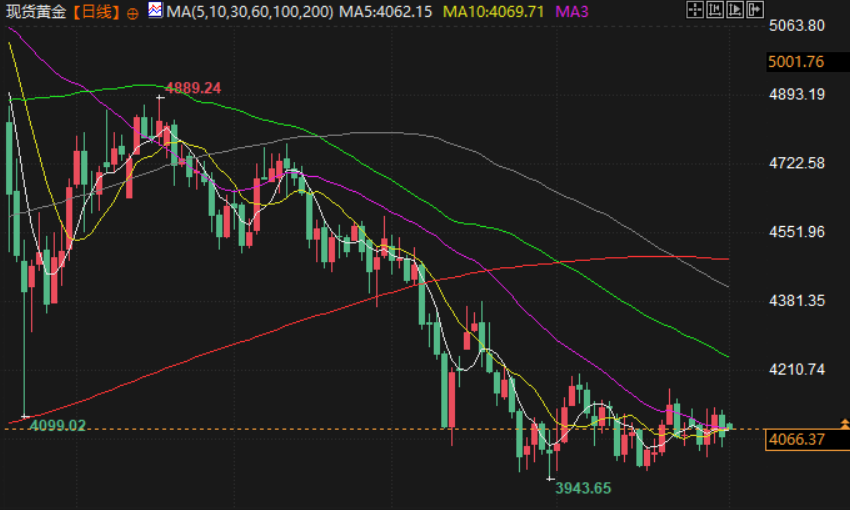 Bybit's chief market analyst, Han Tan, pointed out that although gold ended its four-month losing streak, it still struggled to gain a significant advantage above the psychological level of $4,000. Market expectations that Federal Reserve Chairman Warsh might expand his policy focus from traditional inflation indicators to a broader range of areas also provided some support for gold prices above $4,000. While US inflation slowed in June, renewed tensions in the Middle East pushed up oil prices, suggesting this slowdown may be temporary. Warsh pledged last week to steadfastly reduce inflation but did not hint at a rate hike. Furthermore, a stronger dollar increased the cost of gold for non-dollar investors. CME Group's FedWatch data showed traders expect a 65% probability of a September rate hike, down from over 80% a week earlier. In other precious metals, spot silver fell 2.26% to $57.63, platinum fell 0.6% to $1650.14, and palladium fell 1.8% to $1281.18, but all three achieved monthly gains.
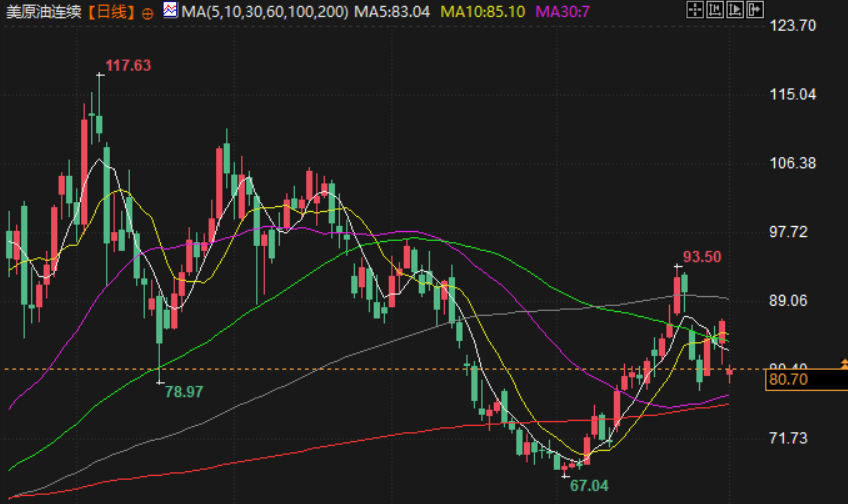 Iran's Fars News Agency reported that the Revolutionary Guard prevented two oil tankers from passing through the Strait of Hormuz, and four others changed course. Kpler ship tracking data also showed that two Very Large Crude Carriers (VLCCs) left the strait on Friday, and overall shipping volume was sparse. Meanwhile, a drone attack on the Egyptian Mediterranean port of Damieta caused two liquefied gas tankers to catch fire, exacerbating the threat to shipping through the Suez Canal. In addition, a Ukrainian military strike on a Russian Volgograd oil refinery caused a fire. Market analysts say that the trading logic has shifted from the war itself to shipping data. Fundamentally, a survey of analysts predicts that the average Brent crude oil price in 2026 will be $85.22 per barrel, higher than the previous forecast of $84.50, suggesting further upside potential.
 The dollar fell 1.17% against the yen to 157.62 yen on Friday, extending losses from the previous day, as traders prepared for a possible second round of official intervention after Japanese authorities intervened to support the yen. Two Japanese government officials revealed that Finance Minister Satsuki Katayama will announce on Monday that Tokyo and Washington have taken joint action in the currency market to prevent further yen depreciation. Japan's top foreign exchange official also stated that he received assistance from the US "beyond psychological support," but strategists at Scotiabank believe it is difficult to determine whether the current slight yen appreciation is an actual intervention or a pre-emptive market reaction to potential intervention. The Bank of Japan kept its short-term interest rate unchanged at 1% on Friday as expected, but Governor Kazuo Ueda signaled a hawkish stance, stating that many policy committee members had high inflation forecasts and that risks were skewed to the upside. Scotiabank believes that the September meeting is likely to tighten policy, and the Bank of Japan's slow pace of interest rate hikes is seen as a reason for the yen's recent fall to a 40-year low. Most analysts surveyed expect interest rates to rise to 1.25% by the end of the year. Against this backdrop, the CME Group's EBS platform saw spot yen trading volume hit a 10-year high and futures trading volume hit a record high last Thursday. Meanwhile, South Korea also took a rare coordinated action to sell dollars to support the won, which fell by about 1% to 1439.66 on Friday.
Key Focus Today
stock market
U.S. stocks closed higher on Friday, with the S&P 500 rising 0.70% to 7489.72, the Nasdaq gaining 1% to 25373.85, and the Dow Jones Industrial Average climbing 0.53% to 52485.03. This was primarily driven by strong earnings from Amazon—whose stock surged over 15%, as growth in its AWS business eased concerns about excessive AI spending—and Microsoft extending its gains from Thursday by another 3%, further boosting investor confidence in AI-related stocks. However, Apple shares plunged 7.4%, as warnings of supply shortages and concerns that iPhone price increases could dampen demand clouded its outlook, dragging down the S&P technology sector by 0.54%. The Philadelphia Semiconductor Index edged up 0.07%, but remains down more than 20% from its June record high. Last week, the S&P 500 rose 1.05%, and the Nasdaq gained 1.59%. In July, the S&P was essentially flat, while the Nasdaq fell 3.2%, and both indices are up about 9% year-to-date. Trading was active, with volume reaching 20.6 billion shares, higher than the previous 20-day average of 17.1 billion shares. S&P 500 companies' second-quarter earnings are expected to surge 48% year-over-year, with AI-related stocks contributing the majority of the growth. However, strong expectations coupled with recent stock price corrections have kept the S&P's price-to-earnings ratio at around 20, slightly above the 10-year average of 19. The S&P equal-weighted index rose for the fourth consecutive month, due to its limited holdings in heavily weighted AI stocks. Three Federal Reserve officials who opposed last week's rate hike called for immediate action to curb inflation on Friday, pushing the 2-year Treasury yield up to 4.28%. The market's probability of a September rate hike is now 65%, down from 82% a week earlier but slightly higher than Thursday's 63%.Gold Market
Gold prices fell about 2% on Friday, with spot gold at $4,046.42 per ounce, mainly as the dollar rebounded from a more than one-month low, putting pressure on the precious metal. However, gold prices still rose 1.1% in July, marking the largest monthly gain since February and the first monthly increase in five months. This was driven by weaker-than-expected US inflation data in June, which reduced market expectations for further interest rate hikes by the Federal Reserve. At the same time, the return of oil prices to pre-conflict levels in Iran earlier in July also eased inflationary pressures. Bybit's chief market analyst, Han Tan, pointed out that although gold ended its four-month losing streak, it still struggled to gain a significant advantage above the psychological level of $4,000. Market expectations that Federal Reserve Chairman Warsh might expand his policy focus from traditional inflation indicators to a broader range of areas also provided some support for gold prices above $4,000. While US inflation slowed in June, renewed tensions in the Middle East pushed up oil prices, suggesting this slowdown may be temporary. Warsh pledged last week to steadfastly reduce inflation but did not hint at a rate hike. Furthermore, a stronger dollar increased the cost of gold for non-dollar investors. CME Group's FedWatch data showed traders expect a 65% probability of a September rate hike, down from over 80% a week earlier. In other precious metals, spot silver fell 2.26% to $57.63, platinum fell 0.6% to $1650.14, and palladium fell 1.8% to $1281.18, but all three achieved monthly gains.oil market
Oil prices rose on Friday, with Brent crude up 3.44% to settle at $90.19 a barrel and WTI crude up 3.38% to settle at $86.80. Brent crude surged nearly 23% and WTI crude nearly 24% in July, marking their strongest monthly performance since March, mainly driven by geopolitical tensions. Iran's Fars News Agency reported that the Revolutionary Guard prevented two oil tankers from passing through the Strait of Hormuz, and four others changed course. Kpler ship tracking data also showed that two Very Large Crude Carriers (VLCCs) left the strait on Friday, and overall shipping volume was sparse. Meanwhile, a drone attack on the Egyptian Mediterranean port of Damieta caused two liquefied gas tankers to catch fire, exacerbating the threat to shipping through the Suez Canal. In addition, a Ukrainian military strike on a Russian Volgograd oil refinery caused a fire. Market analysts say that the trading logic has shifted from the war itself to shipping data. Fundamentally, a survey of analysts predicts that the average Brent crude oil price in 2026 will be $85.22 per barrel, higher than the previous forecast of $84.50, suggesting further upside potential.Foreign exchange market
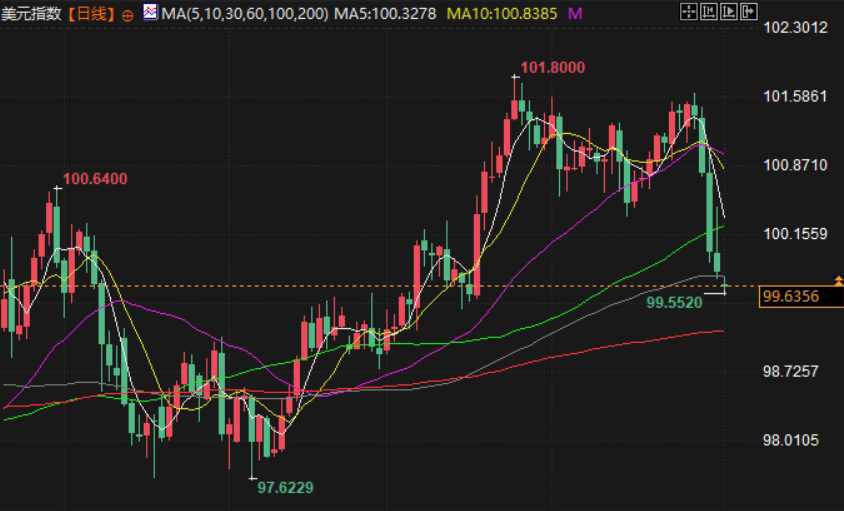
The dollar index fell to 99.78 on Friday, with a cumulative drop of 1.63% last week, marking its biggest weekly decline since the end of January. This decline was mainly driven by market doubts about the Federal Reserve's sincerity in curbing inflation after the Fed kept interest rates unchanged last week. The dollar fell 1.17% against the yen to 157.62 yen on Friday, extending losses from the previous day, as traders prepared for a possible second round of official intervention after Japanese authorities intervened to support the yen. Two Japanese government officials revealed that Finance Minister Satsuki Katayama will announce on Monday that Tokyo and Washington have taken joint action in the currency market to prevent further yen depreciation. Japan's top foreign exchange official also stated that he received assistance from the US "beyond psychological support," but strategists at Scotiabank believe it is difficult to determine whether the current slight yen appreciation is an actual intervention or a pre-emptive market reaction to potential intervention. The Bank of Japan kept its short-term interest rate unchanged at 1% on Friday as expected, but Governor Kazuo Ueda signaled a hawkish stance, stating that many policy committee members had high inflation forecasts and that risks were skewed to the upside. Scotiabank believes that the September meeting is likely to tighten policy, and the Bank of Japan's slow pace of interest rate hikes is seen as a reason for the yen's recent fall to a 40-year low. Most analysts surveyed expect interest rates to rise to 1.25% by the end of the year. Against this backdrop, the CME Group's EBS platform saw spot yen trading volume hit a 10-year high and futures trading volume hit a record high last Thursday. Meanwhile, South Korea also took a rare coordinated action to sell dollars to support the won, which fell by about 1% to 1439.66 on Friday.International News
Trump Says He Agrees to Cancel Attacks on Iran On August 1st local time, US President Trump posted on social media that he had agreed to cancel attacks on Iran. Trump stated, "Iran and other Middle Eastern countries have just asked us to suspend any attacks because we have reached an agreement on the framework of a deal. This will include the immediate, complete, and total opening of the Strait of Hormuz, and an end to Iran's nuclear threat." Trump indicated that based on this request, "I agree to cancel the attacks, but only if an agreement can be reached quickly. Israel is also working with me on this." (CCTV News) Trump: Negotiations with Iran on the 3rd, Agreement Already on the Strait of Hormuz On August 2nd local time, US President Trump, speaking about Iran, stated that an agreement already exists regarding the Strait of Hormuz, and an agreement on denuclearization will also be reached. Trump stated that the US will hold negotiations with Iran on the 3rd. (CCTV) Japanese Finance Minister to Announce Joint US-Japan Intervention in Currency Market to Boost Yen Two Japanese government officials revealed that Finance Minister Satsuki Katayama will announce next Monday that Tokyo and Washington have taken joint action in the currency market to prevent further depreciation of the yen. Sources indicate that Katayama Satsuki will likely emphasize the shared determination of both sides to combat the excessive depreciation of the yen, and that related interventions are ongoing. Previously, market sources stated that US and Japanese authorities had implemented multiple rounds of yen-buying operations, the first joint intervention since 2011, aimed at pushing the yen back from its lowest level since 1986. Iran denies plans to reopen the Strait of Hormuz are pure rumors Iran's Fars News Agency reported on the 2nd, citing sources, that plans to reopen the Strait of Hormuz are pure rumors. One source said that no agreement has been reached on reopening the Strait of Hormuz, and reports on this matter are pure rumors. Another informed military source emphasized that as long as the US continues its hostile actions, the Strait of Hormuz will remain closed, and ships can only pass through the published routes and must obtain permission from the Iranian Islamic Revolutionary Guard Corps Navy. Earlier that day, Israel's Channel 12 television reported that Iranian Foreign Minister Araghchi agreed overnight to a plan proposed by the US and Qatar to "reopen the Strait of Hormuz," and claimed that this prompted US President Trump to cancel his planned attack on Iran. (Xinhua) OPEC+ Agrees to Increase September Oil Production Quotas by 188,000 Barrels Per Day The statement shows that OPEC+ agreed to increase September oil production quotas by 188,000 barrels per day. Saudi Arabia, Russia, Iraq, Kuwait, Kazakhstan, Algeria, and Oman agreed to adjust production and reaffirmed their commitment to maintaining market stability. The next meeting will be held on September 6. The probability of a 25 basis point rate hike by the Federal Reserve in September has risen to 73.6%, and the probability of a 50 basis point rate hike this year is approximately 49.7%. According to CME's "FedWatch": the probability of the Fed keeping interest rates unchanged by September is 26.4%, and the probability of a cumulative 25 basis point rate hike is 73.6% (compared to 63.4% last Friday). The probability of the Fed keeping interest rates unchanged by October is 19.9%, and the probability of at least a 25 basis point rate hike is 80.1%. The probability of the Federal Reserve keeping interest rates unchanged by December is 9.7%, the probability of a cumulative rate hike of 25 basis points is 40.5%, and the probability of a rate hike of at least 50 basis points is 49.7%.Domestic News
The State Administration of Foreign Exchange (SAFE) held a video conference on August 1st to discuss foreign exchange management work for the second half of 2026. The meeting outlined key tasks for foreign exchange management in the second half of 2026. Key tasks included steadily expanding institutional opening-up in the foreign exchange sector; promoting trade facilitation reforms; introducing a package of measures to optimize current account foreign exchange management; comprehensively promoting policies to facilitate foreign exchange receipts and payments in high-level opening-up of cross-border trade; supporting the development of new trade formats such as cross-border e-commerce; optimizing foreign exchange settlement for service trade; and supporting the development of intermediate goods trade. The meeting also emphasized the orderly advancement of high-level opening-up of the capital account; introducing a package of policies to facilitate cross-border investment and financing; promoting nationwide policies for centralized operation of cross-border funds by multinational corporations; issuing regulations on foreign exchange management for domestic and foreign exchange loans; and prudently expanding financial market connectivity. Finally, the meeting stressed strengthening the defenses against external shocks, including monitoring cross-border capital flows, continuously improving macro-prudential management and expectation management, and implementing comprehensive measures to maintain the stability of the foreign exchange market. (SAFE) The People's Bank of China (PBOC) also held its work conference for the second half of 2026. The meeting emphasized the continuation of a moderately loose monetary policy. It called for the comprehensive use of various monetary policy tools, including reverse repos, medium-term lending facilities, and the buying and selling of treasury bonds, to provide short-, medium-, and long-term liquidity, maintain ample liquidity, and guide financial institutions to strongly support the effective financing needs of the real economy. The meeting also stressed improving the short-term interest rate control mechanism, increasing the variety of overnight reverse repo operations, and narrowing the temporary overnight repo/reverse repo rate range. It emphasized strengthening the implementation and supervision of interest rate policies, urging financial institutions to clearly disclose the comprehensive financing costs of loans, and maintaining a low level of overall social financing costs. The meeting also stressed the importance of effective market communication and expectation guidance. At the end of June, total social financing increased by 7.4% year-on-year, and broad money supply increased by 8.0% year-on-year. The meeting reiterated the principle that the market plays a decisive role in exchange rate formation, and that the RMB exchange rate will fluctuate in both directions. (People's Bank of China)- Risk Warning and Disclaimer
- The market involves risk, and trading may not be suitable for all investors. This article is for reference only and does not constitute personal investment advice, nor does it take into account certain users’ specific investment objectives, financial situation, or other needs. Any investment decisions made based on this information are at your own risk.