Gold Trading Alert: Trump backs down, gold opens nearly $40 higher! Middle East tensions suddenly ease, will gold break through $4100?
2026-08-03 07:46:53
On Monday (August 3), spot gold opened sharply higher in early Asian trading, briefly touching $4082.28 per ounce, a significant increase of nearly $40 from Friday's close, and is currently consolidating around $4070. This dramatic fluctuation is not an isolated event, but a direct market reaction to the major shift in the Middle East situation over the weekend. US President Trump announced the cancellation of a new round of large-scale military strikes against Iran and confirmed that he would hold talks with Iran on the 3rd, quickly easing market concerns about further escalation of the geopolitical conflict. At the same time, international oil prices fell sharply, inflationary pressures and expectations of a Fed rate hike eased simultaneously, and the demand for the US dollar as a safe haven weakened, all providing strong support for gold. 
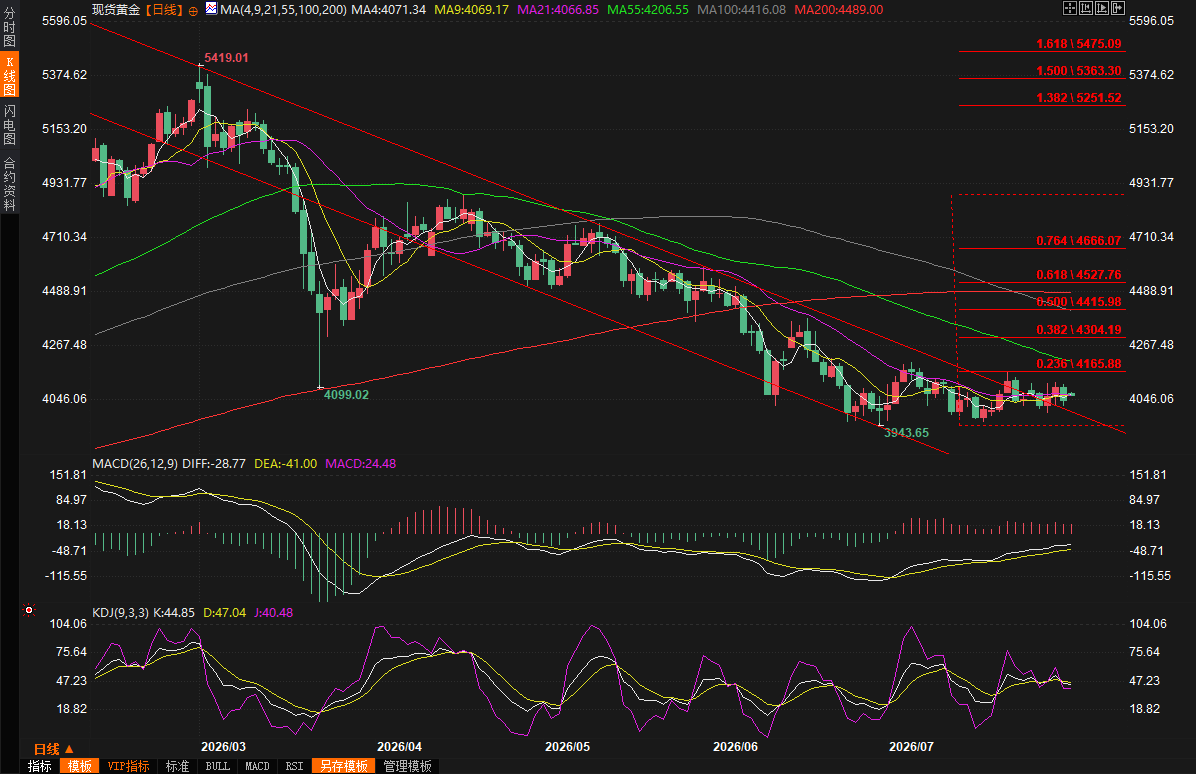 (Spot gold daily chart, source: FX678) At 07:43 Beijing time, spot gold is currently trading at $4068.40 per ounce.
Dramatic turn of events over the weekend: Trump suspends strikes, glimmer of hope appears in Strait of Hormuz negotiations.
Over the past few weeks, the situation in the Middle East has been the core variable driving the price movements of commodities and safe-haven assets. Since the US and Israel launched attacks on Iran in late February, the conflict has continued to escalate, repeatedly raising shipping risks in the Strait of Hormuz and causing significant fluctuations in oil prices. Last Friday, as the market was still digesting news of some oil tankers being forced to return to port, both Brent crude and US crude rose by more than 1%, recording their strongest monthly performance since March. However, the situation took a sharp turn for the worse over the weekend. Trump stated on the Truth Social platform that, based on requests from Iran and other Middle Eastern countries for time to reach an agreement, he had agreed to cancel the attacks, provided that an agreement could be reached quickly to achieve the "immediate, complete, and thorough" reopening of the Strait of Hormuz and end Iran's nuclear threat. Israel and the US made this commitment together. Iran also simultaneously released signals: Foreign Minister Araghchi stated that negotiations with Oman on joint management of the Strait of Hormuz had entered the final stage, and the two sides were discussing the demarcation of new shipping routes under a separation of navigation regime to safeguard sovereignty and security interests. An Iranian Foreign Ministry spokesperson further emphasized that the negotiations were a bilateral matter unrelated to any third party, and warned the United States that Iran would respond commensurately if it took any risky actions. This series of statements quickly eased market concerns about a potential blockade of the Strait of Hormuz and disruptions to the energy supply chain. Oil prices opened sharply lower on Monday, with US crude falling more than 7% to $78.78 per barrel, a four-day low. The decline in oil prices directly reduced the upside risk of inflation and lessened the urgency for the Federal Reserve to further tighten policy, thus creating room for gold to rise.Gold prices closed strong in July: first monthly gain in five months, with inflation data being a key driver.
Despite a strong opening and continued rise in gold prices on Monday, the previous week's performance was not without its challenges. Spot gold fell approximately 1.3% to $4046.42 per ounce on Friday, having earlier fallen more than 2%, primarily dragged down by a rebound in the US dollar from a more than one-month low in the previous trading day. However, looking at the whole of July, gold prices rose by about 1%, marking the largest monthly gain since February and the first positive monthly increase in five months. So far this month, gold prices have risen 1.1%. The core driver of this monthly rally is the slowdown in US inflation data. Key indicators such as the June PCE showed easing inflationary pressures, prompting traders to significantly lower their expectations for a Fed rate hike this year. CME Group's FedWatch data shows that the market's probability of a September rate hike has fallen from over 80% a week ago to about 65%. After the Fed kept interest rates unchanged last week, new Chairman Warsh, while reiterating his firm commitment to reducing inflation, did not release a clear signal of a rate hike, further reinforcing the market's reassessment of the policy path. The US dollar index experienced significant selling during this period. Gold fell approximately 2.4% last Thursday, its largest single-day drop since January 2023, and fell a cumulative 1.6% last week, its largest weekly decline since the end of January. On Monday, the dollar index initially fell 0.24%, hitting a one-and-a-half-month low of 99.52. A weaker dollar lowers the cost of holding gold for non-US investors, becoming a significant external factor supporting gold prices. Meanwhile, US long-term Treasury yields generally rose in July, with the 10-year and 30-year yields recording their largest increases in months, reflecting the market's continued oscillation between uncertainty surrounding the Iranian situation and Federal Reserve policy, but this did not completely offset gold's safe-haven appeal. Bybit's chief market analyst, Han Tan, pointed out that although gold ended its four-month losing streak, it is still difficult to create a significant gap above the psychological level of $4,000. Market expectations that Warsh may expand the Fed's focus from simple inflation indicators and interest rate policy to a broader range of areas provide support for gold prices above $4,000.Multiple factors are at play: with the employment data week approaching, the short-term direction of gold prices remains uncertain.
Looking ahead, the macroeconomic environment for gold remains complex. This week's economic calendar is heavily focused on the job market: Monday sees the release of the July ISM Manufacturing Purchasing Managers' Index, Tuesday features the JOLTS employment report, Wednesday brings ADP employment data and the ISM Services Index, Thursday releases weekly jobless claims, and Friday concludes with the July non-farm payroll report. The strength of the labor market will directly influence market pricing in the Federal Reserve's policy path, thus affecting the relative strength of the dollar and gold. From a sentiment perspective, Wall Street and retail investors have shown a clear divergence in their short-term gold price outlook. A Kitco survey shows that among 17 analysts, 29% expect gold prices to rise in the coming week, 35% are bearish, and the remainder expect sideways movement; among retail investors, 47% are bullish, 30% are bearish, and 23% expect volatility. This divergence reflects the current market hesitation between easing geopolitical risks and the uncertainty surrounding fundamental data. The volatility of oil prices remains a potential variable. Although oil prices fell sharply on Monday due to the cancellation of military action, a rebound in oil prices could reignite inflation concerns if negotiations stall and risks in the Strait of Hormuz escalate again, thus putting downward pressure on gold prices. Conversely, if the agreement proceeds smoothly and shipping in the Strait returns to normal, low oil prices will continue to weaken expectations of interest rate hikes, which would be beneficial for gold.Conclusion: Geopolitical de-escalation opens an upward window, but the $4,000 mark still needs to be tested.
Gold prices opened nearly $40 higher on Monday, clearly demonstrating the sensitive impact of Middle East tensions on safe-haven assets. Trump's decision to postpone military action and initiate negotiations with Iran, coupled with a sharp drop in oil prices and a weakening dollar, provided short-term support. Looking back at July, gold prices achieved a monthly positive return amid softening inflation data and adjustments in policy expectations, demonstrating its resilience in a complex macroeconomic environment. However, for gold to truly establish itself above $4,000 and open up further upside potential, more fundamental support is needed. This week's flurry of employment data will be a key observation window. The Fed's internal disagreements on the interest rate path, Warsh's policy communication style, and the actual progress of Middle East negotiations will all continue to influence market pricing. In the short term, the consolidation around $4,070 may just be the prelude to a new directional choice. Investors need to closely monitor the resonance effect of geopolitical negotiations and US employment data, remaining cautious in an environment where risks and opportunities coexist. (Spot gold daily chart, source: FX678) At 07:43 Beijing time, spot gold is currently trading at $4068.40 per ounce.
- Risk Warning and Disclaimer
- The market involves risk, and trading may not be suitable for all investors. This article is for reference only and does not constitute personal investment advice, nor does it take into account certain users’ specific investment objectives, financial situation, or other needs. Any investment decisions made based on this information are at your own risk.