Gold Trading Alert: Gold Prices Surge to Seven-Week High! Unexpectedly Weak US Jobs Data, US CPI to Test Market Conditions This Week
2026-08-10 07:22:53
The most eye-catching moment in global financial markets last week was undoubtedly the strong rebound in gold prices. Shocked by the significantly weaker-than-expected US July non-farm payroll data, spot gold prices surged on Friday, hitting a seven-week high. This not only recorded the largest weekly gain this year but also significantly shifted market expectations regarding the Federal Reserve's policy path. Meanwhile, subtle changes in the Middle East geopolitical situation further supported gold prices. On Monday (August 10) in early Asian trading, spot gold fluctuated slightly higher, currently trading around $4345 per ounce. 
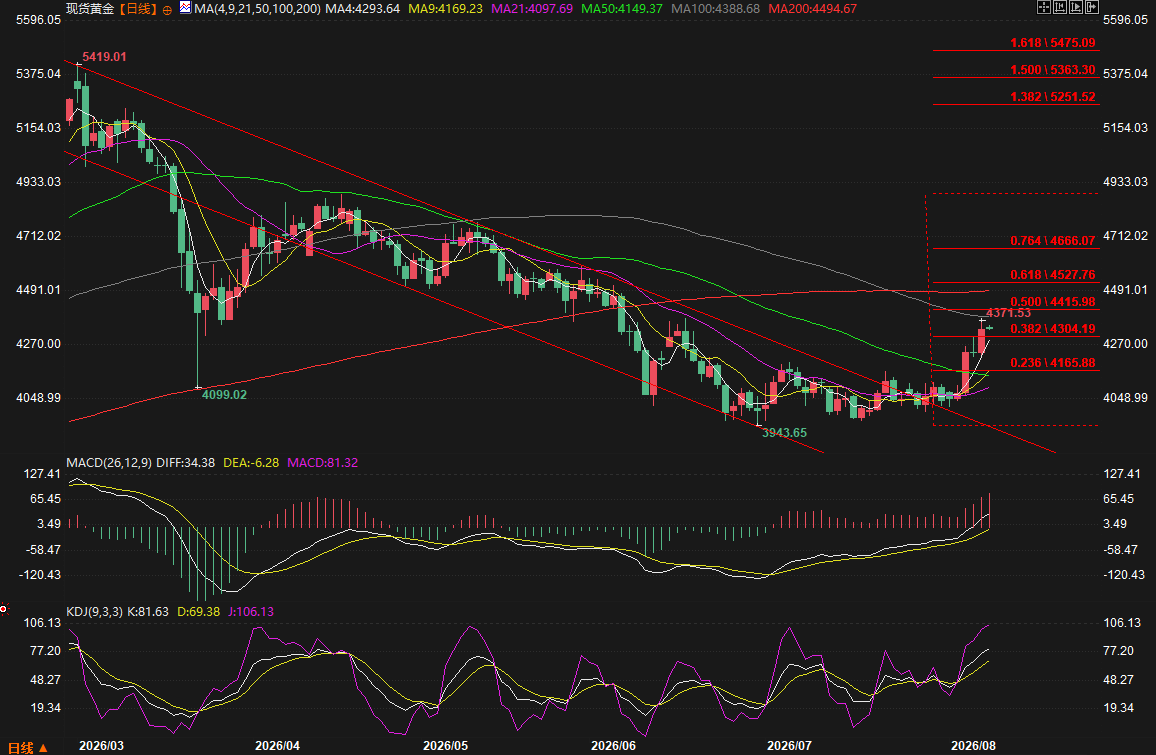 (Spot gold daily chart, source: EasyTrade) At 07:19 Beijing time, spot gold is currently trading at $4344.51 per ounce.
The unexpectedly weak employment data became the direct trigger.
The US July non-farm payrolls report released last Friday completely disrupted the market's previous rhythm. Data from the US Department of Labor showed that non-farm payrolls not only failed to increase in July, but actually decreased by 23,000, far below the market's previous expectation of an increase of 80,000. To make matters worse, the June data was also significantly revised down to an increase of only 20,000. This result far exceeded even the most pessimistic market expectations, immediately triggering a sharp repricing in the interest rate futures market. The labor market has always been one of the core indicators for the Federal Reserve to assess the health of the economy. Previously, the market generally expected that although the labor market had slowed somewhat, it remained resilient enough to support the Fed continuing to raise interest rates in September. However, the negative non-farm payrolls data, coupled with the significant downward revision, challenged the narrative of a "soft landing." David Meger, head of metals trading at High Ridge Futures, bluntly stated that the weaker-than-expected employment data means that the likelihood of the Fed raising interest rates at its next meeting will decrease. Thierry Wizman, global foreign exchange and interest rate strategist at Macquarie Group, also stated that almost no one anticipated negative growth and such a large downward revision, and the market is now inclined to postpone the Fed's interest rate hike from September to October or even December. Following the data release, the interest rate futures market reacted swiftly. According to data from the London Stock Exchange Group, the probability of a Fed rate hike in September plummeted from 57% before the report to 44%, while the probability of maintaining the current rate rose from 43.2% to 56%. The two-year Treasury yield fell 4.2 basis points to 4.245%, and the 10-year Treasury yield also fell 2 basis points to 4.649%. The US dollar index weakened in tandem, falling 0.36% to 99.59, marking its second consecutive week of decline. The weakening dollar and declining real interest rate expectations directly opened up upward potential for gold.Gold prices broke out strongly, posting their biggest weekly gain in seven months.
Fueled by strong employment data, spot gold rose 2.37% on Friday to settle at $4,341.12 an ounce, after hitting an intraday high of $4,371.53, its highest level since June 17. U.S. gold futures also rose 2.3%, settling at $4,399.70 an ounce. Gold prices rose 7.28% last week, marking the largest weekly gain since January 19 and the best week so far this year. Silver, platinum, and palladium also recorded weekly gains, with the precious metals sector showing overall strength. From a technical perspective, after about two months of consolidation and repeated testing of the $4,000 support level, gold finally broke upwards. Last week saw a cumulative gain of nearly $300, with market sentiment clearly shifting from cautious to optimistic. UBS even gave a more aggressive forecast in its latest report, predicting that gold prices will rise to $5,000 an ounce in the first half of 2027. This long-term target further strengthens market confidence in the medium- to long-term bullish trend for gold. However, not all analysts believe the current rally can be sustained overnight. Roukaya Ibrahim, chief commodities strategist at BCA Research, points out that gold around $4,000 is indeed an attractive buying opportunity, but investors need to be patient after last week's sharp rise. She emphasizes that inflation remains the Fed's primary policy target, not the labor market. Market analyst Alex Kuptsikevich believes that while he is bullish on gold in the short term, the upside potential may be limited because the Fed is unlikely to easily abandon its tightening stance in the face of persistent inflationary pressures. He specifically mentions that the price is near but has failed to break through the 50-week moving average (currently around $4,400). The road to $4,500 may be relatively easy, but a more intense tug-of-war will follow.Geopolitical factors provide additional support, but uncertainty remains.
Besides domestic US economic data, recent developments in Middle Eastern geopolitics have also provided some support for gold prices. US officials revealed that negotiations between Iran and Oman have made progress, with both sides expected to reach an agreement on control of the Strait of Hormuz, thereby restoring normal oil shipments. Once the agreement is announced and implemented, the US will lift its blockade of Iranian ports. This development is seen as key to a broader peace agreement, helping to alleviate market concerns about energy supply disruptions. Meanwhile, Saudi Arabia, Turkey, and Pakistan signed a joint defense agreement in Mecca, pledging that any armed attack on any of the three countries would be considered an attack on all three. Although Turkey emphasized that the agreement is purely defensive and not directed against any specific country, its timing amid escalating regional tensions has still attracted market attention. Furthermore, under US mediation, Lebanon and Israel reached an agreement on a shortlist of candidate countries for verifying Hezbollah's disarmament, indicating that efforts to de-escalate regional conflict are still progressing. The marginal easing of geopolitical risks should theoretically suppress safe-haven demand for gold, but recently the focus has been more on easing inflation concerns and reducing pressure on the Federal Reserve to raise interest rates, thus supporting gold prices. The market is also watching whether these developments can truly be implemented and sustained. Iranian President Peshiziyan recently defended the government's negotiating policy in a state television interview, saying that most senior military commanders support a ceasefire through negotiations. This also reflects the tension that still exists within Iran between a peaceful and hardline approach.Houthi rebels attacked Saudi Arabia's Jizan oil refinery, further escalating tensions in the region.
However, the latest news indicates that the Houthi rebels in Yemen announced on Sunday that they had launched a drone attack on Saudi Aramco's oil refinery in Jizan. The Saudi Ministry of Energy subsequently stated that the fire at the refinery had been extinguished and there were no casualties. This attack occurred just two days after Saudi Arabia, Turkey, and Pakistan signed a joint defense agreement aimed at strengthening collective deterrence, stipulating that an armed attack on any one country would be considered an attack on all three. Simultaneously, the Houthi rebels also launched missile and drone attacks on the Yemeni Red Sea port city of Mocha, killing seven people and causing severe damage to port infrastructure. This port is located near the strategically important Bab el-Mandeb Strait, a crucial passage connecting the Red Sea and the Indian Ocean. If this passage is blocked, Saudi Arabia will lose a vital alternative oil export route besides the Strait of Hormuz. Since the US-Israel attacks on Iran in late February, Iran and its regional allies have continued to launch attacks on Saudi Arabia and other Gulf states, as well as energy transport routes. The Houthi rebels announced a naval blockade of the Red Sea against Saudi Arabia last month, further exacerbating the risk of global energy supply disruptions. Peace negotiations between the US and Iran are ongoing, but the issue of right-of-way in the Strait of Hormuz remains a major obstacle. In response to the oil refinery attack, the chairman of Yemen's Saudi-backed presidential council called on the international community to curb the Houthi threat. Pakistan and Turkey have not yet issued formal responses to the attack. Turkey's foreign minister previously emphasized that the new defense agreement is defensive in nature and not directed against any specific country.Short-term bullish sentiment is strong, but this week's CPI data will be a key test.
In summary, the core driver of gold's strong performance last week was the unexpectedly weak US employment data, which led to a downward revision of interest rate expectations, and subsequently a weakening dollar and a decline in real interest rates. The market has begun to reassess the Federal Reserve's policy path, significantly increasing the attractiveness of gold as a zero-yield asset. However, analysts generally warn that this surge was rapid and sharp, and some "quick money" may choose to take profits. The key to whether gold prices can continue to rise lies in the performance of inflation data. This week, the market will see a series of important data releases, with Wednesday's US Consumer Price Index (CPI) being the most crucial. If inflation data is higher than expected, the necessity for the Federal Reserve to maintain its tightening stance will be reinforced again, and gold may quickly experience profit-taking. Conversely, if inflation continues to cool, it will further solidify market expectations that the Federal Reserve will postpone interest rate hikes, providing support for gold prices to test $4,500 or even higher levels. In addition, data such as US retail sales, producer price index, and the University of Michigan consumer sentiment index will also influence market judgments on economic momentum. Nicky Shiels, Head of Research and Metals Strategy at MKS PAMP, warned that gold's rapid and significant rise could prompt short-term funds to exit the market. She believes only a genuinely weaker-than-expected CPI this week would give the market confidence to expect the Federal Reserve to remain on hold throughout the year, thus providing sufficient confidence for gold to test $4,500. In addition, US retail sales data and the University of Michigan consumer sentiment index will also be released this week. Weak consumer data could further reinforce expectations of an economic slowdown, which would be beneficial for gold; while stronger-than-expected data would give the Fed room to raise interest rates, putting pressure on gold prices. Market analyst Fawad Razaqzada also pointed out that the impact of the weak jobs report on gold may not be lasting, as there are two more CPI reports and one jobs report before the next Fed meeting, and uncertainty surrounding oil prices remains. If oil prices and inflationary pressures remain high, the Fed may still be forced to maintain a tightening stance even if the labor market weakens further. From a longer-term perspective, the fundamental support for gold remains solid. Continued gold purchases by global central banks, the normalization of geopolitical uncertainty, and concerns about monetary credit due to high debt levels in major economies all provide underlying demand for gold. UBS's $5,000 target, while having a long time horizon, reflects institutional recognition of gold as a strategic asset allocation. Short-term volatility is inevitable, but the medium- to long-term logic remains intact. In short, last week's seven-week high and largest weekly gain in seven months was a result of both unexpectedly weak employment data and a rapid adjustment in market expectations. Bullish sentiment has been boosted, but the road to higher targets remains challenging. While enjoying the gains, investors should closely monitor this week's inflation data and any policy signals that Federal Reserve officials may release. (Spot gold daily chart, source: EasyTrade) At 07:19 Beijing time, spot gold is currently trading at $4344.51 per ounce.
- Risk Warning and Disclaimer
- The market involves risk, and trading may not be suitable for all investors. This article is for reference only and does not constitute personal investment advice, nor does it take into account certain users’ specific investment objectives, financial situation, or other needs. Any investment decisions made based on this information are at your own risk.