US military ammunition shortages prompt Vance to call for efforts to save oil tankers, signaling a new round of price volatility in oil.
2026-08-12 16:26:55
On Wednesday (August 12), international crude oil prices experienced a volatile trading pattern, rebounding from a low point before rising and then falling back. Currently, WTI crude oil is trading around $83.74, up 0.65%. The core driver of the bullish oil price movement is the US missile attack on an oil tanker, which has rapidly cooled market expectations for a short-term ceasefire and reconciliation between the US and Iran. Negotiations on the opening of the Strait of Hormuz remain stalled. On the bearish side, Pakistan has been mediating between the US and Iran, and the Pakistani Interior Minister traveled to Tehran to meet with Iranian officials for dialogue. Meanwhile, the US has been consistently projecting its determination to control oil prices. The US military fired on a Panamanian-flagged cargo ship in the Gulf of Oman today, and the blockade against Iran remains in full force. Meanwhile, Vance accused Ukraine of attacking Russian oil tankers and demanded that Ukraine cease its attacks on tankers. In the long term, the shortage of high-end US air defense munitions limits large-scale US military operations, while shipping capacity in the Strait of Hormuz and the Strait of Oman disrupts global supply. Multiple geopolitical and macroeconomic variables are collectively influencing the risk premium for crude oil. 
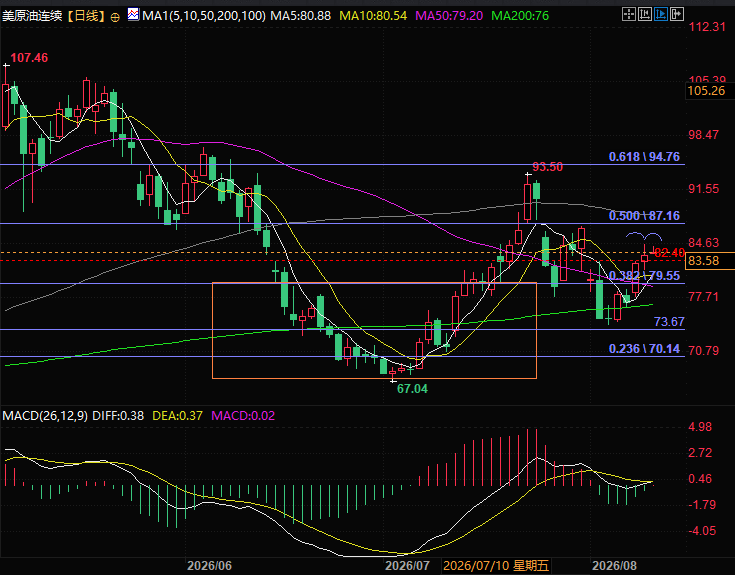 (WTI crude oil futures daily chart, source: EasyForex) At 16:21 Beijing time, WTI crude oil is currently trading at $83.64 per barrel.
The blockade of the Strait of Hormuz exacerbated the collapse of Iran's oil revenues, and bilateral negotiations reached a stalemate.
The US's current core pressure tactic is a comprehensive maritime blockade of Iranian ports, aiming to cut off Iran's oil revenue base and force Tehran to compromise and cease hostilities. Capital Economics statistics show that after the US fully reinstated the blockade last month, Iran's crude oil exports in July nearly plummeted to zero, a precipitous drop from the $4.5 billion in exports in June. Before the war, Iran's annualized crude oil exports accounted for approximately 11% of its GDP, serving as a core source of foreign exchange for military production, subsidies for the people, and imports. Faced with dwindling oil revenues, Iran has implemented a series of policies to offset the economic impact, including commodity rationing and controls on residents' foreign exchange purchases. William Jackson, chief emerging markets economist at Capital Economics, predicts that if Iran cannot obtain substantial concessions from the US, such as lifting sanctions and easing the shipping blockade, its economy will be mired in a prolonged deep recession. Whether a bilateral reconciliation can be reached ultimately depends on the extent of economic recession that the Iranian ruling class is willing to bear for its military and geopolitical ambitions.The Hormuz negotiations have stalled completely, and shipping across the Strait is virtually frozen.
Regarding navigation in the Strait of Hormuz, Commonwealth Bank of Australia analyst Harry Otley pointed out that negotiations surrounding the resumption of navigation in the Strait of Hormuz are currently completely stalled. Iranian officials continue to reiterate the preconditions for resumption, including hard demands such as war reparations from the US and the complete lifting of oil sanctions. This waterway carries one-fifth of the world's maritime crude oil transport and is a core choke point for global energy. Before the war, approximately 130 oil tankers passed through daily; however, data from maritime intelligence agency Windward shows that only 10 ships transited the strait on Monday, a drop to single-digit pre-war levels. A maritime standoff occurred early Tuesday morning: a Panamanian cargo ship attempted to break through the US blockade of Iranian ports, prompting the US to deploy helicopters to fire warning shots at the vessel. The US Central Command confirmed this action, further confirming the continued tightening of US maritime blockade control. Tim Walter, chief market analyst at KCM Trade, stated that while the market has not completely abandoned expectations of diplomatic reconciliation, the prolonged lack of substantial progress in negotiations and the widening differences in demands between the two sides have diminished investor optimism, with risk premiums continuing to support oil prices in the $85-90 range. Sparta Commodities, a commodities research firm, added that as long as two-way shipping in the Strait of Hormuz cannot return to normal, OPEC's capacity to increase crude oil production will remain limited, providing solid support for oil prices. U.S. Energy Secretary Lighthizer claimed that the seven-day average crude oil flow through the Strait had recovered to 9 million barrels per day, but multiple tanker tracking platforms calculated only 7 million barrels per day, leading to widespread market skepticism about the official optimistic figures.US military ammunition shortages constrain large-scale military operations in the Middle East and ease market concerns about extreme conflicts.
The Trump administration publicly acknowledged the shortage of high-end munitions for the US military, attributing the shortfall to the $300 billion in military aid provided to Ukraine during the Biden administration, which continuously depleted the stockpile of Patriot and Standard Missile series air defense interceptors. Multiple US think tanks calculated that after months of intercepting Iranian ballistic missiles and drones, the US military's land-based Patriot air defense missile stockpile has shrunk by more than half, and the shipborne Standard Missile-6 long-range interceptor stockpile is also running low. The expansion cycle for these high-end munitions production lines is several years, making it difficult to fill the gap in the short term. This ammunition shortage directly creates a buffer for the market's bullish sentiment towards crude oil: limited by weapons stockpiles, the US is unable to launch an unlimited large-scale airstrike against Iran's military and energy facilities, reducing the probability of a full-scale war and alleviating investors' extreme panic about a complete disruption of global oil supply. This also explains why current oil prices have only risen moderately and have not triggered a one-sided surge. To hedge against the risk of a single supply route through the Strait of Hormuz, the US is accelerating the development of alternative global oil transportation channels. The US, in conjunction with Gulf states, is planning a transcontinental oil pipeline network to create an export route bypassing the Strait of Hormuz to the Red Sea and the Gulf of Oman. At the same time, it signed a $60 billion energy infrastructure agreement with Iraq to restart cross-border pipeline projects, diverting Middle Eastern crude oil export capacity and reducing global dependence on the Strait of Hormuz.The risk of attacks on oil tankers in the Black Sea has increased, prompting the United States to pressure Ukraine to ease the energy conflict.
The Financial Times of London reported that US Vice President Vance has formally made a clear demand to Ukraine, urging the Ukrainian military to cease attacks on oil tankers docked at Russian Black Sea ports. The core concern for the US is that the dual shipping crises in the Black Sea and the Persian Gulf will simultaneously impact global oil supply, further pushing up oil prices, exacerbating domestic inflationary pressures in the US, and interfering with the Federal Reserve's monetary policy space. US officials confirmed that Ukraine has made a compromise commitment: it will no longer launch attacks on key Black Sea infrastructure for Kazakhstan's oil exports or on non-Russian commercial oil tankers, and will establish a cargo information communication channel to ensure the safety of neutral commercial shipping. The vast majority of Kazakhstan's crude oil is exported through the Caspian Pipeline Group's Black Sea terminal, which accounts for 1% of global crude oil supply daily. Continued attacks on these facilities, coupled with the Hormuz blockade, will create a double supply gap.Viewpoints and Technical Analysis:
The current crude oil market is in a game of geopolitical supply contraction and limited US military operations: insufficient US ammunition reserves have reduced its leverage for military threats, forcing it to resort to economic sanctions and a blockade of Iranian oil shipments. However, this is a double-edged sword. First, it will lead to higher oil prices, contradicting the US's initial intention to open the Strait of Hormuz before the midterm elections to lower oil prices. Second, it is unknown how long it will take for Iran to compromise. If the blockade is very effective, the US will likely not lift the initial blockade a month ago. In other words, the blockade also puts pressure on the US. Consequently, the US military's shortage of high-end ammunition suppresses the possibility of a full-scale war, limiting the upside potential of oil prices. At the same time, the US is pressuring Ukraine to suspend attacks on Black Sea oil tankers and stabilize Black Sea oil shipments, while accelerating the construction of alternative pipelines bypassing the Strait of Hormuz in an attempt to hedge against the risks of relying on a single shipping route. Short-term oil price movements will be highly dependent on two variables: whether there is a breakthrough in US-Iran diplomatic negotiations, and whether the global crude oil supply and demand gap is within a safe range, preventing a second supply crisis. Technical Analysis: WTI crude oil experienced a slight rise followed by a pullback. Today, a short-term double top candlestick pattern may appear on the daily chart. If this pattern appears, it suggests that oil prices will begin to decline. However, if oil prices do not experience a significant pullback today, the double top pattern will not be established. Furthermore, given the recent sharp rebound in oil prices without a significant pullback, it indicates that selling pressure is not significant, and oil prices are likely to continue rising around the 5-day moving average. (WTI crude oil futures daily chart, source: EasyForex) At 16:21 Beijing time, WTI crude oil is currently trading at $83.64 per barrel.
- Risk Warning and Disclaimer
- The market involves risk, and trading may not be suitable for all investors. This article is for reference only and does not constitute personal investment advice, nor does it take into account certain users’ specific investment objectives, financial situation, or other needs. Any investment decisions made based on this information are at your own risk.