Despite a dovish shift in data across the board, the US dollar is still hovering around 99.60. What's wrong with market pricing?
2026-08-19 08:26:58
On Wednesday (August 19) in early Asian trading, the US dollar index fell slightly, currently trading around 99.60, as the market continued to digest recent weak economic data and expectations of a dovish shift in the Federal Reserve's policy stance. The euro retreated slightly from a two-month high, the pound remained near a three-month high, and the yen nearly recovered half of its gains following coordinated intervention. Although geopolitical risks pushed up global bond yields, providing some support for the dollar, market expectations for a September rate hike have significantly diminished, limiting the dollar's overall upward momentum. The tug-of-war between expectations of a Fed policy shift and geopolitical risks continues to dominate the currency market. 
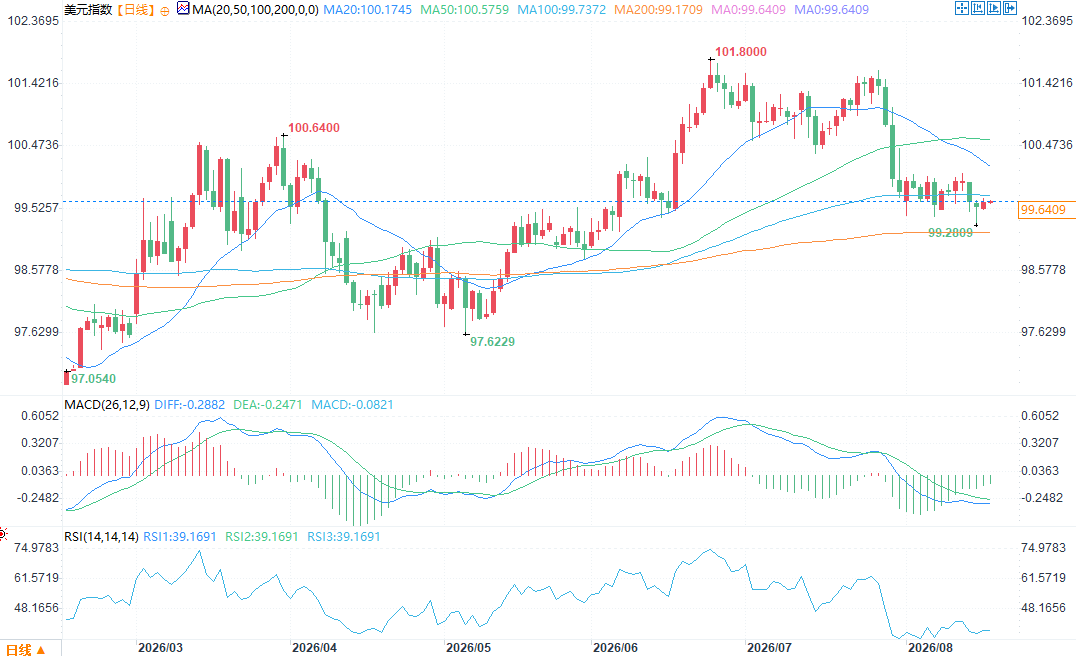 (US Dollar Index Daily Chart, Source: FX678) At 8:24 AM Beijing time on August 19, the US Dollar Index was at 99.60.
Weak data suppresses expectations of interest rate hikes, limiting the upside potential for the dollar.
The continued weakness in U.S. economic data over the past few weeks—an unexpected drop in July nonfarm payrolls, moderate inflation readings, and weak retail sales—has prompted investors to significantly reduce their bets on a September rate hike by the Federal Reserve. Market pricing indicates that the probability of a 25 basis point rate hike in September has shifted from nearly 50/50 to a near 70% probability of no rate increase. Moneycorp's head of North American structured products stated, "Current levels, especially for dollar-denominated currency pairs, reflect the unexpectedly dovish signals we saw at the last Fed meeting, or at least the market's interpretation of them. Before the last decision, Fed Chairman Warsh appeared hawkish, but that's not the case now, at least not in the market's current interpretation. Combined with the fact that neither CPI nor employment data points to inflation, the dollar has suddenly weakened, which is reflected in most currency pairs." Scotiabank's strategy team noted in an investor report, "Moderate inflation and signs of weakness in the U.S. labor market make a September rate hike highly unlikely at this stage—although Fed expectations rose slightly this morning, we believe that short-term dollar gains still present selling opportunities."Geopolitics: Escalating standoff in the Hormuz raises inflation risks and pushes up global yields.
A senior Iranian official told the media that Iran would adopt a "full-scale offensive" military posture due to the deadlock in negotiations. Meanwhile, Washington ruled out extending the June ceasefire agreement. The more than five-month-long conflict continues to fuel inflation concerns and upend the global interest rate outlook. Global bond yields have climbed again, partly due to traders' worries about the impact of a prolonged closure of the Strait of Hormuz on energy prices. The yield on the 30-year US Treasury note rose to its highest level since 2007, and the global yield curve shifted upward in tandem. Brent crude futures held steady around $91 a barrel, the highest level since July 24. The head of fixed income sales for Europe, the Middle East, and Africa at Citadel Securities noted, "Inflation has been above target for most of the past five years, and while a high annual rate of 2% may be acceptable to the Fed, in a world continuously impacted by supply shocks, the inflationary process has little room to breathe."Major currency performance: Euro retreats, Pound holds firm, Yen nears recovery of intervention gains.
The euro edged down to around 1.1575 against the dollar on Wednesday, after hitting a two-month high of 1.1613 on Monday. While geopolitical risks boosted demand for the dollar as a safe haven, fading expectations of a Federal Reserve rate hike limited the euro's downside. The pound traded around 1.3535 against the dollar, slightly below the three-month high reached in the previous session. Mixed UK employment data, but accelerating wages and improved unemployment claims provided support for the pound. The dollar traded around 159.60 against the yen, having given back nearly half of its gains since the joint US-Japan intervention at the end of July. Traders are focusing on the threat of further intervention and the Bank of Japan's meeting next month – where the market expects a rate hike. The Australian dollar dipped slightly to around 0.7080 against the dollar.Summarize
The US dollar index is currently consolidating in a narrow range around 99.60, with the market repricing the Federal Reserve's policy path. Weak employment, inflation, and retail data have reduced the probability of a September rate hike from 50/50 to approximately 30%, and the probability of no rate action is close to 70%, which constitutes the ceiling for a dollar rebound. However, the escalating standoff in the Strait of Hormuz, leading to rising global bond yields and safe-haven demand, is providing tactical support for the dollar. The euro has retreated slightly from a two-month high, the pound is holding firm near a three-month high, and the yen is gradually giving back its intervention gains. In the short term, the dollar lacks a clear unilateral driver—economic data points to a dovish policy outlook, while geopolitical risks constantly remind the market that the threat of inflation has not disappeared. With bullish and bearish forces balancing each other, the currency market is likely to continue its consolidation, awaiting new directional clues from the FOMC meeting minutes. (US Dollar Index Daily Chart, Source: FX678) At 8:24 AM Beijing time on August 19, the US Dollar Index was at 99.60.
- Risk Warning and Disclaimer
- The market involves risk, and trading may not be suitable for all investors. This article is for reference only and does not constitute personal investment advice, nor does it take into account certain users’ specific investment objectives, financial situation, or other needs. Any investment decisions made based on this information are at your own risk.