World Gold Council: Gold is different from ordinary commodities and should be considered an independent asset allocation.
2026-08-19 09:36:58
In asset allocation, many investors habitually categorize gold as a commodity, relying on commodity indices for portfolio allocation. However, the World Gold Council's asset allocation strategist, Jeremy De Pessemier, in his report "Gold: The Most Effective Commodity Investment 2026," offers a different perspective: gold possesses a unique supply and demand structure, diversification and hedging value, and cross-cycle risk resistance capabilities. It cannot be simply equated with ordinary commodities and should be included as a separate sector in investment portfolios. Relying solely on commodity indices to obtain gold exposure underestimates gold's strategic allocation significance.
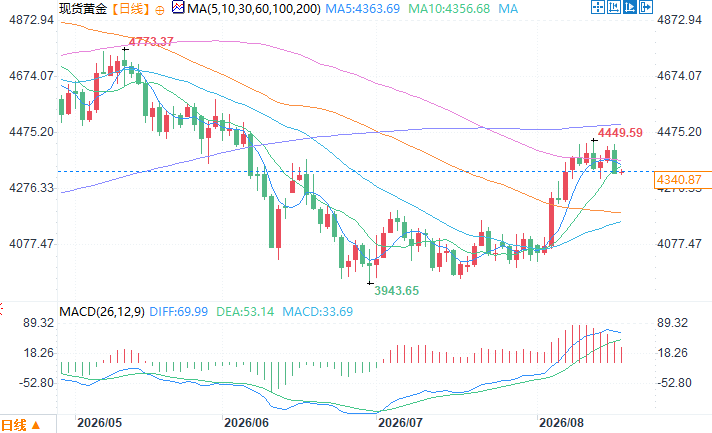 Spot gold daily chart source: EasyTrade. At 9:34 AM Beijing time on August 19th, spot gold was trading at $4349.87 per ounce.
Index allocation has inherent flaws, and the value of gold is underestimated.
Most investors use commodity indices to allocate commodity assets, with gold included as a component. However, Depesemir points out that commodity indices are often compiled based on futures liquidity or annual mine production, standards that are not suitable for the actual situation of the gold market. Besides the futures market, gold enjoys significant liquidity through over-the-counter trading and gold ETFs, and market supply is not limited to annual mine production; a vast amount of above-ground gold can be recycled and recirculated. This results in a generally low weighting of gold in comprehensive commodity indices, failing to reflect its true market depth and strategic value. Even if rising gold prices passively increase the gold weighting within the index, it still falls short of strategic allocation needs. Holding gold through commodity indices also incurs significant rollover costs, while investing in physical gold avoids these losses—an advantage not found in ordinary commodities. Gold is a complex asset; jewelry and technology sectors generate consumer demand, while it also serves as an investment and hedging tool. This dual demand mitigates the impact of economic cycles on gold prices. Consumer demand provides support during economic booms, while investment buying drives up prices during crises.Four core characteristics that differentiate gold from ordinary commodities
Depesemir stated that compared to other commodities, gold possesses four outstanding investment characteristics. In the long term, regardless of economic boom or bust, gold consistently delivers positive returns. Over various cycles over the years, gold's returns have outperformed the overall commodity index and most sub-sectors. Diversified demand also reduces its volatility, improving the risk-adjusted returns of the portfolio. Gold's diversification and hedging capabilities are particularly valuable. It has low correlation with stocks and most commodities, and this correlation dynamically shifts with the environment. During economic upturns, it moves in the same direction as the stock market; however, in the event of systemic risk, it becomes negatively correlated, hedging tail risks—a feat difficult for ordinary commodities to achieve. The report cites historical examples: during the stock market crash at the end of 2018 and the market impact of the 2020 pandemic, while commodities generally plummeted, gold still achieved positive returns, fully demonstrating its safe-haven attributes. Regarding inflation protection, while the global gold market is highly liquid, with daily global gold trading reaching $373 billion by 2025, its massive market capacity can accommodate large institutions' large-scale long-term allocations.Current Status of Combined Configurations and Macro-Scenario Implications
In real-world investing, most portfolios allocate less than 10% to commodities, with gold's share further compressed, often resulting in an actual gold exposure of less than 1%. Data shows that simply increasing commodity allocation does not significantly improve portfolio risk-adjusted returns, but allocating to gold can simultaneously increase absolute returns and reduce portfolio volatility. The report categorizes the market into four macroeconomic scenarios, and gold achieves positive returns in all scenarios, demonstrating far greater stability than commodities. Commodities only perform well during economic recovery phases, facing significant pressure during recessions.Conclusion
In summary, although gold is classified as a commodity, its supply and demand, costs, and hedging capabilities differ fundamentally from ordinary commodities. Jeremy Depesemir emphasizes that gold is suitable for allocation as an independent asset and can complement commodities, but the two cannot substitute for each other. Investors should not simply rely on commodity indices to complete their gold portfolio allocation. Spot gold daily chart source: EasyTrade. At 9:34 AM Beijing time on August 19th, spot gold was trading at $4349.87 per ounce.
- Risk Warning and Disclaimer
- The market involves risk, and trading may not be suitable for all investors. This article is for reference only and does not constitute personal investment advice, nor does it take into account certain users’ specific investment objectives, financial situation, or other needs. Any investment decisions made based on this information are at your own risk.