With the Federal Reserve refusing to raise interest rates and the Treasury engaging in large-scale spending, the US dollar is hovering at a near three-month low. Will it fall further?
2026-08-20 14:21:00
On Thursday (August 20) during the Asian session, the US dollar index fluctuated at low levels, currently trading around 98.80, but still at its lowest level since the end of May. The continued cooling of expectations for a Federal Reserve rate hike is the core drag – the probability of a September rate hike has fallen from 47% a month ago to about 33%. Meanwhile, the US Treasury's announcement of expanding its long-term Treasury bond repurchase program (doubling it from $2 billion to $4 billion) and market concerns about the US national debt exceeding $40 trillion further exacerbated the downward pressure on the dollar. Geopolitically, the escalating conflict between the US and Iran, with Trump announcing the "toughest economic action in history" against Iran and the UAE suspending all trade with Iran, failed to effectively boost the dollar due to safe-haven demand triggered by geopolitical risks. 
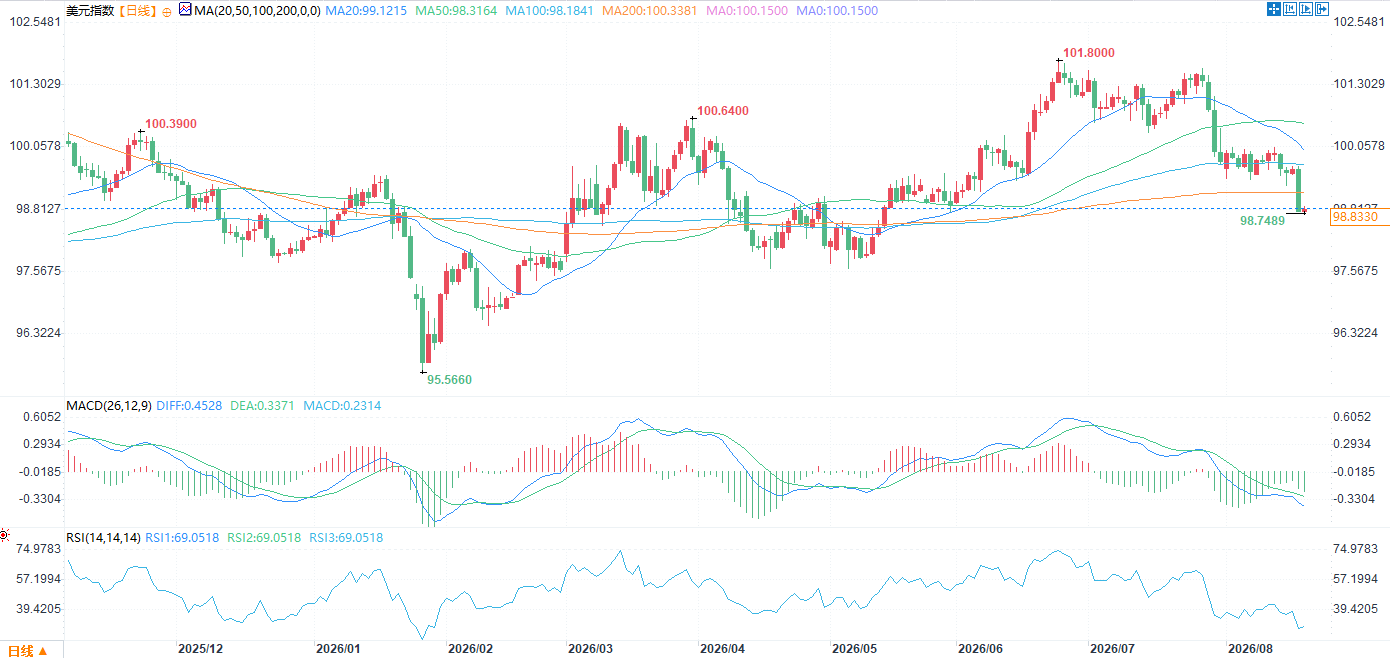 (US Dollar Index Daily Chart, Source: FX678) At 14:16 Beijing time on August 20, the US Dollar Index was at 98.80.
The dollar fell to its lowest level since the end of May due to pressure from both data and policy.
The US dollar index is currently trading around 98.80, its lowest level since the end of May. The unexpected drop in July's non-farm payrolls, moderate inflation data, and weak retail sales have continued to weaken market expectations for a Federal Reserve rate hike in September. The CME FedWatch tool shows that the probability of a 25 basis point rate hike in September has fallen from 47% a month ago to 32.7%. Meanwhile, the US Treasury's bond repurchase operations are also putting pressure on the dollar. A well-known institution reported that the US Treasury will expand the scale of long-term Treasury bond repurchases, doubling the upper limit of a single operation from $2 billion to at least $4 billion, in order to curb a sharp rise in borrowing costs. Coupled with market concerns that the US national debt will exceed $40 trillion, the dollar is under pressure and weakening.Geopolitics: US-Iran conflict escalates, but safe-haven buying fails to boost the dollar.
Geopolitically, the conflict between the US and Iran continues to escalate. Trump announced the "toughest economic action in history" against Iran, stating it would be an unprecedented economic conflict and isolation, and that countries providing financial aid to Iran would face severe economic consequences. Meanwhile, the UAE, after being attacked by two ballistic missiles, announced a suspension of all trade with Iran, which denied launching the missiles. However, the safe-haven demand triggered by geopolitical risks failed to effectively boost the US dollar. DBS Bank research economists noted that the dollar traded sideways overall, with the market weighing the geopolitical risks in the Strait of Hormuz against the recent bond sell-off; investors were unwilling to decisively push the dollar higher in the current context.Institutional Views
A research report released by Commerzbank on August 17th pointed out that since the end of last year, market expectations for Federal Reserve rate hikes have been significantly higher than those of other G10 central banks, supporting the US dollar. However, this gap has narrowed recently, especially in the past two weeks, with the market continuously lowering its pricing of Fed tightening, while expectations in other developed economies have not declined in tandem. The bank's economists still expect three US rate cuts next year; if this trend continues, the dollar will face renewed pressure. Recent data and policy expectations have already caused the dollar to lose its previous "relative rate hike advantage." Commerzbank emphasized that if the market continues to reduce its bets on Fed rate hikes, the dollar may face further losses. Mitsubishi UFJ Financial Group, in its latest research report, stated that recent soft data (retail sales, non-farm payrolls, CPI) and declining short-term US Treasury yields have weakened dollar support, and a steepening yield curve is unfavorable for the dollar. The market has significantly lowered its pricing of Fed rate hikes. Mitsubishi UFJ Financial Group believes that the US dollar will depreciate in 2027 after the interest rate hike window closes (after inflation falls), and current soft data and yield changes have supported its prediction of "moderate weakening again next year".Summarize
The US dollar index is currently trading around 98.85, its lowest level since the end of May. The continued cooling of the probability of a Federal Reserve rate hike (falling to about 33% in September) and the Treasury's expansion of long-term bond repurchase operations are both weighing on the dollar. Geopolitically, the escalating conflict between the US and Iran has failed to effectively boost the dollar due to safe-haven buying. Investors are simultaneously assessing geopolitical risks in the Strait of Hormuz and digesting the continued sell-off in the bond market, leaving the dollar lacking a clear direction and maintaining range-bound trading. (US Dollar Index Daily Chart, Source: FX678) At 14:16 Beijing time on August 20, the US Dollar Index was at 98.80.
- Risk Warning and Disclaimer
- The market involves risk, and trading may not be suitable for all investors. This article is for reference only and does not constitute personal investment advice, nor does it take into account certain users’ specific investment objectives, financial situation, or other needs. Any investment decisions made based on this information are at your own risk.