Cooling US economic data coupled with expanded US Treasury buybacks sent the dollar index to a new low since May.
2026-08-20 16:35:05
The dollar index continued to weaken in early European trading on Thursday, trading around 98.80, having touched its lowest level since the end of May at one point. The main reason for the recent pressure on the dollar is the marginal cooling of US economic data, which has significantly reduced market expectations for a renewed interest rate hike by the Federal Reserve in the near term. At the same time, the US Treasury's expansion of long-term Treasury repurchase operations has provided some liquidity support to the bond market, further diminishing the dollar's interest rate advantage.  US economic data is one of the core drivers of the recent dollar weakness. The unexpected decline in July's employment data, coupled with relatively mild recent US inflation data, has led investors to reassess the Federal Reserve's future policy path. Current market pricing indicates that the probability of a Fed rate hike in September has fallen to 32.7%, significantly lower than 47% a month ago. This rapid decline in the probability of a rate hike means that the interest rate differential support previously relied on by the dollar has weakened significantly. While the Fed's July meeting minutes still released hawkish signals, the market is paying more attention to changes in the data released after the meeting. If the job market continues to weaken and inflationary pressures further ease, the necessity for the Fed to raise rates again may decrease. Conversely, if rising energy prices lead to a renewed rise in inflation expectations, the Fed may maintain a relatively cautious policy stance. Therefore, the dollar market is currently waiting for more economic data to confirm its position, rather than simply trading a single hawkish signal from the Fed. US fiscal policy is also influencing the dollar and bond markets. The US Treasury plans to expand its long-term Treasury repurchase operations, increasing the maximum size of a single operation from $2 billion to at least $4 billion. By increasing the scale of repurchases, the Treasury hopes to improve liquidity in the long-term bond market and alleviate the problem of rapidly rising financing costs. From a market perspective, if long-term US Treasury yields decline due to liquidity support, the attractiveness of dollar-denominated assets may weaken, thus putting further pressure on the dollar index. Simultaneously, market concerns about the continued expansion of US government debt and long-term fiscal financing pressures may also reduce some investors' willingness to allocate to dollar-denominated assets. However, the dollar has not completely lost its safe-haven function. The situation in the Middle East and the shipping risks in the Strait of Hormuz still provide some support for the dollar. When market risk appetite declines, the dollar, as one of the world's major safe-haven currencies, often attracts some capital inflows. Therefore, despite the weak fundamentals of the dollar, geopolitical risks make it difficult for short sellers to form a sustained one-sided trend. The risks in the Strait of Hormuz are particularly noteworthy. This region is a crucial global energy transport route; if transport security deteriorates significantly, international energy prices may rise further, pushing up global inflation expectations again. For the dollar, this impact is twofold: on the one hand, rising energy prices may strengthen US inflation and delay expectations of Fed easing, thus benefiting the dollar; on the other hand, if the energy shock significantly drags down global economic growth, the market may trade with stronger safe-haven demand. TD Bank research suggests that the US dollar is currently trading within a range, with the market reassessing the risks associated with the Strait of Hormuz. Investors are focused on the uncertainty surrounding the shipping route while also digesting recent volatility in the US Treasury market. Therefore, while the dollar has safe-haven support, it lacks a clear driver for a sustained rise. The future direction of the dollar index will depend on the interplay between US economic fundamentals and safe-haven demand. If US employment and inflation data continue to cool, the market may further reduce expectations of a Fed rate hike, putting greater pressure on the dollar. Conversely, if Middle East risks escalate further, or a sharp rise in energy prices leads to a resurgence in US inflation expectations, the dollar may have a chance to rebound. The focus should now be on US initial jobless claims, manufacturing data, and speeches by Fed officials, while also observing changes in US Treasury yields and the situation in the Strait of Hormuz. In particular, if US Treasury yields continue to decline while geopolitical risks do not worsen further, the dollar may remain weak; conversely, if safe-haven funds and interest rate expectations both shift towards the dollar, a significant technical rebound could be triggered. From a daily chart perspective, the US dollar index maintains a clear downtrend, currently trading below the 100-day moving average and the Bollinger middle band, remaining in the lower half of its recent trading range. The 14-day RSI is currently around 29.60, already in oversold territory, indicating that bearish pressure remains dominant, but the momentum for further short-term declines may be slowing after the recent drops. The first support level to watch is the lower Bollinger band around 98.55; a break below this level could lead to further testing of lower levels. Initial resistance is at the 100-day moving average around 99.72, followed by the Bollinger middle band around 100.00. Only a sustained recovery above these levels can significantly alleviate the current bearish structure; stronger resistance lies at the upper Bollinger band around 101.50. Looking at the 4-hour chart, the US dollar index remains in a weak, oscillating state in the short term, with the area around 98.80 being a key area to watch. With the daily RSI entering oversold territory, the US dollar may experience a short-term technical rebound. If the price can regain above 99.00 and further break through 99.72, the rebound could extend to around 100.00. However, if the rebound is consistently suppressed and falls below 98.55, the downtrend is likely to extend further. Overall, the 4-hour chart remains bearish, but the oversold condition means that shorting should be approached with caution due to the risk of a rapid pullback. The direction of the subsequent breakout will determine the next phase of the market movement.
 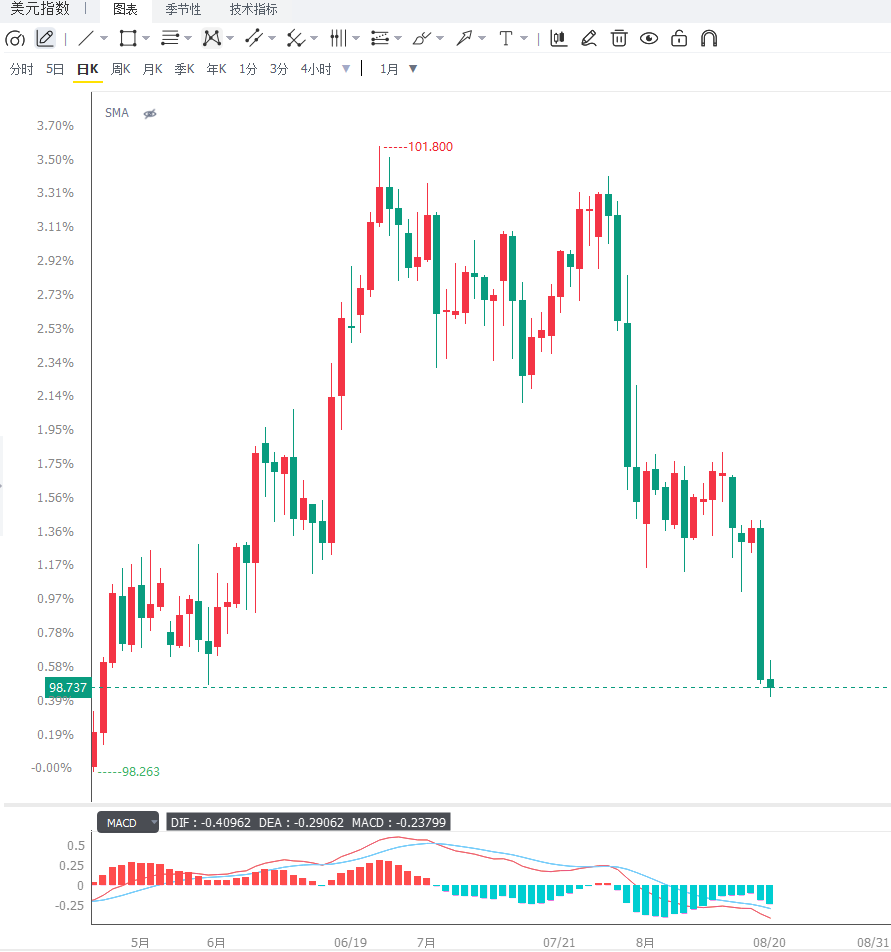 Editor's Summary: The US dollar index is currently under pressure from multiple factors, including cooling economic data, declining expectations of interest rate hikes, and increased long-term US Treasury bond repurchases. The probability of a September rate hike has fallen to 32.7%, coupled with the dollar index falling to its lowest level since the end of May, making the short-term weakness of the dollar more pronounced. However, risks in the Strait of Hormuz and global safe-haven demand still provide a floor for the dollar, so the index is more likely to fluctuate within a weak range rather than continue a one-sided decline. Technically, 98.55 is a key support level, while 99.72 to 100.00 constitutes a resistance zone for any rebound. If 98.55 is breached, the dollar's weakness may further intensify; if geopolitical risks drive safe-haven funds back to the dollar, a rapid rebound after overselling should be anticipated.
US economic data is one of the core drivers of the recent dollar weakness. The unexpected decline in July's employment data, coupled with relatively mild recent US inflation data, has led investors to reassess the Federal Reserve's future policy path. Current market pricing indicates that the probability of a Fed rate hike in September has fallen to 32.7%, significantly lower than 47% a month ago. This rapid decline in the probability of a rate hike means that the interest rate differential support previously relied on by the dollar has weakened significantly. While the Fed's July meeting minutes still released hawkish signals, the market is paying more attention to changes in the data released after the meeting. If the job market continues to weaken and inflationary pressures further ease, the necessity for the Fed to raise rates again may decrease. Conversely, if rising energy prices lead to a renewed rise in inflation expectations, the Fed may maintain a relatively cautious policy stance. Therefore, the dollar market is currently waiting for more economic data to confirm its position, rather than simply trading a single hawkish signal from the Fed. US fiscal policy is also influencing the dollar and bond markets. The US Treasury plans to expand its long-term Treasury repurchase operations, increasing the maximum size of a single operation from $2 billion to at least $4 billion. By increasing the scale of repurchases, the Treasury hopes to improve liquidity in the long-term bond market and alleviate the problem of rapidly rising financing costs. From a market perspective, if long-term US Treasury yields decline due to liquidity support, the attractiveness of dollar-denominated assets may weaken, thus putting further pressure on the dollar index. Simultaneously, market concerns about the continued expansion of US government debt and long-term fiscal financing pressures may also reduce some investors' willingness to allocate to dollar-denominated assets. However, the dollar has not completely lost its safe-haven function. The situation in the Middle East and the shipping risks in the Strait of Hormuz still provide some support for the dollar. When market risk appetite declines, the dollar, as one of the world's major safe-haven currencies, often attracts some capital inflows. Therefore, despite the weak fundamentals of the dollar, geopolitical risks make it difficult for short sellers to form a sustained one-sided trend. The risks in the Strait of Hormuz are particularly noteworthy. This region is a crucial global energy transport route; if transport security deteriorates significantly, international energy prices may rise further, pushing up global inflation expectations again. For the dollar, this impact is twofold: on the one hand, rising energy prices may strengthen US inflation and delay expectations of Fed easing, thus benefiting the dollar; on the other hand, if the energy shock significantly drags down global economic growth, the market may trade with stronger safe-haven demand. TD Bank research suggests that the US dollar is currently trading within a range, with the market reassessing the risks associated with the Strait of Hormuz. Investors are focused on the uncertainty surrounding the shipping route while also digesting recent volatility in the US Treasury market. Therefore, while the dollar has safe-haven support, it lacks a clear driver for a sustained rise. The future direction of the dollar index will depend on the interplay between US economic fundamentals and safe-haven demand. If US employment and inflation data continue to cool, the market may further reduce expectations of a Fed rate hike, putting greater pressure on the dollar. Conversely, if Middle East risks escalate further, or a sharp rise in energy prices leads to a resurgence in US inflation expectations, the dollar may have a chance to rebound. The focus should now be on US initial jobless claims, manufacturing data, and speeches by Fed officials, while also observing changes in US Treasury yields and the situation in the Strait of Hormuz. In particular, if US Treasury yields continue to decline while geopolitical risks do not worsen further, the dollar may remain weak; conversely, if safe-haven funds and interest rate expectations both shift towards the dollar, a significant technical rebound could be triggered. From a daily chart perspective, the US dollar index maintains a clear downtrend, currently trading below the 100-day moving average and the Bollinger middle band, remaining in the lower half of its recent trading range. The 14-day RSI is currently around 29.60, already in oversold territory, indicating that bearish pressure remains dominant, but the momentum for further short-term declines may be slowing after the recent drops. The first support level to watch is the lower Bollinger band around 98.55; a break below this level could lead to further testing of lower levels. Initial resistance is at the 100-day moving average around 99.72, followed by the Bollinger middle band around 100.00. Only a sustained recovery above these levels can significantly alleviate the current bearish structure; stronger resistance lies at the upper Bollinger band around 101.50. Looking at the 4-hour chart, the US dollar index remains in a weak, oscillating state in the short term, with the area around 98.80 being a key area to watch. With the daily RSI entering oversold territory, the US dollar may experience a short-term technical rebound. If the price can regain above 99.00 and further break through 99.72, the rebound could extend to around 100.00. However, if the rebound is consistently suppressed and falls below 98.55, the downtrend is likely to extend further. Overall, the 4-hour chart remains bearish, but the oversold condition means that shorting should be approached with caution due to the risk of a rapid pullback. The direction of the subsequent breakout will determine the next phase of the market movement. Editor's Summary: The US dollar index is currently under pressure from multiple factors, including cooling economic data, declining expectations of interest rate hikes, and increased long-term US Treasury bond repurchases. The probability of a September rate hike has fallen to 32.7%, coupled with the dollar index falling to its lowest level since the end of May, making the short-term weakness of the dollar more pronounced. However, risks in the Strait of Hormuz and global safe-haven demand still provide a floor for the dollar, so the index is more likely to fluctuate within a weak range rather than continue a one-sided decline. Technically, 98.55 is a key support level, while 99.72 to 100.00 constitutes a resistance zone for any rebound. If 98.55 is breached, the dollar's weakness may further intensify; if geopolitical risks drive safe-haven funds back to the dollar, a rapid rebound after overselling should be anticipated.
- Risk Warning and Disclaimer
- The market involves risk, and trading may not be suitable for all investors. This article is for reference only and does not constitute personal investment advice, nor does it take into account certain users’ specific investment objectives, financial situation, or other needs. Any investment decisions made based on this information are at your own risk.