Gold Trading Alert: Gold Prices Continue to Climb! Iran Sanctions + US Treasury Buybacks + Warsh's Debut: How Long Can the Bullish Frenzy Last?
2026-08-25 07:46:59
The global gold market is experiencing a remarkable rally. On Monday (August 24), spot gold continued its strong momentum from last week, reaching as high as $4,680.70 per ounce during the session, a more than three-month high since May 14, before ultimately closing up 1% at $4,652.48. US gold futures for December delivery also strengthened, rising 1.1% to $4,730.40 per ounce. In just one month, London spot gold has steadily climbed from below $4,100, with a cumulative increase of over 13% since August. Gold prices have risen for the third consecutive week, with a weekly gain exceeding 5% last week, strongly breaking through the key $4,600 level. Jim Wyckoff, market analyst at American Gold Exchange, stated, "At the start of this week's trading, both fundamental and technical factors are favorable for the gold market." He pointed out that the stabilization or even slight decline in Treasury yields has provided solid support for gold prices. With prices trending upward, Wyckoff believes the path of least resistance for gold in the coming weeks will "continue to be sideways or further upside," unless a technical reversal signal emerges. Spot gold extended its gains in early Asian trading on Tuesday (August 25), currently trading around $4675 per ounce, up about 0.5%. 
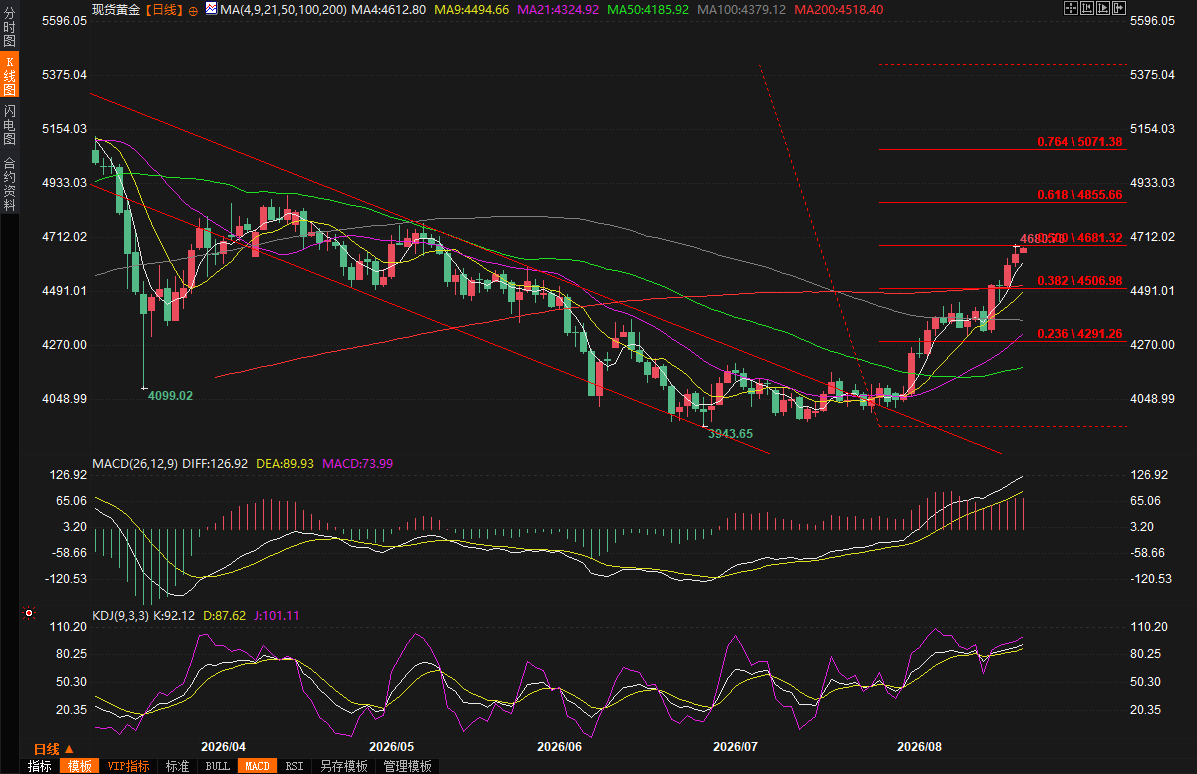 (Spot gold daily chart, source: FX678) At 07:42 Beijing time, spot gold is currently trading at $4675.86 per ounce.
A weakening dollar: the key driver of rising gold prices
The US dollar's performance is one of the core drivers of this round of gold price increases. The dollar index had previously fallen to a three-month low, and although it rebounded slightly by 0.17% to 98.99 on Monday, it remains weak overall. The fundamental reason for the continued weakening of the dollar lies in the multiple missteps the US has made in military, geopolitical, and financial areas, leading to a decline in the dollar's safe-haven value. For gold, a weaker dollar means that dollar-denominated gold becomes relatively cheaper for non-dollar investors, directly reducing purchase costs and stimulating a buying frenzy. More importantly, market concerns about the sustainability of US fiscal policy are fundamentally shaking the dollar's credibility. As Shaun Osborne, chief foreign exchange strategist at Scotiabank, stated, "There always has to be a price to pay, either in terms of rising US Treasury yields or the dollar having to make concessions." The dollar's weakening adjustment is not a short-term phenomenon. Coupled with midterm election pressure, expectations of passive fiscal tightening, and the trend of "US debt becoming like UK debt," analysts believe the dollar may weaken further in the medium term, and its high for the year may have already been reached. This provides long-term structural support for the continued rise in gold prices.Fiscal Intervention: The Ministry of Finance's "Big Move" Ignites Gold Prices
The US Treasury's aggressive intervention in the bond market was a key catalyst for the recent surge in gold prices. On August 19, the US Treasury announced it would at least double the size of its 10- to 30-year Treasury bond repurchase program, increasing the maximum single operation from $2 billion to "at least $4 billion." Subsequently, Treasury Secretary Bessant further hinted that the actual repurchase size could be even higher. More significantly, media reports, citing senior Treasury officials, indicated that the Treasury could utilize its nearly $1 trillion General Account (TGA) to fund the repurchase program. This series of actions was interpreted by the market as the US government artificially suppressing long-term interest rates and "supporting" its massive debt. Following the announcement, yields on 30-year and 10-year US Treasury bonds fell significantly, and assets such as gold surged. Spot gold rose nearly 3% at one point that day. However, the effect of the repurchase only lasted one day, and long-term bond yields subsequently largely reversed their losses. This exposed a deeper issue: market concerns about the long-term fiscal prospects of the US have not disappeared. With inflation remaining above target and the fiscal deficit continuing to expand, traders are increasingly concerned about the sustainability of US fiscal policy. Some analysts have pointedly remarked that using expanded repurchase agreements to address soaring long-term bond yields is akin to "using a rocket launcher against a hurricane." Lower long-term bond yields cannot solve the debt problem and may even worsen it in the long run. This policy intervention has not only failed to quell market anxieties but has also exacerbated expectations of a potential weakening of the dollar. The consensus on Wall Street is pointing in one direction—the "devaluation trade" is making a comeback. The market is beginning to reassess the relationship between US fiscal policy and bond yields, significantly increasing the attractiveness of gold as a credit alternative to the dollar.Geopolitical Storm: Iran Sanctions and Trade Friction Escalate
Geopolitical risks are continuously fueling safe-haven demand for gold. On Monday, the US announced an expansion of secondary sanctions against Iran, which Treasury Secretary Bessenter called an "Economic Landing Day" operation aimed at "cutting off every economic lifeline supporting Iran." The US Treasury Department imposed sanctions on nearly 60 entities, individuals, and vessels, with warnings covering five major sectors: digital assets, technology, gold, aviation, and shipping. Bessenter explicitly stated that countries and entities doing business with Iran risk being excluded from the dollar-based financial system. However, the market is generally skeptical about the actual effectiveness of this round of sanctions. Analysts point out that Bessenter did not elaborate on how the new measures would achieve their intended goals, and without concrete action against specific companies or countries, the statement is "just empty talk." Other analysts believe that this move is "more of a performance than something substantial." Jorge Leon, head of geopolitical analysis at Rystad Energy, bluntly stated, "Unless China further significantly reduces its purchases, the additional impact on Iranian oil revenues is likely to be relatively limited." But regardless of the actual effectiveness of the sanctions, the geopolitical tensions themselves are already enough to support market risk aversion. Meanwhile, trade tensions between the US and Canada continued to escalate—the US announced a 50% tariff on Canadian cars, trucks, auto parts, and steel, effective January 1, 2027. Canadian Prime Minister Carney subsequently announced retaliatory tariffs on some US goods, to be imposed on September 8. This escalation of trade tensions further increased market uncertainty and boosted safe-haven buying of gold.Technical Breakthrough: The 200-day moving average signals a complete bullish dominance.
The technical breakout has provided additional momentum for gold's rise. Last week, gold prices broke strongly above the closely watched 200-day moving average (currently around $4,518) and climbed above the $4,600 mark. Technical analysts typically consider a break above the 200-day moving average a clear bullish signal. Gold prices are now above all key moving averages. From a broader perspective, spot gold has risen approximately 15% since its July lows. Societe Generale analysts point out that gold has broken out of a minor bottoming pattern, regained its position above the 200-day moving average, and continued its rebound. The area around the 200-day moving average (currently around $4,518) is considered a key support level. In the short term, $4,700 is a key resistance level. A decisive break above this level would bring the mid-May high of $4,770 and the $4,890-$4,900 range into focus. However, the RSI indicator has entered overbought territory above 70, increasing the risk of short-term profit-taking. Until the fundamental trend shows a clear reversal, shorting based solely on technical indicators remains a risky strategy.This week's focus: PCE data and Walsh's debut.
The market is currently holding its breath awaiting two key events: Wednesday's release of the US Personal Consumption Expenditures (PCE) price index, and Federal Reserve Chairman Warsh's first keynote speech at the Jackson Hole Economic Symposium on Friday. The PCE is the Fed's preferred inflation indicator, and its results will directly impact market expectations for the interest rate path. If the data further indicates easing price pressures, the market may raise its expectations for future monetary policy easing, potentially putting pressure on the dollar and US Treasury yields, thus providing stronger upward momentum for gold. Some research reports indicate that if the PCE data is weak, expectations for interest rate cuts may strengthen, and gold prices could recover to above $5,000. Warsh's Jackson Hole debut is particularly significant. This year's symposium theme is "Financial Innovation: Its Impact on Payments and Policy." Since taking office, Warsh has consistently reduced forward guidance and pushed for adjustments to the Fed's policy communication methods. If his speech releases a dovish signal, market expectations for interest rate hikes will cool, potentially providing new impetus for precious metals; if he emphasizes inflation risks and releases a hawkish signal, the dollar and US Treasury yields may strengthen, potentially putting short-term pressure on precious metals. However, UBS economists noted in a report that Warsh's "attempt to end any form of forward guidance suggests we may not be able to get any information from him about the direction of the federal funds rate." Morgan Stanley's chief U.S. economist, Michael Gapen, also stated, "We expect him to remain silent on the near-term outlook for monetary policy—including the expansion of the Treasury repurchase program." This means the market may not receive clear interest rate guidance from Warsh's speech, and gold volatility may actually increase as a result.Institutional Outlook: Target Prices Continue to Rise
With gold prices breaking through resistance levels, major institutions have raised their gold price targets. Citigroup raised its 0-3 month gold price target to $4,800 per ounce, up from $4,500 previously, while maintaining its 6-12 month target at $5,000. UBS maintained its year-end gold price target at $4,600 and newly predicted a target price of $5,400 by the end of September 2027. Caitong Securities believes that the bottom for gold prices may have been reached, with a third-quarter target of $4,900 and a medium-term target of $6,000. However, short-term risks should not be ignored. PCE data may trigger a repricing of inflation expectations, Warsh's remarks at Jackson Hole may surprise the market, and overbought technical indicators may trigger profit-taking. But from a medium- to long-term perspective, the underlying logic supporting gold's upward movement—frequent global geopolitical risks, continued doubts about the dollar's credibility, and the unresolved structural problems of US debt—remains unchanged. Gold's substitution effect for the dollar continues to strengthen, providing ample momentum for gold price increases. (Spot gold daily chart, source: FX678) At 07:42 Beijing time, spot gold is currently trading at $4675.86 per ounce.
- Risk Warning and Disclaimer
- The market involves risk, and trading may not be suitable for all investors. This article is for reference only and does not constitute personal investment advice, nor does it take into account certain users’ specific investment objectives, financial situation, or other needs. Any investment decisions made based on this information are at your own risk.