Brent crude at $90: Geopolitical risk premium returns rapidly, can tight supply continue to support oil prices?
2026-08-31 15:40:02
Brent crude rose nearly 2% in European trading on Monday (August 31), currently trading near the $90/barrel mark. The US strikes on Iranian launchers over the weekend triggered market concerns about Persian Gulf supplies, while traffic volume in the Strait of Hormuz and Russia's extension of its diesel export ban were key factors supporting the oil market. 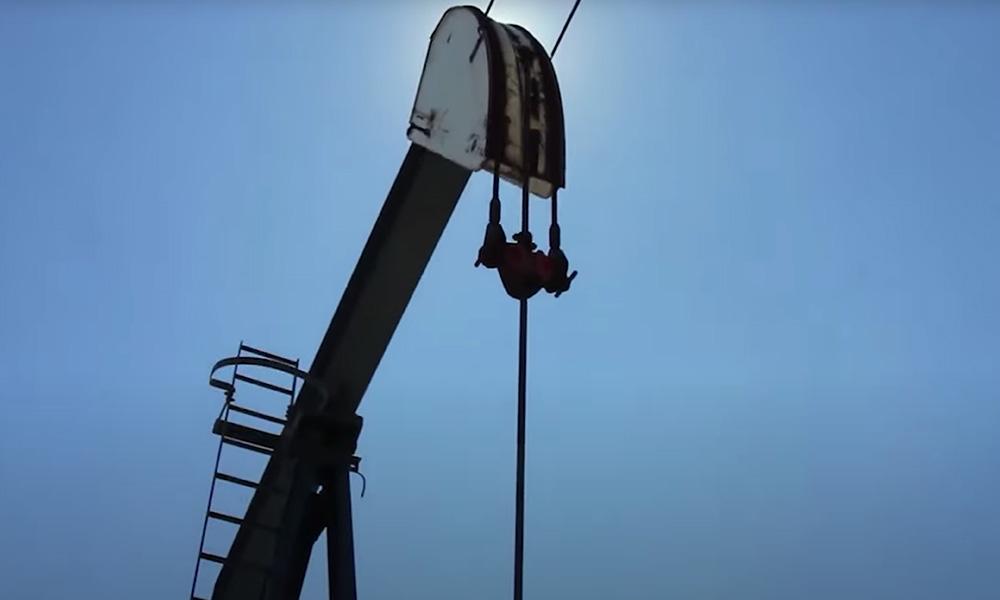
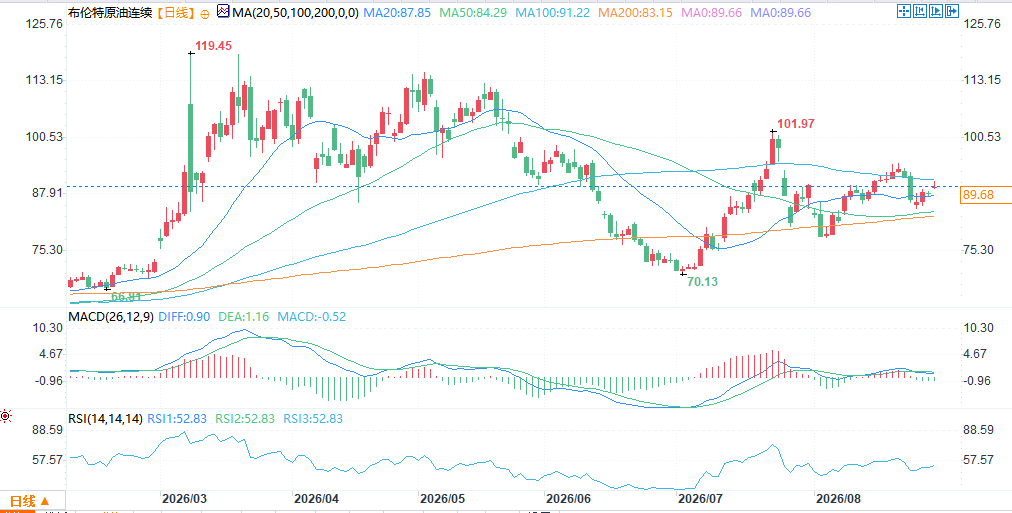 (Brent crude oil futures daily chart, source: EasyTrade) At 15:27 Beijing time, Brent crude oil futures were trading at $89.85 per barrel.
Geopolitical tensions support Brent crude oil prices
Brent crude oil strengthened at the start of the week, with ICE Brent briefly rising above $90 a barrel in early Asian trading, extending gains following the geopolitical shock at the end of last week. The US strike on Iranian launchers, triggered by signs that Iran was preparing to lay mines in the Strait of Hormuz, quickly sparked concerns about the security of Persian Gulf oil supplies. ING analysts point out that the key issue now is whether the conflict will escalate into further fighting and whether it will cause international shipping companies to hesitate to pass through the Strait of Hormuz, a crucial energy chokepoint. In recent weeks, Middle Eastern oil-producing countries have gradually regained confidence and are more comfortable transporting crude oil through the strait, resulting in relatively smooth supply flows. However, if the situation escalates further, these flows could face disruptions or delays again, pushing up risk premiums. In the short term, Brent oil prices will be highly sensitive to the subsequent developments of the conflict: if tensions ease quickly, oil prices may give back some of their gains; if military action expands or shipping is disrupted, supply concerns will further support oil prices, exacerbating volatility in the global energy market.Russia's extension of the diesel export ban exacerbates supply shortages.
Russia announced last weekend that it would extend its diesel export ban for another month, until the end of September 2026. This move further exacerbates the already tight supply situation in the global diesel market, which was already under pressure due to tensions in the Persian Gulf and potential supply disruptions from Russia. As a key refined petroleum product, diesel export restrictions directly tighten the availability of diesel in the international market. The extension of the ban coincides with a period of seasonally increased demand, providing additional support for both diesel and crude oil prices. ING points out that the combined impact of potential disruptions in the Persian Gulf and the Russian diesel ban is significantly tightening the supply-demand balance in the global refined petroleum product market. Refinery margins and crack spreads may benefit as a result, indirectly boosting expectations for crude oil demand. In the short term, if the Russian ban is strictly enforced and tensions in the Middle East remain high, diesel and crude oil prices may remain relatively strong; if the ban is subsequently eased or geopolitical risks deteriorate, supply pressure is expected to ease. Overall, the structural tightness in the refined petroleum product market is becoming an important factor supporting oil prices, and investors need to closely monitor changes in export policies and shipping dynamics.Institutional Views
Morgan Stanley projects an average oil price of around $90 per barrel in the third quarter of 2026, peaking near $100 per barrel in the fourth quarter, before falling back to $95 in the first quarter of 2027 and $90 in the second quarter. The upward revision is based on the significantly slower-than-expected recovery of Middle Eastern supply, which will keep the global oil market in a state of shortage throughout the fourth quarter of 2026 and the first quarter of 2027. The bank points out that floating storage inventories have decreased sharply by approximately 170 million barrels in recent weeks, Middle Eastern exports have fallen back to March/April levels, and onshore inventories have declined in tandem, rapidly depleting the supply buffer. Diesel crack spreads have also reached record highs, reflecting a similarly tight refined product market. While high oil prices may dampen some demand, the delayed supply-side recovery remains the dominant factor. Morgan Stanley believes that if the normalization of shipping in the Strait of Hormuz continues to be delayed, oil prices have further upside potential; conversely, if supply recovers rapidly, the gains may be reversed. Goldman Sachs expects Brent crude to trade primarily in the $80-90/barrel range until a new US-Iran agreement is reached or the conflict escalates significantly. The bank anchors its fair value at around $80, believing that current prices already incorporate a risk premium, but the physical market remains tight. Analysts emphasize that if shipping through the Straits continues to be disrupted, oil prices could surge again; if the conflict de-escalates and normal traffic flows resume, prices are expected to converge towards fair value. (Brent crude oil futures daily chart, source: EasyTrade) At 15:27 Beijing time, Brent crude oil futures were trading at $89.85 per barrel.
- Risk Warning and Disclaimer
- The market involves risk, and trading may not be suitable for all investors. This article is for reference only and does not constitute personal investment advice, nor does it take into account certain users’ specific investment objectives, financial situation, or other needs. Any investment decisions made based on this information are at your own risk.