Gold Trading Alert: A double whammy of surging oil prices and looming interest rate hikes has driven gold prices to a near two-week low. Is the bull market about to end?
2026-09-01 07:36:02
On Monday (August 31), spot gold prices fell 0.2% to close at $4,448.56 per ounce, after hitting a low of $4,396.43 during the session, the lowest level since August 19. December U.S. gold futures fell even further, closing down 1.1% at $4,481.50. This movement quickly attracted market attention: in the past month, gold had risen by approximately 9.7%, on track for its largest monthly gain since January, with silver and palladium also performing strongly. However, hawkish comments from Federal Reserve Chairman Warsh at the Jackson Hole symposium, coupled with a surge in oil prices due to renewed U.S.-Iran conflict, instantly changed market sentiment. Investors began to reassess the interest rate path, putting downward pressure on gold prices in the short term. This correction was not an isolated event, but rather the result of multiple intertwined factors. Rising interest rates and rising inflation expectations were the core forces suppressing gold prices. Daniel Pavilonis, senior market strategist at Stone X, pointed out that rising energy prices and declining crude oil inventories pushed up inflation expectations, U.S. Treasury yields continued to climb, and the dollar remained near its highest level in nearly two weeks. These factors combined have created an unfavorable environment for gold, a non-interest-bearing asset. Although the US dollar exchange rate has seen a slight pullback, limiting the decline in gold prices to some extent, the overall sentiment has shifted from optimism to caution. On Tuesday (September 1st) in early Asian trading, spot gold traded in a narrow range, currently hovering around $4445 per ounce. Today's focus will be on the US August ISM Manufacturing PMI, the US July JOLTs Job Openings, and the US July Construction Spending Month-on-Month. 
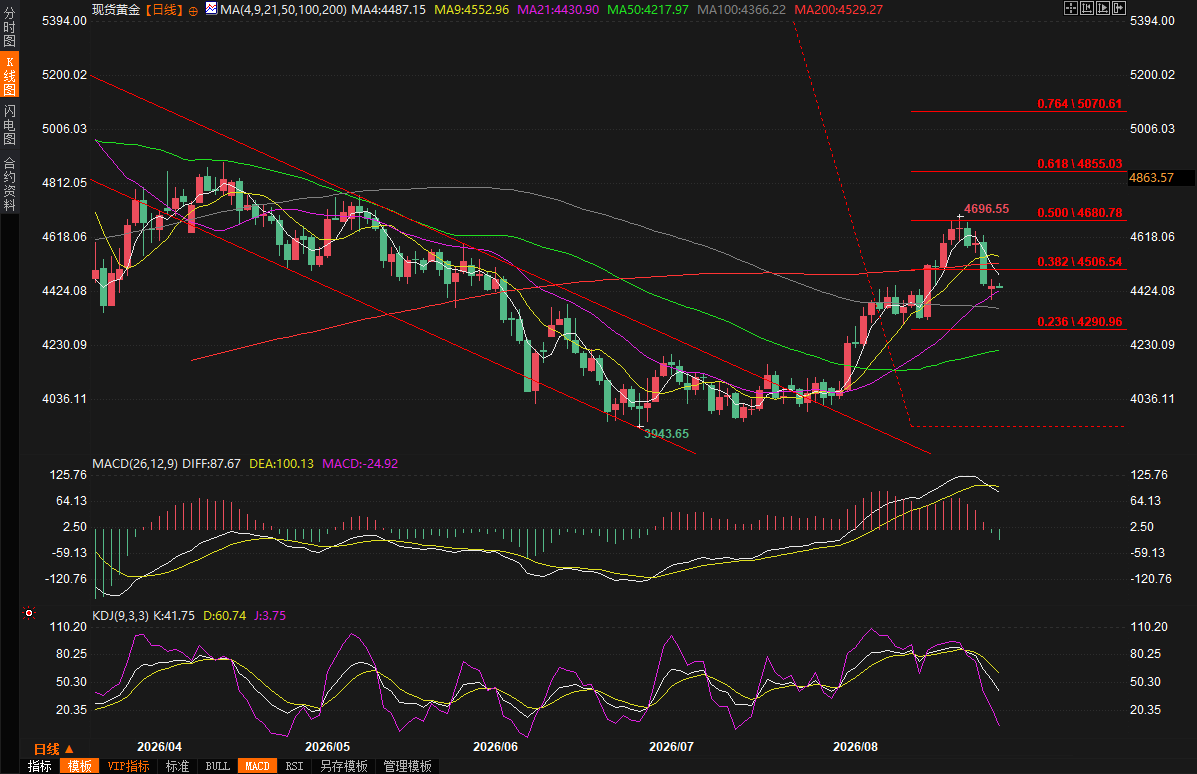 (Spot gold daily chart, source: FX678) At 07:32 Beijing time, spot gold is currently trading at $4447.31 per ounce.
The Fed's hawkish signals are reshaping market expectations.
The real trigger for this round of adjustments was Federal Reserve Chairman Warsh's speech in Jackson Hole last Friday. He clearly stated that if policymakers cannot be confident that inflation is heading towards the 2% target, the Fed will have "more work to do." This statement was interpreted by the market as the clearest hint of an interest rate hike to date. According to the CME FedWatch tool, traders' probability of a September rate hike jumped rapidly from about 36% before Warsh's speech to around 64%, with some data even approaching 66%. This directly pushed up US Treasury yields—the 10-year Treasury yield rose to 4.768% at one point, a new high since mid-January 2025; the 30-year yield also hit a recent high. Warsh subsequently reinforced this position at the G20 Finance Leaders' Meeting. He talked about the global investment boom, how capital is no longer idle due to a lack of opportunities, and how the old narrative of long-term stagnation is no longer applicable. He even openly discussed whether the potential growth rate of the US economy is underestimated and whether productivity is undergoing positive changes. These comments boosted growth expectations on the one hand, and made the market realize on the other hand that strong investment demand could make inflation more sticky, requiring the Federal Reserve to raise interest rates to cope. Rising short-term interest rate expectations directly weakened the relative attractiveness of gold. Meanwhile, the market is turning its attention to the upcoming US employment data this week. The ADP employment report and non-farm payroll data will be key observation windows. Previously, the unexpectedly weak employment data in July had lowered expectations for interest rate hikes. Economists currently predict that approximately 55,000 new jobs will be added in August. If the data continues to weaken, the case for a Fed rate hike will significantly diminish; conversely, if employment remains resilient, the policy meeting on September 15-16 will be more likely to signal tightening. This high degree of uncertainty makes gold prices particularly sensitive at the current level.Geopolitical conflicts drive up oil prices, reigniting inflation concerns.
Another major factor weighing on gold prices stemmed from the sudden escalation of the US-Iran conflict. On Sunday, the US military struck missile launchers on Iran's Larak Island, the first known direct military action since late July. Iran responded by launching missiles at US bases in Jordan. President Trump publicly stated that he would "strike them hard" and pledged further action. This six-month-long conflict, which at one point escalated into an economic standoff and shipping blockade, now risks renewed open warfare. As a result, crude oil prices surged more than 2.5% on Monday to a near one-week high. Brent crude settled near $90.49 a barrel, while US crude closed at $85.76. The Strait of Hormuz, a key passage for about one-fifth of global oil transport, has seen shipping volumes plummet to extremely low levels, and the premium for supply disruption risks has been re-incorporated into prices. The rebound in oil prices directly exacerbated inflation concerns, especially given that US consumers are already feeling the effects of rising fuel costs. JoAnne Bianco, a strategist at BondBloxx Investment Management in Chicago, stated that the rebound in oil prices has complicated the inflation situation, and if the upward trend continues, the market will demand higher risk compensation. It's worth noting that the Trump administration has simultaneously increased secondary sanctions against Iran and indicated it may use Venezuelan oil to replenish strategic petroleum reserves. These measures may alleviate some supply anxieties in the short term, but geopolitical risks themselves continue to support oil prices. Gold, as a traditional safe-haven asset, should theoretically benefit from escalating conflict, but in the current environment dominated by interest rate expectations, the power of safe-haven buying has been significantly weakened. Investors are more concerned about whether high oil prices will force the Federal Reserve to adopt a more hawkish stance against inflation.Monthly gains remain impressive, but short-term momentum faces challenges.
Despite significant pullbacks on a single day and at the beginning of the week, gold is still up 9.7% so far this month, marking one of its best monthly performances this year. Silver and palladium have also performed exceptionally well, with palladium even recording its best monthly gain this year. This suggests that in the past few weeks, market optimism regarding interest rate cuts or easing expectations, as well as hedging demand against global uncertainty, provided strong support for precious metals. However, the current environment has changed. While the US dollar index retreated slightly to around 99.43 on Monday, it had previously reached its highest level since August 17. The upward trend in US Treasury yields also continues. The negative correlation between these macroeconomic variables and gold prices is strengthening. Meanwhile, the break-even yields of five-year and ten-year Treasury Inflation-Protected Securities (TIPS) remain around 2.3%, indicating that the market's pricing in medium- to long-term inflation remains relatively moderate, but persistently high oil prices could change this picture.This week's data and policy signals will determine the direction.
Looking ahead to the next few days, market focus is heavily on US employment data and the subsequent Producer Price Index (PPI) and Consumer Price Index (CPI) reports. Employment data will directly influence the final pricing of a September rate hike probability; inflation data may validate or undermine Warsh's assertion that "there is still work to be done." If employment is weak and inflation declines, gold prices are expected to regain support; conversely, if data shows both economic resilience and sticky inflation, gold may further test support near two-week lows. From a longer-term perspective, the underlying logic for gold has not completely collapsed. The global investment boom, geopolitical risks, and rising debt levels in major economies still provide a long-term narrative for precious metals. However, in the short term, the repricing of interest rate paths will be the dominant force. Traders and investors need to rebalance between "safe-haven demand" and "rising opportunity costs." In summary, the drop in gold prices to near two-week lows is a direct result of the combined effects of a shift in Fed policy expectations and geopolitical conflicts. Monthly gains remain substantial, indicating that the previous upward momentum is not weak, but the market has begun pricing in a potentially higher interest rate environment. This week's employment and inflation data will be key turning points. Whether gold can maintain its strength in September depends on whether these data can reignite expectations of easing or further solidify the hawkish narrative. (Spot gold daily chart, source: FX678) At 07:32 Beijing time, spot gold is currently trading at $4447.31 per ounce.
- Risk Warning and Disclaimer
- The market involves risk, and trading may not be suitable for all investors. This article is for reference only and does not constitute personal investment advice, nor does it take into account certain users’ specific investment objectives, financial situation, or other needs. Any investment decisions made based on this information are at your own risk.