Hajime Takada releases hawkish signals! Can the yen break through the 160 level?
2026-09-02 13:38:04
On Wednesday (September 2nd) during Asian trading hours, the USD/JPY pair briefly surged to 160.38, currently trading around 160.00. The exchange rate has been fluctuating around the 160 level for several days. While Hajime Takada's hawkish remarks provided short-term support for the yen, the market is still weighing the anticipated interest rate hikes against the reality of the USD/JPY interest rate differential. Hajime Takada, a member of the Bank of Japan's Policy Board—the most consistently hawkish dissident on the board—stated that the central bank needs to be "flexible" in raising interest rates and warned that rising overseas interest rates could push Japan's neutral interest rate to a level higher than market expectations. He pointed out the risk of higher-than-expected inflation due to current energy price increases. Takada urged the Bank of Japan to shift from "encouraging inflation" to "demonstrating its determination to prevent inflation from deviating upwards," and characterized 2026 as the beginning of a "new phase" where interest rate hikes will not proceed at a fixed pace. 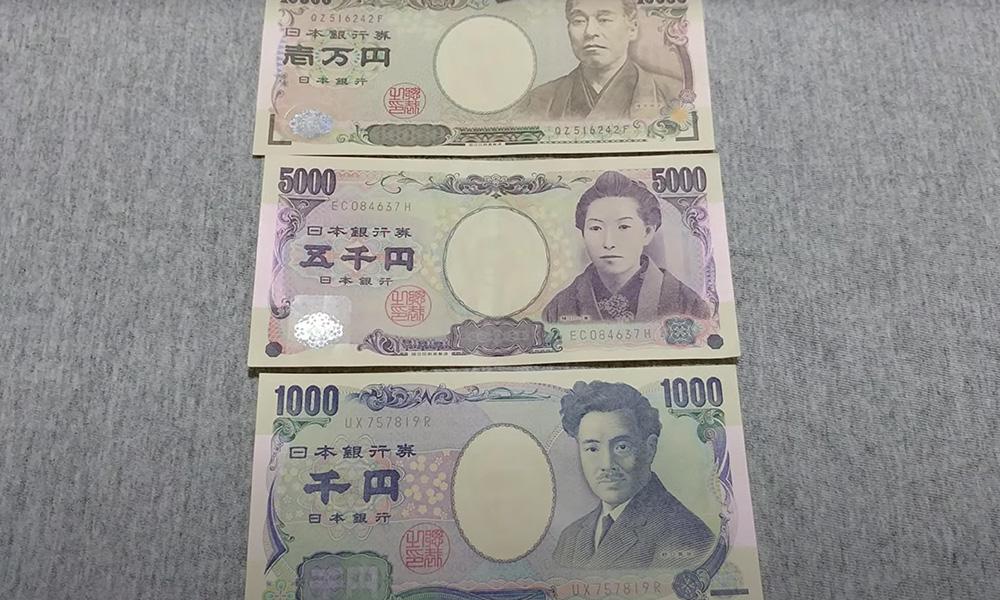
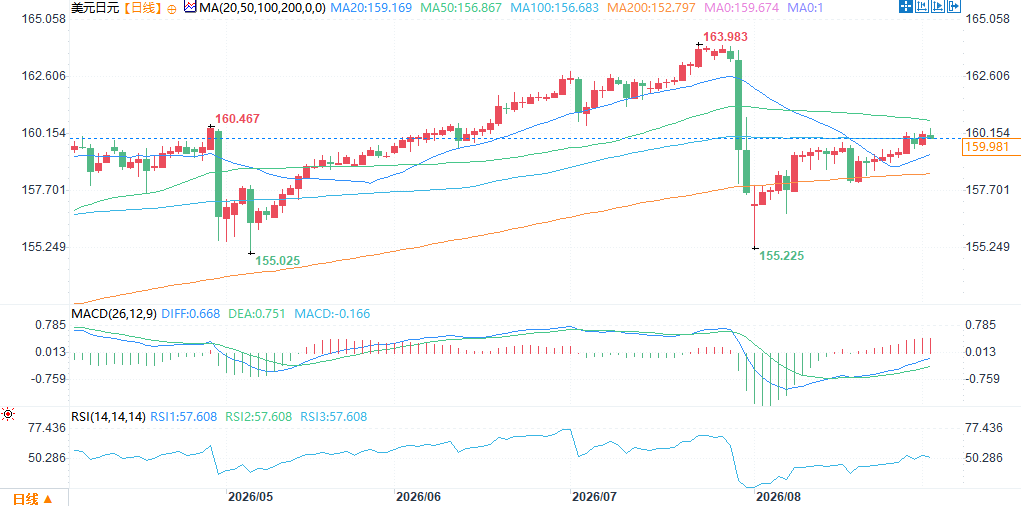 (USD/JPY daily chart, source: FX678) At 13:37 Beijing time, USD/JPY was trading at 159.97/98.
Takata: Flexible interest rate hikes are needed; the neutral interest rate may be higher than market expectations.
Bank of Japan policy board member Hajime Takada stated that the central bank needs to adopt a "flexible" interest rate hike strategy, closely monitoring overseas economic and policy developments while assessing the degree of domestic financial easing. He called for a shift in policy focus from "encouraging potential inflation" to "demonstrating a determination to prevent inflation from deviating upwards," and characterized 2026 as the beginning of a "new phase" where interest rate hikes will not proceed at a fixed pace. Takada emphasized that policy rates need to converge more quickly towards the neutral rate to prepare for a potential second round of price effects. He specifically warned that rising overseas interest rates could push Japan's neutral rate higher than generally expected by the market through capital flows and expectations, meaning that the terminal interest rate of this tightening cycle may be underestimated by the market. Takada's remarks conveyed a more hawkish signal overall, suggesting that the central bank will maintain greater flexibility and sensitivity to external factors in future decision-making to avoid policy lag leading to an increased risk of runaway inflation.Risks and Communication: Energy price and foreign exchange fluctuations require close monitoring.
Hajime Takada further warned that the continued divergence in monetary policy paths between Japan and other major economies could trigger high volatility in the foreign exchange market. Therefore, close attention needs to be paid to long-term interest rate trends, and effective and timely communication with the market is crucial. He pointed out that current energy price increases already pose a real risk of higher-than-expected inflation. If overseas inflationary factors continue to flow in, Japan may face greater-than-expected upward price pressure, which would further strengthen the rationale for flexible interest rate hikes. Takada emphasized that how smoothly the Bank of Japan exits its long-term easing policy will largely determine the market's evaluation of its final policy framework. Communication errors or uneven pace during the exit process could amplify market volatility and weaken policy credibility. Therefore, against the backdrop of intertwined risks from energy prices and exchange rates, maintaining high vigilance and strengthening expectation management have become key tasks in current policy implementation.Institutional Views
Despite Takada's hawkish comments reinforcing expectations of a rate hike, institutions remain cautious about the yen's upside potential. MUFG, in its September Monthly FX Outlook, believes the Bank of Japan's September rate hike is largely priced in, with two more hikes expected by mid-2027, but each action will have limited support for the yen. The partial fading of Fed tightening expectations will help USD/JPY decline, but domestic factors in Japan (including capital outflows and fiscal pressure) will limit the decline. MUFG maintains the Bank of Japan's stance of gradual normalization, with the policy rate path pointing to higher levels. In the short term, the yen may remain volatile at high levels due to US Treasury yields and geopolitical risks, but in the medium to long term, as interest rate differentials narrow, the yen will gradually strengthen. Goldman Sachs believes that persistently high US yields, low recession risk, Japanese fiscal pressure, and the Bank of Japan's slow pace of rate hikes will continue to drive the yen's depreciation. Intervention effects are only temporary, and the fundamental-driven depreciation pressure is difficult to reverse. Goldman Sachs favors using the yen as a funding currency for carry trades, noting that unless there is an unexpected negative shock to US growth or the Bank of Japan shifts to more aggressive tightening, the upward trend is unlikely to reverse. Current market implied probabilities suggest a high probability of reaching 165 by mid-next year.Summarize
Hajime Takata stated that flexible interest rate hikes are necessary, the neutral interest rate may be higher than market expectations, and there is a risk of higher-than-expected energy price inflation. He called for a shift from "encouraging inflation" to "demonstrating a determination to prevent inflation from deviating." 2026 will mark the beginning of a "new phase." Takata's remarks strengthened expectations of a September rate hike, suggesting that the final interest rate may be underestimated. The USD/JPY pair may continue to fluctuate around 160 in the short term. Takata's hawkish comments provide marginal support for the yen, but interest rate differentials remain the dominant force. The market will focus on the actual outcome of the September meeting and subsequent policy signals. (USD/JPY daily chart, source: FX678) At 13:37 Beijing time, USD/JPY was trading at 159.97/98.
- Risk Warning and Disclaimer
- The market involves risk, and trading may not be suitable for all investors. This article is for reference only and does not constitute personal investment advice, nor does it take into account certain users’ specific investment objectives, financial situation, or other needs. Any investment decisions made based on this information are at your own risk.