The crude oil market is signaling a shift, with institutions saying Brent crude has a chance to challenge the $120 mark.
2026-09-09 14:58:07
During the intense confrontation in the Iranian conflict, oil transport through the Strait of Hormuz was nearly disrupted, leaving the global market facing a supply gap of 10 to 15 million barrels per day. The market initially anticipated a sharp rise in oil prices, but this did not materialize. A key variable behind this was the sudden decline in oil demand from major Asian countries. For most of 2026, both oil imports and domestic refinery processing volumes in these countries are expected to decline significantly, becoming a major force suppressing international oil prices. Recently, market signals have undergone a fundamental shift. Related trading information emerged in overseas markets on Monday (September 7th), coupled with news of an attack on Saudi Aramco's Jizan oil facilities, further exacerbating concerns about global oil supply.
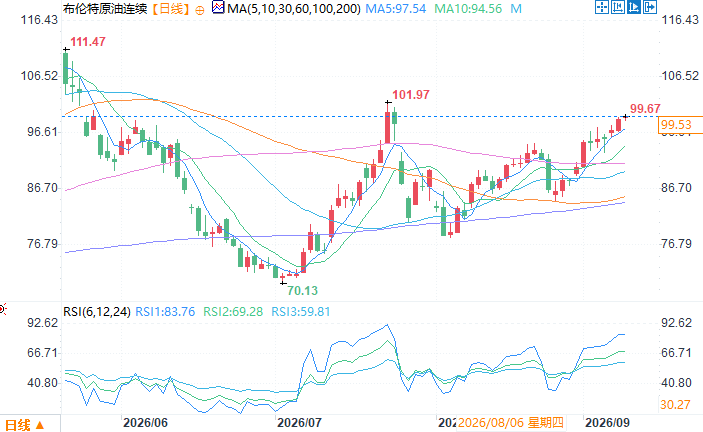 Brent crude oil daily chart source: EasyTrade. At 14:57 Beijing time on September 9, Brent crude oil was trading at $99.47 per barrel.
Price spread signals reverse, crude oil demand in major Asian countries emerges from trough.
One of the key indicators for judging the strength of crude oil demand in major Asian countries is the price spread between their crude oil and Brent crude. During periods of weak demand, this spread fell to as low as -$20 at the end of April, a deep discount, a typical sign of weak demand. However, in the past few weeks, crude oil prices in these countries have risen sharply, approaching the highs reached after the outbreak of the Iranian conflict, stabilizing above $100, and forming a considerable premium over Brent crude. This reversal in the price spread structure signifies a major change in the crude oil demand landscape of major Asian countries. As for the underlying reasons, whether it's a domestic economic recovery or an attempt to exert influence before relevant summits and midterm elections, the market remains uncertain. However, judging from actual transactions in the spot market, as the world's largest crude oil importer, buyers in these countries have already actively pushed up spot crude oil prices in markets such as Africa, Canada, and Latin America. With supply disruptions in the Strait of Hormuz and restrictions on Iranian crude oil exports, countries are vying for alternative oil sources, intensifying competition. Domestic small and medium-sized refineries that previously relied on low-priced Iranian crude oil are facing enormous pressure. Just a few months ago, due to insufficient domestic demand, these refineries had even suspended production on a large scale.A global oil rush has erupted, with spot prices for different types of oil continuing to rise.
The buying frenzy in the spot market directly drove a rapid rise in spot premiums for various crude oil products. According to unnamed traders speaking to the media, this week, the premium of Congolese Denor crude oil to buyers from major Asian countries reached as high as $20 per barrel relative to Brent crude oil on the ICE Futures Exchange, a further increase from the $15 per barrel premium two weeks ago. These Congolese buyers are simultaneously purchasing bulk shipments of crude oil from Canada, Brazil, and Argentina, with strong demand pushing up the price of Russian East Siberian Pacific crude oil (ESPO). Asian buying also drove Dubai crude oil futures towards $100 per barrel. Although the total volume of seaborne crude oil imports by major Asian countries has not yet returned to pre-war levels, currently hovering around 10 million barrels per day, the price difference in their crude oil reflects a rapid recovery in imports, and the competition for global alternative oil sources is likely to intensify further. Liao Na, founder of GL Consulting, stated that the rebound in crude oil imports is mainly due to improved refinery processing profits and the release of domestic inventory replenishment demand. Improved refinery processing profits, the recovery of refined oil exports, and commercial inventory replenishment have jointly driven refineries to increase crude oil purchases. Domestic independent small refineries are under the greatest pressure, as their traditional sources of crude oil from Iran and Venezuela have shrunk significantly due to the restructuring of the global energy landscape. She said that the recent large-scale crude oil purchases by major Asian countries are largely driven by refineries taking advantage of good processing profits, with commercial enterprises actively replenishing their inventories also playing a role. However, this does not indicate a strengthening of domestic end-user demand.Goldman Sachs warns of upside risks in oil prices and offers hedging strategies.
Daan Struyven, co-head of global commodities research at Goldman Sachs, analyzed that the ability of major Asian markets to flexibly adjust their purchasing scale according to oil prices helps to mitigate the surge in crude oil prices. However, he also warned that if attacks on shipping routes in the Middle East continue to increase, Brent crude oil prices could potentially rise to as high as $120 per barrel. He stated that a series of events in recent days indicate that the possibility of escalating shipping disruptions should not be ignored. In terms of trading strategies, Goldman Sachs believes that if oil prices experience another significant surge, going long on natural gas and diesel is the preferred direction to capture profits. He added that while crude oil has significant upside potential, investors are advised to go long on global natural gas and refined oil products to hedge against geopolitical risks, as the refined oil market will be more severely impacted by supply shocks than the crude oil market.Conclusion
In summary, the core variables in the crude oil market have shifted. The previous situation where weak demand from major Asian countries suppressed oil prices no longer exists. Buyers from these countries are scrambling for alternative crude oils globally, driving up spot premiums. However, investors need to be rational. This round of crude oil purchases is largely driven by refinery profit recovery and commercial restocking, and the strength of the actual recovery in domestic end-user consumption remains to be seen. Coupled with the continued geopolitical turmoil in the Middle East and persistent shipping security risks, Brent crude oil has the potential to reach $100 or even higher. Going forward, it is crucial to monitor the country's crude oil price spread, crude oil import data, and news regarding facilities and shipping security in the Middle East, as these factors will determine the extent of this round of crude oil price movements. Brent crude oil daily chart source: EasyTrade. At 14:57 Beijing time on September 9, Brent crude oil was trading at $99.47 per barrel.
- Risk Warning and Disclaimer
- The market involves risk, and trading may not be suitable for all investors. This article is for reference only and does not constitute personal investment advice, nor does it take into account certain users’ specific investment objectives, financial situation, or other needs. Any investment decisions made based on this information are at your own risk.