After two historic short-selling cleansings, have the yen short sellers run out of "ammunition"?
2026-09-14 14:28:10
On Monday (September 14) during Asian trading hours, the USD/JPY pair fluctuated higher, recovering most of Friday's losses and currently trading around 154.15, up about 0.45%. This rebound occurred against the backdrop of a historic cleansing of speculative positions. Speculators recently staged one of the largest yen position reversals on record, and historical experience shows that such reversals are often followed by further weakening of the USD/JPY. According to the latest CFTC data released last Friday, as of the week ending September 8, net speculative yen positions shifted from approximately 92,000 net short contracts to nearly 11,000 net long contracts. Two historic short cleansings have occurred in the past month or so, indicating that the vulnerability posed by extreme short positions has been largely eliminated; however, this does not mean that the risk of further yen strength has disappeared—a broader unwinding of carry trades may be even larger. 
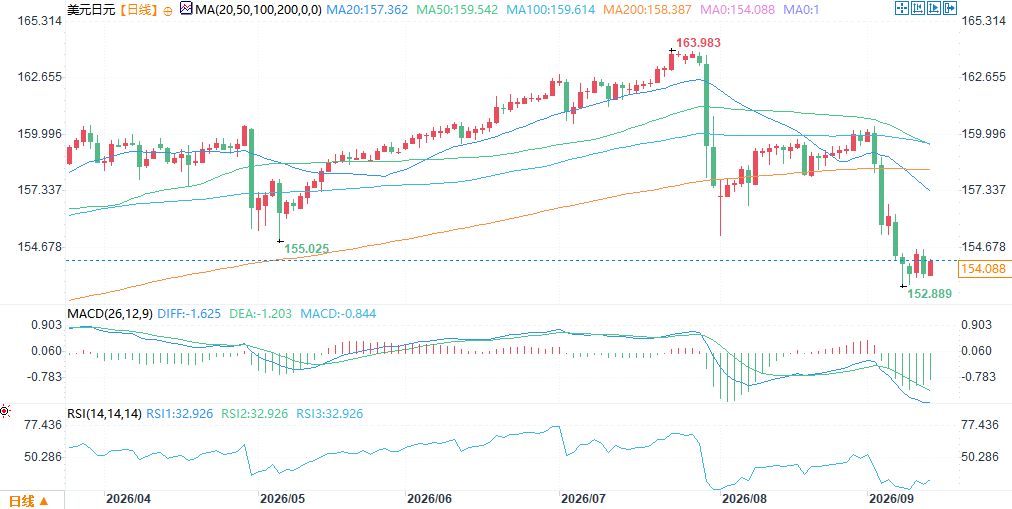 (USD/JPY daily chart, source: FX678) At 14:26 Beijing time, USD/JPY was trading at 154.18/19.
Yen short positions were wiped out at an almost historic pace.
The USD/JPY pair has experienced significant short covering over the past two weeks, and the latest data suggests that a large part of this movement may have been driven by speculators massively clearing short yen positions. Data from the week ending September 8 shows a dramatic shift in net speculative positions, from approximately 92,000 net short contracts to nearly 11,000 net long contracts. While this doesn't reflect total open interest across the entire forex market, it provides a useful reference point for the recent aggressiveness of speculators' shifts. Going back to 1986, only one larger bearish reversal has occurred, and that happened in early August of this year. Net speculative positions have also turned net long for the first time since the end of February. This means that the market has experienced two historic short cleansings in just over a month, strongly suggesting that the vulnerability posed by extreme short positions has been largely removed. However, this does not mean the risk of further yen strength has disappeared. Forced short covering by futures speculators is one thing; broader unwinding of yen-funded carry trades is another—the latter could be much larger if asset prices fall or risk appetite deteriorates further, forcing investors to reduce leveraged positions.Historical patterns point to further strengthening of the yen.
Even without broader carry trade unwinding, historical experience shows that a sharp reversal in speculative positions is often followed by further strengthening of the yen. Looking back at previous instances where net speculative yen positions improved by more than 40,000 contracts in a single week while remaining net short, there was a 60% probability that USD/JPY would weaken after one week, a 93% probability after two weeks, and 67% probabilities after four and eight weeks. The clearest pattern appears in the following two weeks—in 14 out of 15 historical cases, USD/JPY weakened after two weeks. The resulting declines ranged from a drop of approximately 4.6% to a rise of 2.1%, with an average decline of 1.2%. Of course, past performance does not predict future returns, and frequent occurrences of a pattern in history do not guarantee a repeat. However, the results show that a large-scale cleansing of speculative short positions historically does not necessarily indicate the end of the USD/JPY downtrend.Institutional Views
Deutsche Bank expects the USD/JPY exchange rate to fall to around 135 by the end of September 2026. Deutsche Bank points out that the resilience of the Japanese economy and sticky inflation will support the Bank of Japan's continued gradual interest rate hikes, with two rate hikes expected by the end of September, potentially bringing the policy rate to 1%. Meanwhile, continued easing by the Federal Reserve will narrow the USD/JPY interest rate differential, further supporting the yen. Although political factors may delay the pace of rate hikes, fundamentals still point to a medium-term appreciation of the yen. Deutsche Bank holds a relatively optimistic view on the yen, believing that policy normalization and capital inflows will drive a significant decline in the USD/JPY exchange rate. Royal Bank of Canada (RBC) forecasts the USD/JPY exchange rate at 158 in the third quarter, 160 in the fourth quarter, and then gradually decline to around 154 by the end of 2027. The bank believes that the dollar will continue to benefit from its high yield advantage and safe-haven status in the near term, making a significant appreciation of the yen unlikely in the short term. While the Bank of Japan has expectations of rate hikes, the pace is relatively moderate, coupled with the uncertainty of Federal Reserve policy, the USD/JPY exchange rate may initially remain high. In the medium to long term, as the Bank of Japan eases its quantitative tightening, domestic funds return to Japan, and interest rate differentials narrow, the yen will begin to recover more significantly from 2027.The Federal Reserve, the Bank of Japan, and energy remain key risks.
Despite historical trends favoring a continued downward trend, USD/JPY traders still face numerous known and unknown macroeconomic risks this week. The Federal Reserve and the Bank of Japan's policy decisions on Thursday and Friday, respectively, are obvious risks, while energy price volatility could also significantly impact direction. Evidence of the latter was already present in Monday's Asian session – USD/JPY rose after a surge in crude oil futures. The Fed's September meeting will be the core focus this week. The market has already heavily priced in a 25 basis point rate hike. If the decision meets expectations and is accompanied by a hawkish statement, the dollar may receive short-term support, thus pushing up USD/JPY; conversely, a dovish tone or emphasis on data dependence could trigger a dollar pullback and a relative yen strengthening. The Bank of Japan's decision (Friday) is equally crucial. The market has already largely priced in a September rate hike. If the Bank of Japan delivers on its promise and signals further normalization, the yen will receive a significant boost, limiting USD/JPY's upside potential; if the stance falls short of expectations, it could trigger a return of yen short positions. In addition, energy price fluctuations remain an important variable—if geopolitical tensions related to Iran continue to push up crude oil prices, it may indirectly benefit the US dollar by increasing US inflation expectations, or put pressure on the yen by worsening Japan's terms of trade. (USD/JPY daily chart, source: FX678) At 14:26 Beijing time, USD/JPY was trading at 154.18/19.
- Risk Warning and Disclaimer
- The market involves risk, and trading may not be suitable for all investors. This article is for reference only and does not constitute personal investment advice, nor does it take into account certain users’ specific investment objectives, financial situation, or other needs. Any investment decisions made based on this information are at your own risk.