With Saudi Arabia diverting oil through the Strait of Hormuz, Asian refiners are getting extra crude oil, is the oil market about to shift?
2026-09-17 14:04:15
Brent crude futures edged lower in Asian trading on Thursday (September 17), falling more than 1% to $104.18 a barrel in early trading. Saudi Arabia is supplying additional crude cargoes to Asian refiners via ship-to-ship transshipment near the port of Sohar in Oman. Earlier this week, oil prices hit a roughly four-month high of $109.72 due to loading halts in Yanbu and Saudi cancellations of some deliveries to European customers. Two pumping stations on the east-west pipeline were damaged in last week's attack, and the repair timeline remains unclear. This pullback reflects an easing of the acute supply shock rather than a resolution to the conflict itself, thus casting doubt on the sustainability of the decline. 
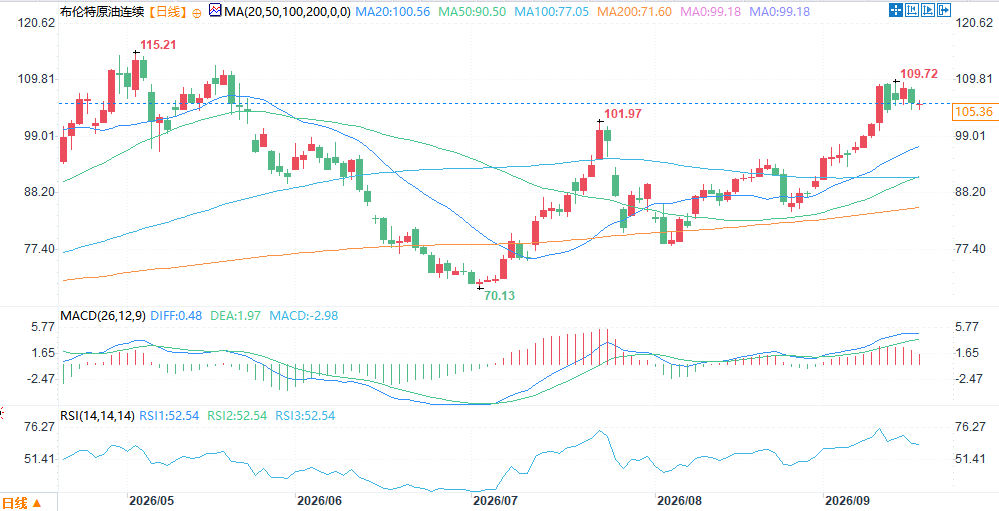 (Brent crude oil futures daily chart, source: FX678) At 14:02 Beijing time, Brent crude oil futures were trading at $104.83 per barrel.
Detour arrangement: Ship-to-ship transshipment via the port of Sohar, Oman
Saudi Arabia is providing additional crude oil loadings to Asian refiners via ship-to-ship transshipment near the port of Sohar in Oman. Sources familiar with the matter said this detour is intended to mitigate some of the impact on global supply caused by attacks on east-west pipelines. Saudi Aramco supplies Arab Light, Medium, and Heavy crude to long-term Asian customers, with loading points located outside the Strait of Hormuz. A chief strategist at a prominent institution said that concerns about supply tightness eased slightly after news broke that Saudi Arabia would ship via Oman. He added that market expectations of a de-escalation of tensions in the Middle East next week also limited oil price increases. This move demonstrates Saudi Arabia's flexibility in adjusting export routes to maintain stable supply to the Asian market, alleviating some price pressure in the short term.The fundamental problem remains unresolved: the pipeline is still damaged, and the repair timeline is unclear.
Yanbu became Saudi Arabia's main oil export route after Iran began blocking the Strait of Hormuz following attacks by the United States and Israel. Before the war, this vital chokepoint carried about one-fifth of the world's oil supply. In last week's attacks, two pumping stations on the east-west pipeline were damaged, and according to three oil and security sources, the repair timeline remains unclear. The detour through Oman addressed the immediate loss of loading capacity at Yanbu, but it did not change the fact that the east-west pipeline itself remains damaged and lacks a clear repair timeline. This distinction is crucial in determining the sustainability of this decline. Some capacity may be restored within days, but full repair could take weeks, and supply uncertainty persists.The conflict continues to escalate: Houthi attacks continue, and Saudi airstrikes continue in Yemen.
Despite Thursday's oil price pullback, the underlying conflict shows no signs of abating. Saudi warplanes struck targets in Yemen, and Houthi rebels launched drones and missiles at Saudi cities on Wednesday. The Iranian-backed group claims its rapid advance has expanded Iran's influence in the Middle East conflict. Tactical supply repairs eased recent price pressures, but the continued escalation of the conflict makes the sustainability of Thursday's decline highly questionable. If the Oman bypass proves insufficient to offset further disruptions, or if expectations of Middle East easing fail to translate into concrete action next week, the risk premium embedded in oil prices could quickly resurface. Geopolitical tensions remain a key factor driving oil price volatility.Summary: Tactical repair vs. conflict escalation; the sustainability of the decline remains questionable.
In summary, Saudi Arabia's export via Oman is a tactical repair to address the loss of loading capacity at Yanbu, rather than a signal of conflict resolution. The east-west pipeline remains damaged, its repair timeline unclear, the Strait of Hormuz remains blocked, and attacks between Houthi rebels and Saudi Arabia continue. Thursday's oil price decline reflects an easing of the acute supply shock, not a reduction in geopolitical risks. Going forward, attention should be paid to whether the Oman bypass can continue to fill the supply gap, whether there is progress in the east-west pipeline repair, and whether the expected easing of tensions in the Middle East next week will materialize. If any of these factors deteriorate, the risk premium for oil prices could quickly rebound. (Brent crude oil futures daily chart, source: FX678) At 14:02 Beijing time, Brent crude oil futures were trading at $104.83 per barrel.
- Risk Warning and Disclaimer
- The market involves risk, and trading may not be suitable for all investors. This article is for reference only and does not constitute personal investment advice, nor does it take into account certain users’ specific investment objectives, financial situation, or other needs. Any investment decisions made based on this information are at your own risk.