Soaring US Treasury yields sound alarm bells, making it increasingly difficult for the US to resolve its debt crisis through growth.
2026-09-25 17:28:13
This week's sharp rise in US Treasury yields has served as a stark warning to the market. The robust economic situation, persistent inflationary pressures, and continuously rising national debt costs are intertwined, making the Trump administration's economic path, burdened with massive debt, increasingly difficult. It has also exposed the ideological differences between the two major US economic policymakers.
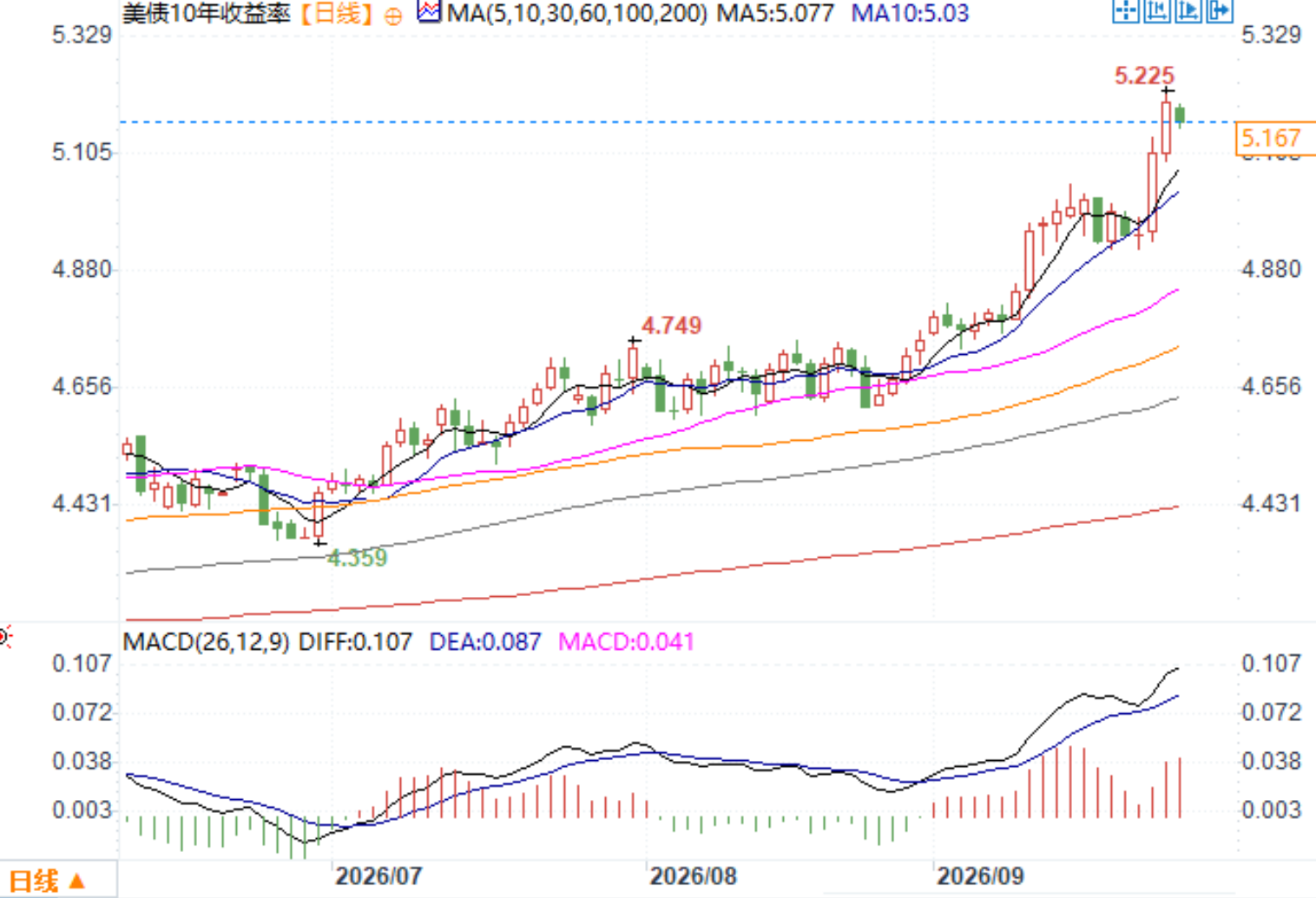 10-year US Treasury yield daily chart. Source: EasyTrade. At 17:23 Beijing time on September 25th, the 10-year US Treasury yield was 5.167%.
US Treasury yields jump, market interprets economic signals
The U.S. Purchasing Managers' Index (PMI) for September, released on Wednesday, significantly exceeded expectations. Simultaneously, the Federal Reserve began raising short-term policy interest rates last week, triggering a sharp market reaction. The 2-year Treasury yield touched 4.945%, followed by the 10-year Treasury yield reaching 5.225%. While these yield levels are unusual in recent years, they are not uncommon over a longer period. Between 1990 and 2006, the average 10-year Treasury yield was approximately 5.9%. The subsequent years of slow growth and low interest rates reshaped Americans' expectations of borrowing costs. The current investment boom in artificial intelligence is driving economic growth, intensifying competition for capital and pushing up interest rates. Data released last week by the U.S. Census Bureau showed that median real income is projected to rise 2.6% to $87,460 by 2025, while the poverty rate is expected to fall by 0.5 percentage points to 10.2%.High fiscal deficit and soaring debt interest pressure
This economic boom is largely built on massive government deficit spending. Trump's two terms saw massive tax cuts, coupled with war-related expenditures related to Iran, further widening the fiscal gap. The Congressional Budget Office estimates that the federal deficit will exceed 6% of GDP this year. Analysts predict that the fiscal and tax policy bills passed last year will add $4.7 trillion to the deficit over the next ten years, with tariff revenue only partially offsetting it. The market has ample credit supply. Federal Reserve Chairman Kevin Warsh stated that banks and other financial institutions are issuing bonds on a large scale, and credit spreads remain low, meaning borrowers have little difficulty obtaining loans. This is one of the core reasons why he and other Fed officials voted to raise interest rates. Subsequently, several Fed officials, including Governor Michael Barr, indicated that further interest rate hikes are highly likely.The clash of ideas between the two decision-makers is becoming apparent.
Kevin Warsh considers the 10-year Treasury yield a core indicator of the economy, calling it "the most important asset globally" at a recent press conference. He stated that he adjusted the Federal Reserve's communication mechanisms to receive clearer, raw market signals. While the goal of interest rate hikes is to curb inflation risks, he does not want to trigger a recession, stating, "Our core mission is to ensure sustained, stable, and long-term economic growth." Treasury Secretary Scott Bessent takes a completely different approach, believing that the Treasury can intervene when the market deviates from equilibrium. He previously increased the Treasury's repurchase of long-term Treasury bonds due to perceived overheating in the market. At an event on September 8th (Eastern Time), Bessent stated, "I cannot change the equilibrium price, but the market will never be in equilibrium forever. Once it becomes unbalanced, my job is to guide the market back to equilibrium."Long-term debt risks should not be ignored.
The US Treasury needs to continuously replace existing debt while covering its large deficit, leading to market speculation that the Treasury may reduce the issuance of long-term Treasury bonds and instead increase the issuance of short-term Treasury bills. However, the Federal Reserve's increase in short-term interest rates will directly raise the government's interest costs. The Federal Budget Committee estimates that if the 10-year Treasury yield remains at 5%, it will be 80 basis points higher than the Congressional Budget Office's benchmark; if this level continues for ten years, annual interest payments will reach $2.7 trillion, exceeding the scale of Social Security and Medicare programs. High interest rates mean that the US economy must maintain high-speed growth for a long period to be able to alleviate debt pressure through growth, a goal that is extremely difficult to achieve. The International Monetary Fund estimates that the US government needs to achieve a primary fiscal surplus of 1% of GDP for the debt to enter a downward trend. Trump has also promised to issue $5,000 checks to citizens if the Republicans win a landslide victory in the midterm elections, making a shift to fiscal austerity in the US highly unlikely.Conclusion
The bond market is unconcerned with political maneuvering; the rise in yields reflects the market's pricing in the persistent inflation and massive financing needs under a strong economic environment. Even if policymakers are unwilling to accept this outcome, they cannot ignore the signals conveyed by the bond market. 10-year US Treasury yield daily chart. Source: EasyTrade. At 17:23 Beijing time on September 25th, the 10-year US Treasury yield was 5.167%.
- Risk Warning and Disclaimer
- The market involves risk, and trading may not be suitable for all investors. This article is for reference only and does not constitute personal investment advice, nor does it take into account certain users’ specific investment objectives, financial situation, or other needs. Any investment decisions made based on this information are at your own risk.