The USD/JPY pair rebounded to 157.85, with the bullish trend still in control.
2026-09-28 14:06:15
Trading began on Monday (September 28), with the USD/JPY pair finding support on dips and rebounding during the Asian session, reaching 157.85 and partially recovering losses from Friday's pullback from multi-week highs. Following the release of the Bank of Japan's meeting minutes, the pair maintained its upward trend, with price action largely driven by the strength of the US dollar. Currently, hawkish expectations from the Federal Reserve, coupled with concerns about energy inflation, continue to support US Treasury yields at multi-year highs, while geopolitical risks from the US-Iran standoff are also fueling safe-haven buying of the dollar. The Bank of Japan's July meeting minutes released a dovish signal, weakening the yen's support. Multiple fundamental factors are collectively supporting a continued upward trend for USD/JPY, with the market awaiting short-term trading clues from speeches by Federal Reserve officials during the North American session.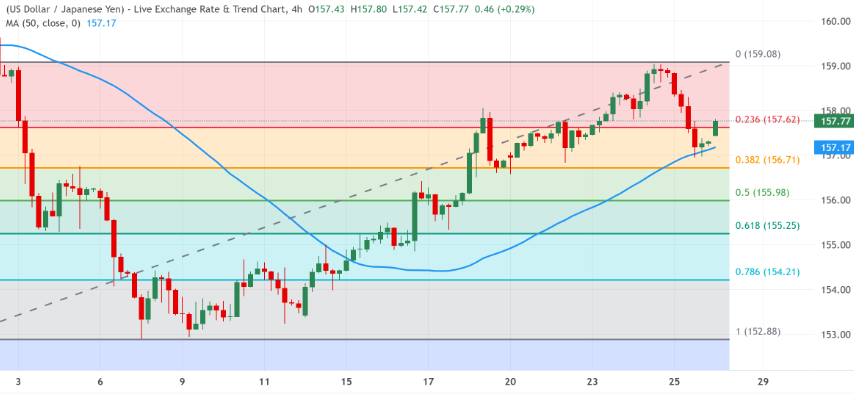 Chart: USD/JPY 4-hour chart
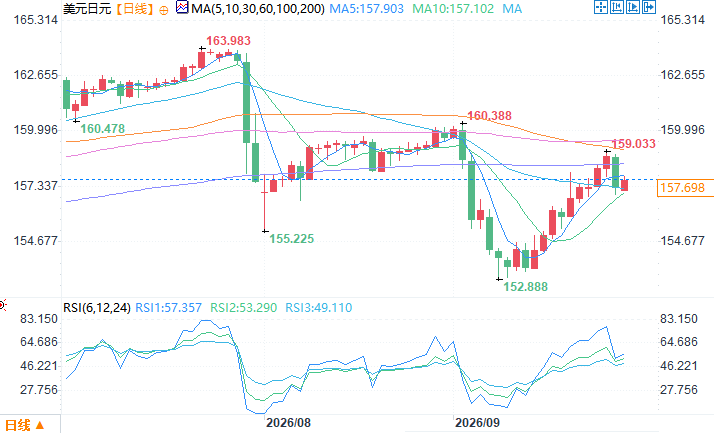 USD/JPY Daily Chart Source: FX678 At 14:05 Beijing time on September 28, the USD/JPY exchange rate was 157.75/76.
Fundamentals: A stronger US dollar is the core driver, while the Japanese yen struggles to find effective support.
Amid a hawkish Federal Reserve policy outlook, concerns about energy-driven inflation have led to market expectations of further monetary tightening by the Fed, keeping US Treasury yields at multi-year highs. In addition, geopolitical risks stemming from the US-Iran standoff have boosted demand for the safe-haven dollar, keeping its price near its highest level since July 29th, a key positive factor driving the USD/JPY exchange rate higher. Following the release of the Bank of Japan's July monetary policy meeting minutes, the yen's fluctuations were very limited. The minutes showed that the Bank of Japan's board members reached a consensus that Japan's financial environment remains loose, with companies steadily passing on cost pressures from rising raw material prices, keeping inflation high. Even with continued speculation that Japanese regulators might intervene again to support the currency, this failed to effectively boost yen bullish sentiment. The Bank of Japan's overall policy stance leans dovish, creating less upward resistance for the USD/JPY exchange rate. However, market traders are unlikely to make large bets on one-sided trends, with most choosing to observe the subsequent developments in the Middle East. From a fundamental perspective, the current macroeconomic environment is generally more favorable for the US dollar, supporting the continuation of the upward trend in USD/JPY that has lasted for several weeks. Traders are turning their attention to the North American session, awaiting public speeches from key members of the Federal Open Market Committee, looking for short-term trading opportunities. Chart: USD/JPY 4-hour chartTechnical Analysis: The four-hour chart shows a bullish structure, with clear key resistance and support levels.
From a technical perspective, the USD/JPY pair showed resilience on the 4-hour chart, initially below the 50-period simple moving average before rebounding above the 23.6% Fibonacci retracement level. This movement indicates potential buying demand in the market, and the overall trend remains bullish above the 50-period moving average. The primary resistance level is currently around 159.08, near the recent cycle high. A sustained hold and break above this level would open up further upside potential. On the downside, support levels are at the 23.6% Fibonacci retracement at 157.62, followed by the 50-period simple moving average at 157.17. Further downside support lies at the 38.2% Fibonacci retracement at 156.71 and the 50% Fibonacci retracement at 155.98. These levels will act as support levels for the pair should the price retraces.Conclusion
A comprehensive analysis from both fundamental and technical perspectives revealed that at the start of the new week, bargain hunting propelled the USD/JPY pair to rebound from Friday's pullback. The US dollar remained strong, supported by expectations of a Fed rate hike, high US Treasury yields, and geopolitical safe-haven demand. Meanwhile, easing signals from the Bank of Japan weakened the yen's resilience, and intervention rumors failed to reverse its weakness. Technically, the pair held key moving averages and retracement support levels, maintaining its medium-term upward trend. The main focus in the short term is on developments in the Middle East and policy statements from Fed officials during the North American session. If Fed officials continue to deliver hawkish comments, USD/JPY could challenge the cyclical high near 159.08; however, a pullback is likely if market risk appetite improves, coupled with stronger intervention signals from Japan. USD/JPY Daily Chart Source: FX678 At 14:05 Beijing time on September 28, the USD/JPY exchange rate was 157.75/76.
- Risk Warning and Disclaimer
- The market involves risk, and trading may not be suitable for all investors. This article is for reference only and does not constitute personal investment advice, nor does it take into account certain users’ specific investment objectives, financial situation, or other needs. Any investment decisions made based on this information are at your own risk.