The US dollar fluctuated narrowly at the start of the non-farm payroll week. Which way will Friday's data push the probability of an October rate hike?
2026-09-28 14:12:15
The US dollar index traded in a narrow range during Asian trading hours on Monday (September 28), currently hovering around 101.10. The dollar is expected to remain volatile this week due to a series of US economic data releases, particularly Friday's September non-farm payrolls data. Other important releases include the JOLTS job openings and August personal consumption expenditures price index, the September ADP employment change, and the ISM manufacturing PMI. The market is currently pricing in a near 68% probability of another rate hike at the Fed's October meeting. 
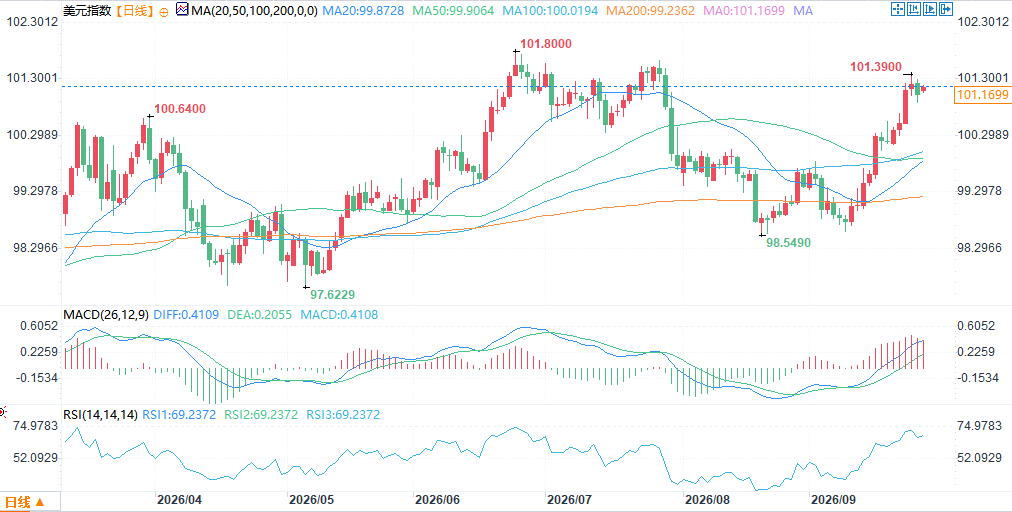 (US Dollar Index Daily Chart, Source: EasyForex) At 14:10 Beijing time, the US Dollar Index was at 101.13/14.
Non-farm payroll data is the core of this week and will dominate expectations for Federal Reserve interest rates.
The US September non-farm payroll data is expected to be the core focus of the market this week and will dominate adjustments to the Federal Reserve's subsequent interest rate expectations. The CME FedWatch tool shows that the probability of another rate hike at the Fed's October policy meeting is approaching 68%. At the September meeting, the Fed raised interest rates by 25 basis points, increasing the target interest rate range to 3.75% to 4.00% and hinting at at least one more rate hike this year. This week will also see the release of a series of key economic indicators, including JOLTS job openings data, the August PCE price index, the September ADP employment change, and the ISM manufacturing PMI. These data will collectively shape market judgments on the Fed's policy path. Strong non-farm payroll growth and a low unemployment rate will strengthen expectations of "higher and longer" tightening; weak data may prompt the market to lower the probability of a rate hike. As a crucial pillar of the Fed's dual mandate, the performance of the labor market directly relates to the assessment of inflation stickiness and the pace of policy adjustments. Investors are closely watching data details to assess the resilience of the labor market and thus predict the policy inclination at the October meeting. Overall, the non-farm payroll data will be a key anchor for pricing the Fed's expectations this week.Oil prices rise, Trump leaves open the possibility of military action against Iran.
Global oil prices rose primarily due to US President Trump's heightened concerns about military action against Iran. Trump stated on Sunday that he believed the conflict with Iran would be won "soon," adding that additional military strikes were possible before the midterm elections. This statement exacerbated geopolitical uncertainty in the Middle East, directly supporting international oil prices. The Strait of Hormuz, a key oil shipping route, remains vulnerable to navigational risks, fueling market concerns about supply disruptions. High oil prices push up overall inflationary pressures through energy costs, indirectly influencing the Federal Reserve's policy expectations. Meanwhile, geopolitical tensions provided some safe-haven support for the US dollar, but high oil prices also increased the risk of rising inflation, making central banks face more complex trade-offs in their interest rate decisions. Investors need to pay close attention to Trump's subsequent remarks and the evolution of the Middle East situation; any signals of escalating military action could further push up oil prices and reinforce tightening expectations. The linkage between oil prices and geopolitics has become an undeniable source of risk premium in the current macroeconomic market, transmitting its effects to the US dollar and interest rate-sensitive assets.US Dollar Index Consolidates Around 101: Cautious Pricing Amid Non-Farm Payrolls and Geopolitical Variables
The US dollar index is trading around 101.10, with a relatively stable start to the week. The market is adopting a wait-and-see approach ahead of key data releases, and the dollar's volatility is expected to increase significantly this week. If the upcoming non-farm payroll data is stronger than expected, it could further strengthen expectations of a Fed rate hike in October, thus supporting a stronger dollar; if the data is weaker, the probability of a rate hike will cool, and the dollar will face downward pressure. Geopolitically, Trump's statements regarding Iran and the subsequent oil price movements will also affect the safe-haven demand for the dollar. Currently, the dollar's movement is more driven by interest rate expectations, but energy prices and Middle East uncertainties constitute additional variables. Traders are closely monitoring this week's data calendar, preparing to adjust their positions after the release of key indicators such as the non-farm payroll data. The consolidation of the dollar index near the 101 level reflects the market's cautious pricing of the policy path. If subsequent data confirms economic resilience and sticky inflation, the dollar is expected to receive further support; conversely, it may experience a phase of decline.Summarize
The US dollar index traded around 101.10 at the start of the non-farm payroll week, with the market focused on a series of US economic data releases this week, especially Friday's September non-farm payroll data. The market is pricing in a near 68% probability of a Fed rate hike in October, following a 25 basis point increase at the September meeting to a 3.75% to 4.00% range and hinting at at least one more rate hike this year. Oil prices rose due to Trump's reservations about military action against Iran, exacerbating geopolitical uncertainty and supporting inflation expectations. Going forward, attention will be focused on non-farm payroll data, JOLTS, PCE, ADP, and ISM manufacturing PMI, as well as developments in the Middle East. If the data supports a hawkish stance, the dollar may strengthen; if the data weakens or geopolitical tensions ease, the dollar may face downward pressure. (US Dollar Index Daily Chart, Source: EasyForex) At 14:10 Beijing time, the US Dollar Index was at 101.13/14.
- Risk Warning and Disclaimer
- The market involves risk, and trading may not be suitable for all investors. This article is for reference only and does not constitute personal investment advice, nor does it take into account certain users’ specific investment objectives, financial situation, or other needs. Any investment decisions made based on this information are at your own risk.