The Middle East conflict and the double whammy of AI demand prompt the Reserve Bank of Australia to intervene for the fourth time. How sticky is inflation?
2026-09-29 13:40:18
On Tuesday (September 29) during the Asian session, the Reserve Bank of Australia announced a 25 basis point interest rate hike, causing the Australian dollar to rise briefly against the US dollar, climbing from 0.7006 to around 0.7028. 
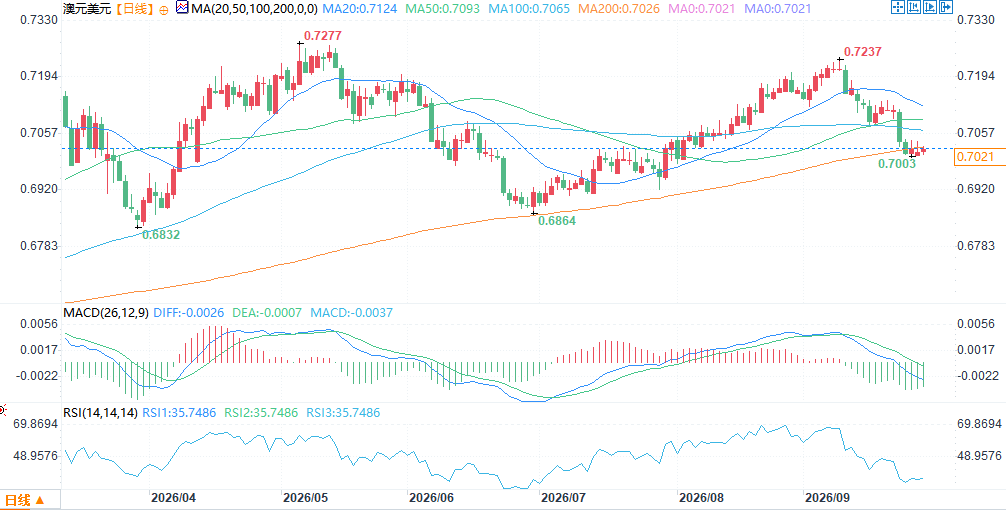 (Australian dollar to US dollar daily chart, source: EasyForex) At 13:37 Beijing time, the Australian dollar to US dollar exchange rate was 0.7009/10.
The Reserve Bank of Australia raised interest rates by 25 basis points to 4.60%.
The Reserve Bank of Australia's Monetary Policy Committee unanimously decided today to raise the cash rate target by 25 basis points to 4.60%. This is the bank's fourth rate hike this year, tightening by a total of 100 basis points and pushing the official rate to its highest level since November 2011. The committee's statement explicitly noted that inflation remains high and some of the upside risks mentioned at the August meeting are becoming a reality. The market had already largely priced in this rate hike, and the Australian dollar rose briefly against the US dollar after the announcement, trading around 0.7025, a slight recovery from its pre-decision low. Analysts believe that the rate hike itself was in line with expectations; the key factor truly influencing the Australian dollar's future trajectory lies in the RBA's stance on the future policy path. The unanimous adoption of the decision indicates a strong consensus within the committee regarding further tightening, providing some support for the Australian dollar in the short term.Sources of inflationary pressures: The combined effects of Middle East conflict and AI demand
The statement detailed the multiple drivers of persistently high inflation. The escalating conflict in the Middle East has pushed global energy prices far above levels assumed in the August forecast; demand related to artificial intelligence is driving rapid price increases for global technology goods; and domestic production capacity pressures remain significant. Business contact information indicates that many companies are facing rising costs and have already raised or plan to raise prices for goods and services. Short-term inflation expectations remain high, and recent Australian inflation data was stronger than expected at the last meeting. These factors combined make the downward path of inflation more difficult. Market commentary points out that the dual pressures from energy price shocks and the AI investment boom are the core context of this interest rate hike, increasing the necessity for the Fed to continue its actions in the future.Current economic situation: Growth slows but resilience remains.
Despite a slowdown in output growth, the June quarterly data remained marginally stronger than expected. Consumer spending is gradually decelerating as anticipated, home prices in most capital cities continue to fall, and new home loans have declined significantly. The labor market has moderated broadly as expected in recent months, leading indicators have remained generally stable, while business investment and debt growth have remained robust. The Committee believes that the three rate hikes this year have tightened financial conditions, the economy appears to be slowing, but inflation remains too high. This combination of "cooling growth and sticky inflation" is the key contradiction compelling the Fed to continue its actions. Analysts interpret this as the cooling housing market helping to alleviate demand pressures, but strong investment and a resilient labor market may slow the pace of inflation decline.The outlook is highly uncertain: external shocks and internal constraints coexist.
The domestic economic and inflation outlook remains highly uncertain. The Middle East conflict remains unresolved, with scenarios of higher-than-expected inflation and lower-than-expected economic activity. Global oil supply disruptions continue to push up energy prices and inflation, and prolonged uncertainty could also drag down growth overseas and in Australia. However, so far, growth from Australia's major trading partners has been stronger than expected, and the boost from AI-related investments has outweighed the adverse effects of the Middle East conflict. Domestically, weak productivity growth continues to constrain potential growth, and the impact of the sluggish housing market remains uncertain. The Committee emphasized that it will closely monitor data developments and changes in risks to guide subsequent policy decisions. The market generally believes that this balanced statement leaves room for further rate hikes while avoiding an overly hawkish signal.Policy stance: Further tightening is necessary to anchor expectations.
The Committee explicitly stated that some upside risks to inflation have emerged since its last meeting. Further disruptions to global oil supplies, recent data showing higher-than-expected growth and inflation in Australia, and the fact that rising fuel prices have partially passed on to other goods and services have all contributed to this inflationary shock. This inflationary shock is compounded by capacity pressures in the economy. To ensure that high inflation does not become entrenched, aggregate demand growth needs to remain moderate for some time to alleviate capacity pressures and bring inflation back to the target range. The Committee judged that, given recent developments, it is necessary to further tighten financial conditions to support inflation returning to the target range within a reasonable timeframe. The statement's inclusion of "including further increases in the cash rate target if necessary" was interpreted by the market as clear open-ended guidance, increasing the likelihood of further action in November.Market Reaction and Outlook: Australian Dollar Receives Support but Upside Limits
Following the announcement of the rate hike decision, the Australian dollar strengthened against major currencies, particularly against the New Zealand dollar and the Japanese yen. However, its gains against the US dollar were limited, as the market had already priced in the rate hike, and rising expectations of a Fed rate hike constrained the Australian dollar's relative advantage. The stock market reaction was muted, with major Australian stock indices fluctuating slightly. Analysts pointed out that the Reserve Bank of Australia maintained a data-dependent stance, and the key focus going forward will be on the upcoming inflation and employment data. If the data continues to be strong, the probability of a rate hike in November will increase significantly; if signs of economic slowdown accelerate, the policy path may become more cautious. Overall, this rate hike solidified the Reserve Bank of Australia's determination to combat inflation, providing short-term support for the Australian dollar, but the global interest rate environment and geopolitical risks will continue to dominate medium-term exchange rate movements. However, the US dollar was supported by safe-haven demand due to the Middle East situation, limiting the Australian dollar's gains against the US dollar, which has currently retreated to [missing information]. (Australian dollar to US dollar daily chart, source: EasyForex) At 13:37 Beijing time, the Australian dollar to US dollar exchange rate was 0.7009/10.
- Risk Warning and Disclaimer
- The market involves risk, and trading may not be suitable for all investors. This article is for reference only and does not constitute personal investment advice, nor does it take into account certain users’ specific investment objectives, financial situation, or other needs. Any investment decisions made based on this information are at your own risk.