Fed's Cook says AI demand is "spreading" its inflationary effects; will the Fed intervene again in October?
2026-09-29 14:02:19
On Tuesday (September 29) during Asian trading hours, the US dollar index fluctuated slightly higher, currently trading around 101.30. With the dollar maintaining its strength, the latest statements from Federal Reserve officials are worth noting. Federal Reserve Governor Lisa Cook stated on Monday that rising demand for artificial intelligence is causing "spreading" inflationary effects that have implications for the entire economy. In her keynote speech at the Oakland Technology Week conference, Cook pointed out that prices of AI-related goods, including chips, computers, and software, have "skyrocketed" over the past year. 
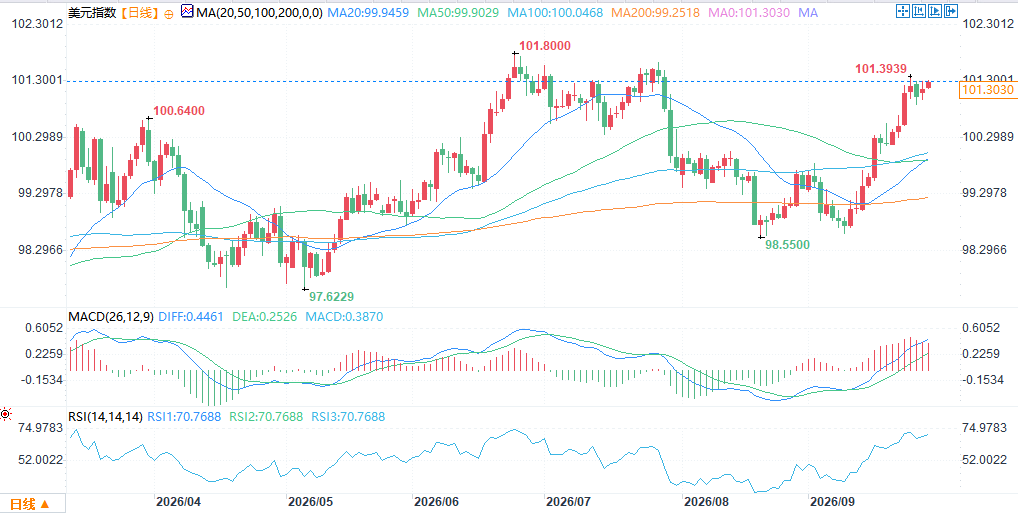 (US Dollar Index Daily Chart, Source: EasyForex) At 14:00 Beijing time, the US Dollar Index was at 101.30.
Prices of AI-related goods have surged, but this is partly due to a shift in demand rather than overall inflation.
Cook noted that prices for AI-related goods, including chips, computers, and software, have "surged" over the past year. She believes some of these sharp price increases reflect a shift in demand towards AI-related sectors, rather than an increase in overall economic demand. She added that supply chains will adjust and resolve the resulting price pressures "without policy intervention." This assessment suggests that the Federal Reserve should not view rising prices for AI-related goods as general inflation, but rather distinguish between sectoral price pressures and overall economic pressures.Data center investment may transmit price pressures to other sectors.
Cook stated that the central bank's attempt to combat "sector-specific inflation" through monetary policy tools might be a mistake, but she acknowledged that AI demand is putting "some pressure on the economy as a whole." She pointed out that data center investment relies on inputs such as construction labor and energy, which are widely used across many sectors of the economy. Therefore, increased AI investment could introduce price pressures into other sectors. She later stated, "You can see signs in the inflation data that the pressures may be spreading," noting rising electricity and water costs. This statement suggests that the impact of AI demand may extend from AI-related goods to broader input and utility costs.Inflation has been above target for more than five years, which Cook calls "too high and for too long."
Annual inflation has been above the Federal Reserve's 2% target for more than five years, with the Consumer Price Index (CPI) at 3.4% last month. Cook noted that inflation has been "too high for too long." She did not commit to any future monetary policy decisions, stating that "the amount and magnitude of any future adjustments" will depend on the economy's response to the Fed's recent rate hikes. She said, "Looking ahead, I will consider what policy rates might be needed to continue guiding inflation down to our target." This statement preserves policy flexibility while confirming that inflation remains a core concern.The FOMC raised interest rates unanimously this month, and the market is pricing in a roughly 70% probability of a rate hike in October.
The Federal Open Market Committee (FOMC), to which Cook belongs, unanimously voted earlier this month to raise interest rates by 25 basis points due to persistent inflation. This decision came amid calls from Trump for rate cuts. Cook's dismissal was blocked by the Supreme Court during the summer. Traders, using the CME FedWatch tool, are pricing in a roughly 70% probability of another 25-basis-point rate hike at the FOMC's next meeting at the end of October. The Personal Consumption Expenditures Price Index—the Fed's preferred inflation gauge—will be released Wednesday morning, providing the market with the latest signal on the inflation path.Summarize
Federal Reserve Governor Tim Cook stated that rising demand for AI is causing diffuse inflationary effects, with AI-related goods prices soaring, but this is partly due to demand shifts rather than overall inflation. She acknowledged that data center investment may be passing on price pressures to widely used inputs such as construction labor and energy, noting that rising electricity and water costs indicate these pressures may be spreading. Cook called inflation "too high and too long," but did not commit to future policy decisions, emphasizing that it depends on the economy's response to recent rate hikes. The FOMC unanimously raised rates by 25 basis points this month, and the market is pricing in a roughly 70% probability of a rate hike in October. Wednesday's PCE inflation report will provide the market with the latest signals. Going forward, attention should be paid to whether AI-related price pressures continue to spread, whether the PCE data confirms inflation stickiness, and further statements from Fed officials regarding an October rate hike. If inflationary pressures spread and the data supports a hawkish stance, expectations for an October rate hike may strengthen; if the data weakens, the rate hike path may face reassessment. (US Dollar Index Daily Chart, Source: EasyForex) At 14:00 Beijing time, the US Dollar Index was at 101.30.
- Risk Warning and Disclaimer
- The market involves risk, and trading may not be suitable for all investors. This article is for reference only and does not constitute personal investment advice, nor does it take into account certain users’ specific investment objectives, financial situation, or other needs. Any investment decisions made based on this information are at your own risk.