Japan's finance minister says the yen is undervalued; will the US and Japan intervene again?
2026-09-30 08:10:16
On Wednesday (September 30) during Asian trading hours, the US dollar rose slightly against the Japanese yen, currently trading around 157.40, while Tokyo stated that the yen was undervalued. Japanese Finance Minister Katayama said on Tuesday that an undervalued yen is generally a problem, and that she and Bessant agreed to strengthen cooperation during a phone call on September 25. 
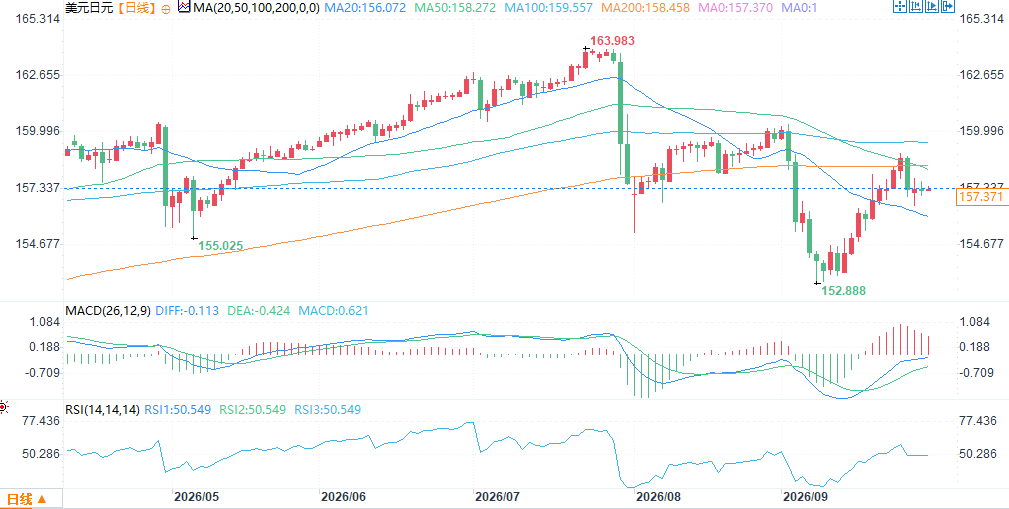 (USD/JPY daily chart, source: FX678) At 8:06 Beijing time, USD/JPY was trading at 157.38/39.
Katayama stated that the yen is undervalued, but the dollar/yen exchange rate remained unchanged.
Katayama stated on Tuesday that the undervaluation of the yen is generally a problem, and she and Bessant agreed to strengthen cooperation during their phone call on September 25. She added that Japan will maintain close contact with the U.S. Treasury Department to ensure an orderly currency market. Japan's last round of yen purchases began on July 30, when the yen was near its weakest level in about four decades, with the Ministry of Finance spending a record 15.4 trillion yen. This statement indicates that the government has limited tolerance for a weak yen, but the effects of verbal intervention have not yet been reflected in the exchange rate.Katayama stated that the government is not pursuing reflationary policies, leaving room for the Bank of Japan to raise interest rates.
Katayama also stated that the Sanae Takaichi government is not a reflationist. Vice Finance Minister for International Affairs, Mimura, said on Monday that the market should take information from Tokyo and Washington seriously, a comment interpreted by Mitsubishi UFJ analysts as encouraging bets on the Bank of Japan raising interest rates more quickly under US pressure. The Bank of Japan raised its policy rate to 1.25% on September 18, the highest in 31 years, while the Federal Reserve's range was 3.75%-4.00%. Intervention buys time; only a narrower interest rate differential will make the trade of borrowing yen to buy high-yield US assets less attractive, a trade that keeps the dollar/yen exchange rate high. The Bank of Japan needs to raise rates ten more times by 25 basis points to reach the bottom of the Federal Reserve's range. This interest rate differential realistically means that as long as the Federal Reserve maintains high interest rates, the weakness of the yen will be difficult to fundamentally reverse.The Bank of Japan made its decision on October 30, two days later than the Federal Reserve.
The Bank of Japan's next decision comes two days after the Federal Reserve meeting. The Ministry of Finance will release intervention data from August 27 to September 28 on Wednesday, showing whether the exchange rate checks reported on September 18 translated into actual yen purchases. The Bank of Japan's quarterly Tankan survey will be released on Thursday, with the large manufacturers index expected to rise to 25 from 22. A summary of opinions from the Bank of Japan's September meeting will also be released on Thursday. Larger figures from the Ministry of Finance will show that there is financial support behind the September warnings, making the next push towards the year's high more costly for dollar buyers. Smaller figures will suggest that Tokyo has been making verbal pronouncements rather than buying since the end of August. This data will reveal the true extent of official intervention.Tokyo's September CPI will be released on Thursday, while the Fed's PCE will be released on Wednesday and non-farm payrolls on Friday.
Tokyo's September consumer price index (CPI) was released on Thursday (Beijing time), with inflation excluding fresh food expected to rise to 2.4% from 1.8%, and the unemployment rate projected at 2.4%. Across the Pacific, the Federal Reserve's preferred inflation gauge will be released on Wednesday, and non-farm payrolls will be released on Friday; both will influence the October 28 policy decision, two days before the Bank of Japan's. These data will collectively shape market expectations for the policy paths of the Federal Reserve and the Bank of Japan, thus affecting the USD/JPY exchange rate. If US inflation and employment data support further Fed rate hikes, the USD/JPY may continue to face upward pressure; if the data weakens, the yen may get a breather.Summarize
Katayama stated that the undervaluation of the yen is generally a problem, and agreed with Bessant to strengthen cooperation, adding that the government's non-reflationist stance leaves room for the Bank of Japan to raise interest rates. Japan's last round of intervention cost a record 15.4 trillion yen. The Bank of Japan's decision on October 30th came two days later than the Federal Reserve's. Markets are focused on the Bank of Japan's September meeting summary, Ministry of Finance intervention data, Tokyo CPI, and US PCE and non-farm payroll data. These data will determine the short-term direction of USD/JPY: if US data supports a rate hike and the Bank of Japan proceeds gradually, USD/JPY may continue to rise; strong preliminary data or the Bank of Japan signaling a faster rate hike could support the yen. Given the still wide interest rate differential between the US and Japan, the yen's weakness is unlikely to be fundamentally reversed; intervention can only buy time. (USD/JPY daily chart, source: FX678) At 8:06 Beijing time, USD/JPY was trading at 157.38/39.
- Risk Warning and Disclaimer
- The market involves risk, and trading may not be suitable for all investors. This article is for reference only and does not constitute personal investment advice, nor does it take into account certain users’ specific investment objectives, financial situation, or other needs. Any investment decisions made based on this information are at your own risk.