Gold Trading Alert: Gold Prices Plunge Over 3% This Week! Even the disappointing non-farm payrolls data couldn't save the bulls; will the battle to defend $4,000 begin this week?
2026-10-05 07:46:17
This past weekend was not a pleasant one for gold investors. On Friday (October 2nd), international gold prices fell again, with spot gold down 0.9% to $4139.28 per ounce, a cumulative drop of approximately 3.4% for the week; US gold futures closed down 1%, settling at $4162.30. Adding to the woes of bulls, the US September non-farm payroll data came in significantly lower than expected, causing gold prices to surge by over 1% to $4226.51 at one point, but the rally was short-lived, quickly pushed back down by a rebounding dollar and high US Treasury yields. All precious metals declined for the week. Wall Street sentiment clearly turned bearish, and retail investors lost their bullish majority for the first time since the end of July. On Monday (October 5th) in early Asian trading, spot gold traded in a narrow range, currently at $4144.52 per ounce. Whether the $4000 level can hold will be the focus of this week's battle between gold bulls and bears. 
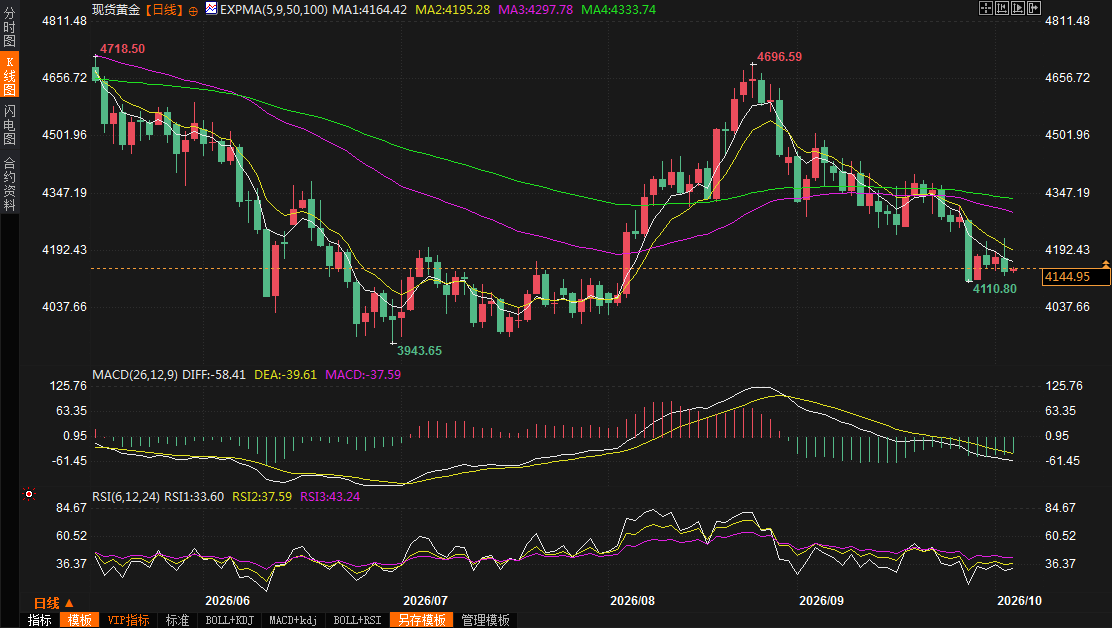 (Spot gold daily chart, source: EasyTrade) At 07:41 Beijing time, spot gold is currently trading at $4144.92 per ounce.
The unexpectedly weak non-farm payrolls data only provided temporary support, causing gold to rise and then fall back.
The most dramatic moment last Friday came from the U.S. Labor Department. September non-farm payrolls increased by only 29,000, far below economists' expectations of 90,000; August's increase was revised down to 133,000 from the previously reported 162,000; the unemployment rate rose to 4.2%, higher than economists' expectations of 4.1%. Following the data release, the market's initial reaction was to buy gold, with spot gold rising over 1% to $4,226.51 at one point, as traders immediately reduced their bets on a Fed rate hike. However, this rally was short-lived. As U.S. Treasury yields reversed their decline and rose again, the dollar also recovered its losses, and gold's gains were quickly reversed, turning into a decline. Bybit's chief market analyst, Han Tan, pointed out that gold bulls may not be too excited at the moment because they know the Fed remains hawkish. Gold price movements in the coming months will largely depend on how much the Fed is willing to tolerate potential weakness in the labor market while remaining committed to curbing U.S. inflation. In other words, the poor employment figures have not changed the Fed's policy framework, but only reduced the tail risk of an October rate hike, which is insufficient to sustain a rise in gold prices.The US dollar and US Treasury yields are two major obstacles for gold.
The core forces weighing on gold remain the US dollar and US Treasury yields. Last Thursday, the yields on 10-year and 30-year US Treasury bonds hit their highest levels since 2002. On Friday, yields initially fell but then rose after a weak jobs report. The 10-year yield rose 4.72 basis points to 5.281%, the 30-year yield to 5.6321%, and the 2-year yield to 4.827%. The 10-year yield rose for the fifth consecutive week, the 30-year yield for the second consecutive week, and only the 2-year yield recorded a weekly decline. The US dollar index fell 0.1% to 101.88 on Friday, but still maintained its weekly upward trend, putting pressure on the euro against the dollar. For non-interest-bearing gold, a stronger dollar means higher costs for buyers of other currencies, while high US Treasury yields increase the opportunity cost of holding gold. On a broader scale, since the outbreak of the war between the US and Israel against Iran at the end of February, gold has fallen by more than 20%, as the market anticipates that conflict-induced inflation may keep interest rates high for a longer period. This chain of "war - oil prices - inflation - high interest rates" has become the most difficult headwind for gold to overcome this year.The Fed's policy remains unclear; holding rates steady in October does not necessarily mean a shift in policy.
Following the release of the employment data, the interest rate market quickly adjusted. The CME FedWatch tool showed that traders initially perceived a lower probability of a Fed rate hike this month, from about 70% earlier last week to about 22%, while the probability of keeping rates unchanged this month rose to about 80%, up from 74% before the data release. However, LSEG data showed that traders still believe there is about an 88% chance of a Fed rate hike in December. This means the market has not shifted to a "rate cut trade," but rather is simply postponing the timing of the next rate hike. The Fed had already raised rates after its September policy meeting and hinted at further rate hikes, with Chairman Warsh reiterating monetary policy independence despite repeated calls from President Trump to lower borrowing costs. The latest inflation data was lower than expected, and at least two senior Fed policymakers opposed another rate hike in October, reinforcing investors' bets on no rate increase this month. Dominic Bunning, head of G10 FX strategy at Nomura, believes this employment data is more like a "Goldilocks" scenario: economic activity remains resilient but has not generated significant inflationary pressure, which is relatively favorable for risk assets and high-beta currencies, and also slightly reduces the tail risk of an October rate hike. But TD Securities strategist Molly Brooks cautioned that the report helps prevent an extreme sell-off, and the bond market "is certainly not out of the woods yet." If the labor market merely stabilizes rather than accelerates again, the Fed will focus more on its inflation target, which reduces the urgency of raising rates to some extent, but does not avert a tightening crisis.Amid the European bond market turmoil and oil price volatility, why aren't safe-haven funds buying gold?
Another key backdrop last week was the European bond market turmoil. With the 2027 elections approaching, markets anticipated rising policy rates and increased political risk, leading to a sell-off of French and Italian government bonds in recent weeks. The yield on French 10-year bonds jumped to its highest level since 2002 on Thursday, and the spread between French and German 10-year bond yields widened to over 150 basis points on Friday, the widest since the end of 2011. Bank of America analysts pointed out that market concerns about French risks have contributed to the euro's resilience against the Swiss franc, with risk reversal option skew premiums widening to historically extreme levels. Meanwhile, European countries agreed to release diesel inventories to curb the surge in fuel prices related to the war with Iran; the US also announced the release of strategic petroleum reserves to stabilize diesel and gasoline prices. StoneX senior commodities broker Daniel Pavilonis believes that the US release of strategic petroleum reserves was the main reason why gold failed to rebound after the non-farm payroll data. Following this announcement, interest rates rose again, and commodities fell across the board, with pressure on everything from agricultural products to exchange rates. FxPro senior market analyst Alex Kuptsikevich pointed out that gold has fallen in five of the past six weeks, briefly dropping to around $4,110 early last week before rebounding to around $4,225 where it encountered selling pressure. Investors appear to be waiting for the worst of the sell-off in US and European government bonds to end before shifting from gold to bonds. He warned that the current bond market movement bears a striking resemblance to the Greek and Eurozone debt crises of 2011-2012; for gold, that was the path to a four-year bear market following the September 2011 peak. If history repeats itself, continued shrinking demand for risk assets could drag gold back to test the $4,000 level.Institutional disagreements intensify, Wall Street is bearish, and retail investors waver.
A Kitco News gold survey released last weekend showed a significant deterioration in market sentiment. Of the 13 analysts surveyed, only 3 (23%) predicted a rise in gold prices this week, 6 (46%) predicted a further decline, and the remaining 4 (31%) predicted sideways movement or were unsure. In an online poll of 182 votes, 85 retail investors (47%) predicted a rise this week, 60 (33%) were bearish, and 37 (20%) expected sideways movement. This marks the first time since the end of July that Main Street investors have lost their bullish majority. However, expert opinions are divided. Mark Chandler, Managing Director of Bannockburn Global Forex, predicts a rise this week, arguing that patient signals from Federal Reserve leadership and several officials, coupled with a disappointing jobs report, have reinforced expectations of no rate hike in October. The interest rate pullback brought positive price action before the weekend, with gold recovering $4,200. A break above the $4,280-$4,300 range would strengthen confidence in the current lows. Adam Barton, head of currency strategy at investingLive, is neutral, looking for buying opportunities to position himself before the strong seasonal factors begin in November and January. Adrian Day, president of Adrian Day Asset Management, is bearish but believes the bearish outlook won't last long, as the end of the war will cause the dollar to resume its decline against the backdrop of unsustainable US deficits, and the Fed's pause in rate hikes will give gold a breather. Rich Checan, president of Asset Strategies International, is bullish, believing that weak jobs data coupled with New York Fed President Williams' comments that there's no rush to raise rates means there won't be a rate hike in October, and gold should see a slight surge. Sean Lusk, vice president of commercial hedging at Walsh Trading, is puzzled and disappointed by gold's failure to sustain its gains. He points out that the initial positive reaction followed by a negative turn, with a surge in stocks and yields, is the real reason for the metals market's predicament. He believes the gold price rally has come to an end. While it may not be a complete reversal, the upward trend is unlikely to be sustained. However, October typically has a bullish seasonality, potentially lasting three to four weeks and rebounding to $4,400 or $4,500, hence his neutral-to-bullish stance. Pavilonis is less optimistic, believing that metal prices have little room to rise further until yields truly break out, and gold prices will at least weaken this week. Kuptsikevich also predicts a decline, possibly even testing $4,000.This week's highlights: Light data, geopolitical factors and Fed minutes take center stage.
Entering Monday, the market faces a relatively light data schedule, but this doesn't mean volatility will be low. Monday will see the release of the September ISM Services PMI; given recent weak employment data, economists will pay particular attention to the employment sub-index. On Wednesday, traders will carefully study the minutes of the Federal Reserve's September monetary policy meeting, looking for clues about the balance of power between hawks and doves on the committee. Thursday will see the release of weekly jobless claims, and Friday will conclude with the University of Michigan's preliminary October consumer confidence survey. With limited economic data, economists expect geopolitical risks to dominate price movements; the French bond market, European energy policy, the US strategic petroleum reserve, and the situation in the Middle East could all trigger market volatility. Technically, gold attempted a rebound after falling to $4110 early last week, but encountered selling pressure around $4225; $4280 to $4300 is a stronger resistance zone, while $4000 is a key psychological support level. If the US dollar and US Treasury yields continue to strengthen, gold prices may retest $4,000. If European measures promptly restore market confidence, or if the bond market sell-off eases, gold may also see a new round of global growth buying, similar to 2020. Overall, last week's gold price decline was not caused by a single factor, but rather by the combined effects of a stronger dollar, high US Treasury yields, the European bond market turmoil, oil prices and the release of strategic reserves, and the Fed's hawkish framework. While the disappointing non-farm payrolls data briefly ignited bullish hopes, it only reduced the probability of an October rate hike and did not change the core logic of "high interest rates lasting longer." This week, the market enters a data-light period, and gold prices are more likely to be driven by bond yields, the US dollar index, and geopolitical factors. For bulls, $4,000 is a psychological defense line that must be held, while $4,280 to $4,300 is a key threshold for confirming a rebound. For bears, as long as yields do not peak, gold will struggle to gain sustained momentum. Market divergence has reached a recent high, with nearly half of Wall Street bearish and most retail bullish sentiment collapsing, which itself implies potentially increased volatility. The long story of gold is far from over; war, deficits, and potential policy shifts could still provide support for gold prices in the future. However, for this week, caution and patience may be more important than aggressive betting. (Spot gold daily chart, source: EasyTrade) At 07:41 Beijing time, spot gold is currently trading at $4144.92 per ounce.
- Risk Warning and Disclaimer
- The market involves risk, and trading may not be suitable for all investors. This article is for reference only and does not constitute personal investment advice, nor does it take into account certain users’ specific investment objectives, financial situation, or other needs. Any investment decisions made based on this information are at your own risk.