Crude Oil Trading Alert: A Triple Game Between OPEC+ Production Policy, G7 Reserve Releases, and Middle East Geopolitics
2026-10-05 08:30:20
On Monday (October 5) in early Asian trading, Brent crude oil for December delivery traded around $102 per barrel, down slightly by 0.2%; US crude oil for November delivery traded below $91 per barrel, down about 0.45%. Short-term pressure on oil prices came from news that the G7 agreed to release 100 million barrels of diesel and crude oil reserves, while supporting factors included the Yemeni government's large-scale military offensive, the Houthi claim to have attacked Saudi Aramco facilities, and Iran's reiteration that the Strait of Hormuz would not be reopened until certain conditions were met. OPEC+ decided on Sunday to maintain its November production target, in line with market expectations, but its actual production remains far below quota levels, and the tight supply situation remains unchanged. 
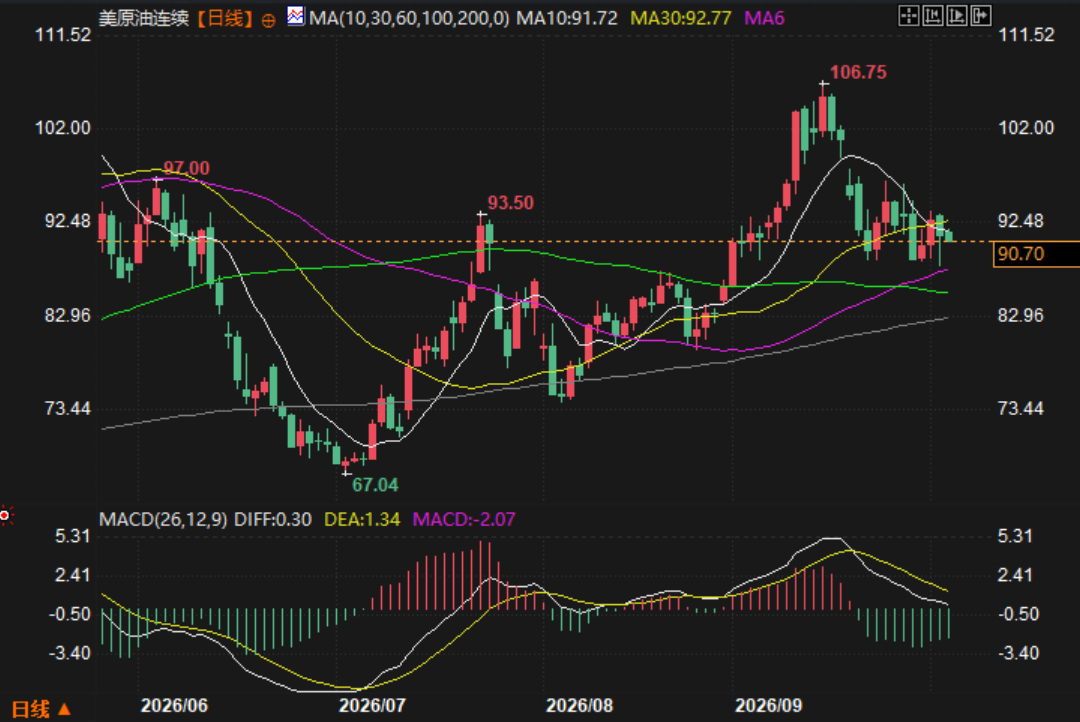 (US crude oil futures daily chart, source: FX678) At 8:28 Beijing time, US crude oil futures were trading at $90.66 per barrel.
OPEC+ maintained its November production target, with most production increase plans remaining on paper.
Following a brief online meeting on Sunday, the seven core OPEC+ members decided to maintain their November crude oil production targets. These seven members include Saudi Arabia, Russia, Iraq, Kuwait, Algeria, Kazakhstan, and Oman. This decision was in line with market expectations that further adjustments to production policy are unlikely before next year. The next meeting will be held on November 1st. Due to continued disruptions to exports caused by the US-Israel war against Iran, actual production from OPEC+ oil-producing countries in the Gulf region has remained well below target levels, with exports fluctuating between 60% and 80% of normal levels in recent months. UBS analyst Giovanni Staunovo stated that maintaining the production ceiling for the seven OPEC+ countries was in line with market expectations, but despite increased shipments through the Strait of Hormuz, production remains far below quota levels, thus the oil market remains tight. Data shows that the seven core OPEC+ members produced 25 million barrels per day in August, an increase of 630,000 barrels per day from July, but still about 5 million barrels per day lower than pre-war levels in February. After years of production cuts, OPEC+ continued to raise its production targets for most of 2026, but due to the conflict in the Middle East, most of these production increase plans remained only on paper.Capacity assessment delayed, 2027 quota allocation uncertain.
Sources familiar with the matter revealed that the OPEC+ capacity assessment, aimed at determining member countries' oil production quotas for 2027, has been delayed due to the disruption of production expansion plans by Middle Eastern countries caused by the US-Israel war against Iran, leading to uncertainty in estimates of future production potential. OPEC+ currently maintains production cuts of approximately 2 million barrels per day for most member countries. Sources said the organization needs the results of the capacity assessment before deciding how to allocate increased production quotas, making adjustments to production policy unlikely before 2027. The Joint Ministerial Monitoring Committee (JMMC), another OPEC+ ministerial body not responsible for policy-making, also met on Sunday to assess the market situation. Russian Deputy Prime Minister Novak stated that the JMMC indicated the global oil market remains highly volatile and faces supply shortages.G7 agrees to release 100 million barrels of reserves, putting short-term downward pressure on oil prices.
The G7 members agreed to release 100 million barrels of diesel and crude oil from their emergency reserves and pledged to avoid imposing energy export restrictions, following pressure from President Trump. Trump stated that Europe has a large supply of diesel and will make a significant contribution to the world, and the US will do the same, refusing to impose export bans. The G7 indicated that, considering previously fulfilled commitments, they would coordinate the release of 100 million barrels through the International Energy Agency (IEA). IEA Executive Director Fatih Birol stated that oil prices began to fall after the decision to release 100 million barrels of oil and fuel reserves. This news was the direct cause of the downward pressure on oil prices last Friday, with Brent crude reversing its gains to close slightly lower, and US crude falling 1.90%. However, Brent crude prices remain above $100 per barrel, compared to around $73 before the outbreak of the conflict with Iran in late February.Geopolitical risks continue to escalate: Yemeni offensive, Houthi attacks, and the Hormuz stalemate.
On the geopolitical front, multiple risks are converging. The Saudi-backed and internationally recognized Yemeni government announced on Sunday a large-scale military operation to retake all areas controlled by the Iranian-backed Houthi rebels. In a televised address, the Yemeni president stated that government forces would continue their offensive until the country is liberated from the group's control. The Houthis, however, claimed to have launched ballistic missiles and drones at Saudi Arabia's Riyadh and Saudi Aramco facilities in the Khurais region, stating this was a response to 50 airstrikes and missile attacks launched by the Saudi-led coalition in Yemen over the past 12 hours. Regarding Iran, state media quoted Iranian Parliament Speaker Qassem Ghalibaf as saying that the Strait of Hormuz will not reopen until the seven conditions set forth in the interim agreement reached with the United States in June are met. The UK's Office for Maritime Trade Operations stated that an oil tanker was hit by an unidentified projectile while exiting the Strait of Hormuz, resulting in a small fire and power outage on board.Market Outlook: The Tug-of-War Between Tight Supply and Reserve Releases
The current crude oil market is caught in a complex web of mixed factors. On the downside, the G7's decision to release 100 million barrels of reserves has put downward pressure on oil prices in the short term, as reflected in the 1.90% drop in US crude oil prices last Friday. On the upside, OPEC+ actual production is far below quotas, delays in capacity assessments limit policy adjustments before 2027, the Yemeni offensive and Houthi attacks on Saudi facilities, and the continued closure of the Strait of Hormuz all contribute to a tight supply situation. Key variables for traders to watch include: the actual pace and scale of the G7 reserve release, the progress of the Yemeni military operation, whether the Houthi attacks on Saudi energy facilities have caused substantial supply disruptions, and any policy signals from OPEC+ before the November 1st meeting. Amid this tug-of-war between tight supply and reserve releases, short-term price volatility may intensify, with the $100/barrel level for Brent crude becoming a crucial battleground between bulls and bears. (US crude oil futures daily chart, source: FX678) At 8:28 Beijing time, US crude oil futures were trading at $90.66 per barrel.
- Risk Warning and Disclaimer
- The market involves risk, and trading may not be suitable for all investors. This article is for reference only and does not constitute personal investment advice, nor does it take into account certain users’ specific investment objectives, financial situation, or other needs. Any investment decisions made based on this information are at your own risk.